

OOBThaiAmulets
LP Anucha - Wat Pho Ratchaburana
LP Anucha - Wat Pho Ratchaburana
Couldn't load pickup availability
ANU01
Jing Jok Song Hang
LP Anucha • Wat Pho Ratchaburana, Ratchaburi
2 Inches
Mainstream Artifact
Bio of LP Anucha: click here
Sacred Craftsmanship
Among the various Kruang Rang associated with LP Anucha, the Jing Jok Song Hang — Two-Tailed Gecko is one of the more unusual forms. Unlike the familiar Buddha images or conventional protective amulets, the Jing Jok belongs to an older stream of Thai animal symbolism in which the characteristics of a creature are transformed into a language of Wicha.
Each artifact was individually made from prepared sacred materials through traditional casting and finishing, so natural variations in texture, colour, form and surface character make every piece unique.
The photographs are representative only. A piece will be selected at random, and the item supplied may differ slightly from the exact piece shown in the images.
Personal Experiences Shared by Luksits
My own interest in LP Anucha's Jing Jok began through a fellow devotee whom I met while visiting the temple.
Rather than recommending one of LP Anucha's more conventional amulets, he specifically encouraged me to collect a Jing Jok for personal use.
He explained that he operated a small laundry shop. After obtaining and using a Jing Jok blessed by LP Anucha, he felt that his business became unusually active compared with neighbouring shops.
What impressed him was not simply the number of customers. According to his account, there were customers who deliberately brought their clothing to his shop even though other laundry shops were located closer to them.
To him, this reflected precisely the traditional character of Jing Jok Wicha: drawing people towards the owner rather than merely waiting for opportunity to arrive.
He continued keeping the Jing Jok because he associated the period after obtaining it with stronger customer attraction and better survival in an increasingly competitive market.
His description was simple. In the modern business world, good products and hard work remain essential, but one also needs the good fortune to be noticed, chosen and remembered.
Summary
The Jing Jok Song Hang combines three important elements of traditional Thai Kruang Rang practice: an auspicious animal form, old sacred metals and specialised consecration.
The gecko represents adaptability, attraction, survival and sensitivity to its surroundings. Its rare two-tailed formstrengthens the symbolism further — two directions of attraction, multiplied opportunity and the ability to draw and retain fortune.
LP Anucha's version is particularly interesting because it was not simply produced as a decorative animal image. It was traditionally cast from a mixture incorporating old religious metals and subsequently consecrated according to the Wicha transmitted through his teachers.
Its traditional emphasis may be understood through four closely connected qualities:
Maha Lap — fortune.
Metta Maha Niyom — goodwill and popularity.
Saneh — attraction and personal magnetism.
Klaew Klaad — awareness and avoidance of danger.
For merchants, it becomes an image of drawing customers. For salespeople, an aid towards being noticed and remembered. For those facing uncertain circumstances, the gecko represents adaptability — the ability to survive, recover and find another path.
Historical Background
Jing Jok means gecko in Thai.
Long before such creatures appeared as formally consecrated amulets, geckos were already part of everyday Thai folk belief. They live close to human dwellings, move almost silently, cling to walls and ceilings, escape rapidly when threatened and produce distinctive calls.
These characteristics naturally gave rise to associations with awareness and the ability to sense what human beings cannot immediately perceive.
One traditional belief concerns a Jing Jok calling when someone is preparing to leave home. Depending upon the circumstances and local interpretation, the call may be regarded as an auspicious greeting or as a warning to reconsider one's timing.
The gecko's natural ability to lose and regenerate its tail also contributed to another important symbolic layer:
survival after adversity, recovery after loss and the ability to begin again.
The Jing Jok Song Hang occupies an even more unusual position. Two-tailed geckos can occur naturally through abnormal regeneration after injury, but their rarity encouraged folk interpretations of them as extraordinary creatures.
Within Thai occult language, unusual natural formations may be regarded as Thon Sit — possessing an inherent auspicious or extraordinary quality even before ritual consecration.
Hence the two tails came to suggest something beyond ordinary attraction:
fortune drawn from more than one direction.
Origins of the Materials
The body of this Jing Jok was cast from a collective mixture of old sacred and religious metals.
According to the lineage account, LP Anucha accepted old alloy religious objects and other suitable ritual metals donated by devotees. Materials could include old temple bells, ritual vessels, urn metal and other religious alloy objects no longer serving their original purpose.
These were melted and combined with LP Anucha's own sacred metal mixture.
The principle is important within traditional amulet making. An old bell, for example, may have sounded repeatedly within temple grounds. A religious vessel may have participated in years of offerings. Other metal objects may have remained within sacred surroundings for considerable periods.
When such objects reach the end of their practical life, their material can be returned to religious use by melting them into new sacred objects.
Ritual
After preparation of the sacred alloy, the Jing Jok figures were produced using the old Lor Bolan casting method.
Molten metal was poured into prepared moulds and allowed to cool naturally. The resulting pieces retained the characteristic irregularities associated with traditional casting — variations in texture, small differences in definition and individual surface character.
Sacred characters and markings appear across the body, transforming the animal representation into a ritual object rather than merely a miniature sculpture.
The finished Jing Jok were then subjected to chanting and consecration.
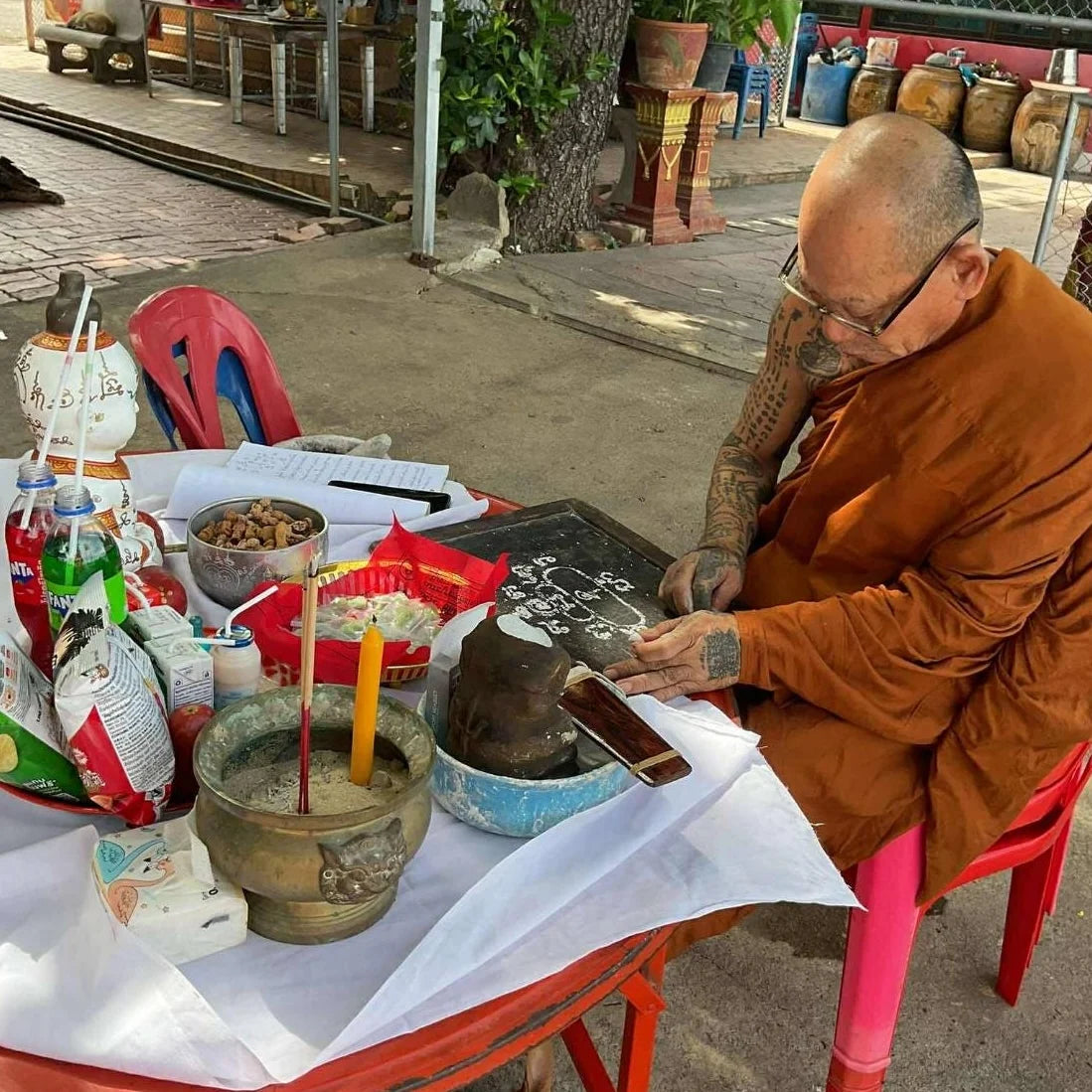
LP Anucha's occult education is associated with several teachers and streams of Wicha, with LP Sanga of Wat Nong Muang regarded as an important principal teacher in his development. His wider studies also exposed him to consecration, yantra inscription, Metta, protection and traditional Kruang Rang practices.
This breadth of training is significant for an uncommon object such as Jing Jok. Not every master chooses to create animal-form Kruang Rang of this nature, and the efficacy attributed to such pieces within tradition depends not simply upon their shape but upon the master's knowledge of the appropriate Wicha and method of awakening the symbolism represented by the creature.
Blessings and Effects
The principal traditional quality of the Jing Jok Song Hang is attraction — not restricted solely to romantic Saneh, but attraction in the broader sense of bringing people, opportunity and favourable circumstances towards the bearer.
For commerce, this becomes Riak Sap and Maha Lap: drawing customers, transactions, financial opportunities and unexpected fortune. The two tails are sometimes interpreted symbolically as sweeping or pulling opportunity towards the owner from multiple directions.
Metta Maha Niyom concerns goodwill. Rather than forcing another person's decision, the traditional intention is that people feel more comfortable approaching, speaking with, remembering and assisting the bearer.
Saneh strengthens personal attraction and presence. This may be interpreted romantically, but in everyday life it is equally relevant to sales, networking, hospitality and occupations where personal rapport matters.
The gecko's instinct for rapid escape also gives the figure a protective dimension associated with Klaew Klaad — avoiding danger before becoming trapped by it. Older folk interpretations additionally associate gecko behaviour and calls with warnings concerning unfavourable timing or unseen circumstances.
The two-tailed form adds the concept of multiplication:
two tails, two directions, expanded opportunity.
Modern Application
The symbolism of Jing Jok translates particularly naturally into modern commercial life.
A shopkeeper needs customers to choose one shop among many. A salesperson needs prospective clients to answer a message or continue a conversation. Someone working on commission needs both opportunity and the ability to recognise it quickly.
These are precisely the situations in which devotees traditionally value Jing Jok.
It is therefore particularly suited to shopkeepers, salespeople, entrepreneurs, property agents, insurance professionals, service businesses, entertainers and others whose livelihood depends upon interaction with people.
There is also a deeper lesson within the gecko itself.
A gecko does not dominate its environment through physical strength. It survives through awareness, adaptability, timing and persistence.
In a competitive environment, those qualities can be as important as authority.
Physical Details
This example is a traditional cast-metal Jing Jok Song Hang, formed as a gecko with a long curving body, raised limbs and distinctive twin-tail construction. Numerous sacred characters and ritual markings appear across the body. The aged alloy displays a darkened surface with natural brown, bronze and metallic undertones characteristic of an older mixed-metal casting. The piece is presently protected within a fitted casing for wearing.
Its traditional Lor Bolan manufacture is important to its character. Surface irregularities, differences in casting definition and variations in patina should not automatically be regarded as flaws; they are part of the individuality expected from pieces produced through older casting methods.
Recommended Pairing
The Jing Jok Song Hang can stand alone, particularly for someone whose primary concern is customer attraction, Metta, Saneh and Maha Lap.
For business use, it pairs naturally with Phra Sivali, combining the Jing Jok's attraction symbolism with Sivali's traditional associations with sustenance, favourable journeys and ease in obtaining necessities.
A Nang Kwak provides another complementary pairing. Nang Kwak symbolically beckons customers and prosperity towards the business, while Jing Jok represents attraction, adaptability and the ability to hold people's attention.
For those requiring greater authority alongside attraction, a Suer or another Maha Amnaj-oriented Kruang Rang may provide the stronger commanding aspect that Jing Jok itself does not primarily represent.
Personal Notes
What makes LP Anucha's Jing Jok Song Hang particularly interesting is that its philosophy is different from that of many forceful protective Kruang Rang.
The Suer commands.
Hanuman advances.
But Jing Jok survives, adapts and attracts.
Its strength lies in understanding its surroundings and finding opportunity where others may overlook it. The rare two-tailed form takes this further, becoming a traditional image of fortune being drawn from more than one direction.
The story shared by the laundry-shop owner captures this character particularly well. His customers were not forced to come to him. They simply continued choosing his shop, sometimes passing nearer competitors along the way.
Within the traditional understanding of Jing Jok Wicha, that distinction matters.
It is not merely about finding opportunity. It is about becoming the person, shop or business that opportunity naturally comes towards.

-
Free Shipping for Singapore| $15 Worldwide | $60 USA For Items Below $350