

OOBThaiAmulets
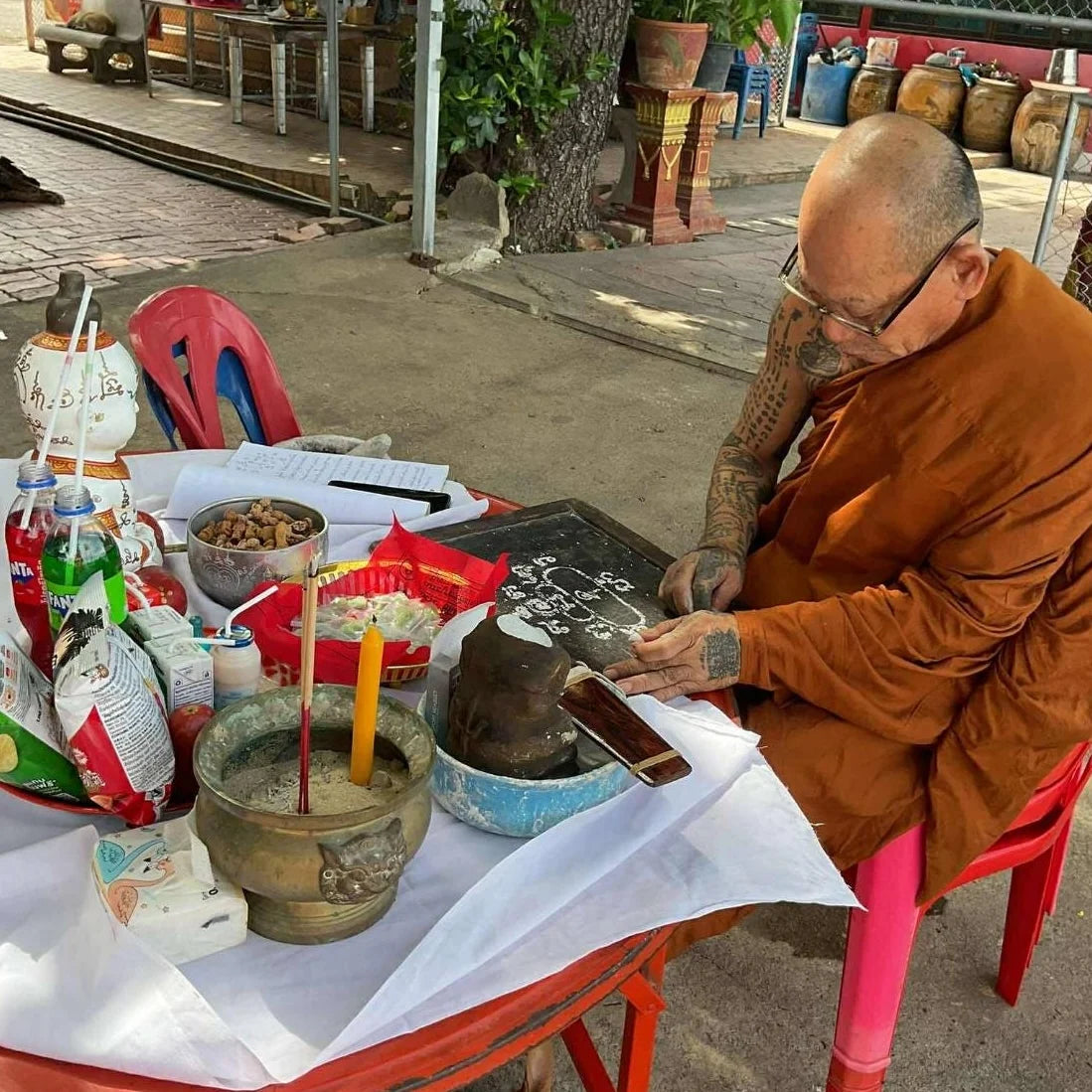
LP Anucha - Wat Pho Ratchaburana
LP Anucha - Wat Pho Ratchaburana
Couldn't load pickup availability
ANU01
Suer
LP Anucha • Wat Pho Ratchaburana, Ratchaburi
2 Inches
Mainstream Artifact
Bio of LP Anucha: click here
Sacred Craftsmanship
This Suer by LP Anucha of Wat Pho Ratchaburana was individually carved from Graduk Kwai, from an animal that had reached old age and passed naturally.
Each Suer is individually handmade from prepared natural Graduk. Variations in colour, patina, density, surface texture, carving and sacred inscriptions are therefore natural, making every piece unique.
Personal Experiences Shared by Luksits
Among LP Anucha's followers, Suer is particularly appreciated by those whose daily lives involve competition, responsibility, leadership and difficult interpersonal situations.
Business owners and working professionals commonly approach Suer not simply as an artifact for physical protection, but as a symbol of having sufficient Baramee and personal authority to stand one's ground.
Followers of LP Anucha have spoken more broadly of experiencing smoother negotiations, stronger relationships with customers and greater confidence when facing important business decisions while carrying his blessed objects.
Some describe the effect less as sudden fortune and more as a gradual feeling of being steadier when circumstances become difficult — less easily intimidated by stronger personalities and more decisive when dealing with problems.
In the case of this Graduk Kwai Suer, however, the symbolism is particularly appropriate: the buffalo endures pressure, while the tiger commands it.
Summary
This Suer brings together two powerful animal traditions within a single artifact.
Graduk Kwai provides endurance.
Suer provides authority.
The buffalo was an animal of labour, patience and extraordinary physical resilience. The tiger represents courage, territorial command, vigilance and Maha Amnaj.
By carving the tiger directly from Graduk Kwai, LP Anucha symbolically brings these qualities together before completing the artifact with hand-applied Yant and ritual consecration.
Within traditional belief, the resulting Suer is particularly associated with Maha Amnaj, Baramee, protection, courage, Kong Grapan Chadtri, Klaew Klaad and the resilience to withstand opposition.
It is an artifact not simply for appearing powerful, but for remaining strong when tested.
Historical Background
The Suer in Thai Kruang Rang Tradition
The tiger occupies a distinctive place among traditional Thai protective forms.
Unlike a domesticated animal whose strength is directed by others, the tiger exists independently. It controls its own territory, moves with confidence and survives through awareness, strength and instinct.
These characteristics contributed to its association with Maha Amnaj — commanding authority and power.
Traditional Suer objects therefore became associated with people whose lives demanded courage and presence: leaders, merchants, travellers and those required to operate within difficult or competitive environments.
Yet the deeper meaning of Suer is not uncontrolled aggression.
A tiger does not need to attack constantly to demonstrate that it is powerful.
Its presence alone establishes boundaries.
For this reason, Suer also became a representation of Baramee — authority that can be recognised without unnecessary confrontation.
LP Anucha's Lineage
LP Anucha's principal foundation in traditional Wiccha came through LP Sanga of Wat Nong Muang, from whom he studied sacred Yant, chanting, consecration and protective practices.
His knowledge was later broadened through other teachers, including LP Non of Wat Khao Phran Thup, LP Boonkham of Wat Chaiyaphum and LP Od of Wat Bang Muang.
These different branches contributed towards his wider knowledge of protective Wiccha, sacred inscriptions, Metta practices and the preparation and consecration of traditional Kruang Rang.
The Suer consequently sits naturally within the protective side of LP Anucha's practice.
Origins of the Materials
Graduk Kwai — Wa Tanoo Bone Relic
The provenance of the material is particularly important to this piece.
The water buffalo was said to have died naturally from old age, after which its Graduk was given to LP Anucha for use in sacred-object making.
This distinguishes the material from something obtained specifically through the killing of an animal for talismanic production.
Within traditional rural symbolism, the water buffalo represents qualities acquired through a lifetime of labour:
strength without extravagance, endurance without complaint, and persistence despite difficult conditions.
The use of Graduk preserves something of that symbolism.
Natural bone is also a highly individual material. Density, colouring, age marks and internal structure differ from section to section, meaning that two carvings produced from the same animal may still appear noticeably different.
For a Suer, the symbolic relationship is particularly strong.
The buffalo supplies endurance and grounded strength.
The tiger supplies courage and authority.
Ritual
The preparation begins with selecting an appropriate section of Graduk Kwai capable of receiving the tiger form.
LP Anucha then works the material into the characteristic Suer Roop, carving the head, body, legs and other identifying features directly into the Graduk.
Because these pieces are individually worked rather than mechanically moulded, the carving retains the irregularities of traditional hand craftsmanship.
Once the physical form is complete, the Suer is hand-Yanted.
This stage is important because the Yant is not merely ornamentation. Within the traditional process, sacred characters establish and direct the intended Wiccha of the object.
The completed artifact is subsequently consecrated through the appropriate chanting and ritual practice.
Its construction can therefore be understood through four stages:
Graduk Kwai provides endurance.
Suer provides commanding form.
Yant establishes the sacred direction.
Consecration completes the Kruang Rang.
Blessings and Effects
The principal traditional quality of this Suer is Maha Amnaj — commanding authority, personal presence and the ability to maintain one's position.
Closely related is Baramee, particularly relevant to leaders and those whose responsibilities require others to trust or respect their decisions.
Kong Grapan Chadtri belongs to the protective aspect of Suer Wiccha and traditionally concerns resilience against physical harm.
Klaew Klaad concerns avoidance: passing safely around danger, accidents, confrontation and troublesome circumstances.
The Graduk Kwai adds a particularly strong symbolism of endurance and stability. Rather than being easily shaken by difficulties, the keeper is reminded to remain steady and continue forward.
Suer is also traditionally associated with courage against opponents, competitors and hostile influences.
For modern devotees, this may be understood more practically as the confidence to deal with difficult personalities, protect one's interests and remain composed when placed under pressure.
Modern Application
This form of Suer has an especially natural place in modern professional life.
For business owners, it represents the strength to protect what has been built and the confidence to make difficult decisions.
For managers and executives, its Maha Amnaj aspect relates to leadership, credibility and maintaining authority without excessive confrontation.
For those working in competitive industries, the tiger represents the willingness to face competition rather than retreat from it.
Graduk Kwai introduces an equally important quality: stamina.
Success rarely depends upon one dramatic victory. More often, it requires continuing through setbacks, financial pressure, difficult negotiations and periods when progress is slow.
In this sense, the combination is particularly meaningful.
Suer gives the courage to confront.
Graduk Kwai gives the endurance to continue.
Physical Details
This example is a compact Suer individually carved from Graduk Kwai, retaining the warm brown and naturally aged colouring of the organic material.
The carving follows a traditional folk-art interpretation rather than a naturalistic tiger. A large head dominates the profile, with a deeply drilled circular eye, incised mouth, compact body and clearly defined paws. The surface retains visible carving marks, natural tonal changes and areas of lighter wear.
Sacred inscriptions are visible along the body and lower base, reflecting the subsequent hand-Yanting of the completed carving.
Small drilled openings are also present within the body. The piece is now housed within a fitted clear protective casing, allowing the original material, carving and inscriptions to remain visible while limiting further handling.
Recommended Pairing
For leadership and professional use, Phra Somdej provides a balanced pairing: Suer for authority and protective strength; Phra Somdej for Buddhist Baramee, mindfulness and composure.
For business owners, Nang Kwak complements the Suer well. Nang Kwak traditionally attracts customers and commercial movement, while Suer protects the keeper's position and strengthens confidence.
Salika is suitable where success depends heavily upon communication and negotiation. Suer establishes presence; Salika supports speech.
Phra Sivali may be paired where livelihood, continuing opportunity and material support are the principal objectives.
Personal Notes
What gives this Suer particular character is not simply that it is carved from bone, but whose Graduk it represents symbolically.
The water buffalo spent its life as an animal associated with work and endurance.
It was not remembered because it was fierce.
It was remembered because it was strong enough to continue.
The tiger represents almost the opposite expression of strength. It is territorial, decisive and commanding. Its presence warns others where the boundary lies.
LP Anucha's use of Graduk Kwai for Suer therefore creates a surprisingly balanced combination.
One represents endurance.
The other represents command.
One carries the burden.
The other protects the territory.
And because the buffalo was said to have reached old age and passed naturally before its Graduk was offered for sacred-object making, the material also carries a sense of a completed natural life being respectfully given another purpose.
The deeper character of the piece can therefore be expressed simply:
The buffalo teaches us to endure.
The tiger teaches us when to stand our ground.
Together, they form a Suer centred upon strength, protection, Baramee and the resilience to remain standing when circumstances become difficult.

-
Free Shipping for Singapore| $15 Worldwide | $60 USA For Items Below $350