

OOBThaiAmulets
LP Anucha - Wat Pho Ratchaburana
LP Anucha - Wat Pho Ratchaburana
Couldn't load pickup availability
Suer Gae
LP Anucha • Wat Pho Ratchaburana, Ratchaburi
3cm
Mainstream Artifact
Bio of LP Anucha: click here
Sacred Craftsmanship
This example by LP Anucha of Wat Pho Ratchaburana was individually carved from Nga, forming the material into the compact profile of a tiger before the sacred inscriptions and consecration were applied.
Each Suer was individually carved from natural Nga and prepared by hand. Variations in colour, grain, age lines, carving, inscriptions and form are therefore natural characteristics of the material and workmanship, making every piece unique.
Personal Experiences Shared by Luksits
LP Anucha's followers frequently describe his sacred objects in practical terms.
Many of his long-term luksits are entrepreneurs, business owners and people whose daily lives involve responsibility, negotiation and important financial decisions.
Among these devotees, experiences are often described not as spectacular events but as steadier business conditions, stronger confidence, smoother negotiations, improved relationships with clients and greater composure when important decisions have to be made.
One businessman in Thailand's beauty industry, whose father had previously collected the sacred objects of LP Deang, described considerable growth in his business after beginning to carry LP Anucha's blessed pieces.
Other devotees have similarly spoken about improved opportunities and greater stability in professional and family life.
Nevertheless, they help explain why objects associated with Baramee, protection and authority, such as Suer Gae, have particular relevance among LP Anucha's business followers.
Summary
This Suer Gae carved from Nga represents the meeting of two different forms of power.
The elephant represents great strength held with stability.
The tiger represents power ready to act.
Within traditional interpretation, Nga already possesses auspicious associations with authority, endurance and protection before it is carved. By transforming the material into Suer and subsequently applying sacred Yant and consecration, LP Anucha directs those qualities towards the established virtues of tiger Wiccha.
The resulting artifact is traditionally associated with Maha Amnaj, Baramee, Kong Grapan Chadtri, Klaew Klaad, Maha Ud, courage, protection and Maha Chok.
Yet its deeper character is not simply aggression.
It represents controlled strength — the ability to stand firmly, command respect and remain difficult to intimidate when confronted by opposition.
Historical Background
Suer Gae — The Carved Sacred Tiger
Suer Gae belongs to the broader Thai tradition of Kruang Rang, sacred objects whose forms, materials and consecration methods work together to express particular qualities.
The tiger has long occupied an important position within this tradition.
A tiger possesses territory and commands it.
It moves independently, observes carefully and does not require constant aggression to establish its position. This gave Suer its association with Maha Amnaj — commanding authority.
For this reason, sacred tiger objects became particularly relevant to people whose lives required courage, leadership or the ability to confront dangerous and competitive environments.
Nga and the Elephant
Nga introduces a second animal symbolism.
The elephant represents immense physical strength, but traditionally its significance extends beyond strength alone.
It carries associations of dignity, endurance, stability and high standing.
The combination of material and tiger form therefore creates an interesting balance.
The elephant is difficult to move.
The tiger is difficult to challenge.
Within Suer Gae, these qualities become complementary rather than contradictory.
Origins of the Materials
Nga
The principal material is Nga, naturally displaying the warm white colouring and fine internal characteristics associated with aged organic material of this type.
For Nga, these qualities centred upon strength, endurance, authority and protection.
Its physical durability also made it suitable for intricate hand carving. Unlike moulded powder or cast metal, every section of natural Nga possesses its own grain, tonal variation and age characteristics.
Once carved into Suer, the material assumes another layer of meaning.
The elephant's strength becomes the body of the tiger.
The tiger's authority becomes the form through which that strength is expressed.
Ritual
The material is then individually worked into the form of Suer, establishing the characteristic head, mouth, body, legs and tail.
Because these are hand-carved pieces, perfect mechanical symmetry is neither expected nor necessary. The individual character of the carving remains part of the artifact.
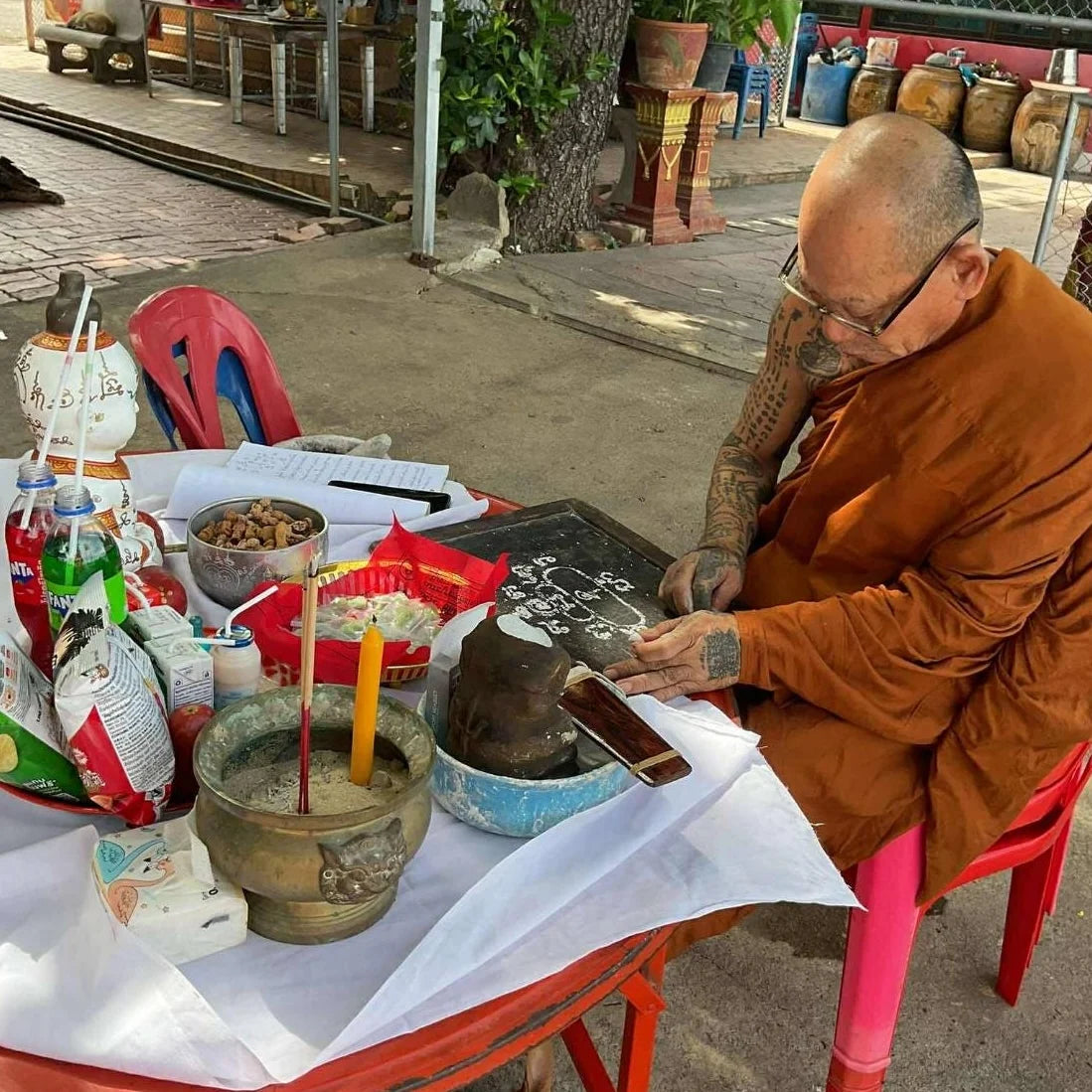
After the physical form has been completed, LP Anucha hand-inscribes sacred Yant upon the piece.
This stage establishes the ritual framework of the artifact before consecration.
The Suer is subsequently empowered through chanting, meditation and the traditional protective Wiccha LP Anucha received through his teachers.
His principal foundation came through LP Sanga of Wat Nong Muang, with later studies broadening his knowledge through masters including LP Non of Wat Khao Phran Thup, LP Boonkham of Wat Chaiyaphum and LP Od of Wat Bang Muang.
The completed Suer can therefore be understood through four connected stages:
Nga provides the inherent material symbolism.
Suer provides the form.
Yant establishes the ritual direction.
Consecration activates the completed Kruang Rang.
Blessings and Effects
The most prominent traditional quality of Suer Gae is Maha Amnaj — commanding authority, presence and the ability to gain respect.
This makes it particularly appropriate for leaders, managers, business owners and those operating within competitive environments.
Kong Grapan Chadtri concerns bodily protection and resilience against physical harm within traditional belief.
Klaew Klaad concerns avoidance of danger — escaping or passing around accidents, hostile situations and other forms of misfortune.
Maha Ud belongs to the older protective traditions in which certain forms of Wiccha were believed capable of stopping or obstructing weapons. This should be understood as a traditional spiritual attribution rather than literal physical protection.
Baramee concerns personal standing and the natural respect generated by one's presence.
Maha Chok introduces the fortune aspect of Suer. The tiger's ability to identify, pursue and successfully capture its objective becomes a metaphor for finding opportunities and obtaining favourable results.
There is also a Metta and business dimension, where the keeper seeks not domination but sufficient confidence, credibility and favourable circumstances to secure customers, opportunities and cooperation.
Modern Application
For a modern keeper, Suer Gae is particularly relevant where life requires authority combined with composure.
A business owner may approach it for confidence when dealing with competitors, employees or difficult negotiations.
An executive may value its traditional association with leadership and Baramee.
Someone involved in sales may instead focus upon Maha Chok — identifying opportunities and successfully bringing them to completion.
For those who travel frequently or work in unpredictable surroundings, the traditional Klaew Klaad and protective aspects may be more important.
The tiger symbolism should not be interpreted as encouragement towards aggression.
A mature interpretation of Suer Wiccha is almost the opposite.
The strongest tiger does not need to attack everything around it.
Its presence is already understood.
Physical Details
This Suer Gae is individually hand-carved from pale Nga, with the natural material displaying subtle cream tones, fine grain lines and darker age-related markings.
The tiger is presented in a compact seated profile. Its head is disproportionately prominent, giving the carving a particularly strong traditional folk character. The open mouth, individually cut teeth, circular eye, foreleg and curved body have all been worked directly into the material.
Small drilled openings are visible at several points on the carving, forming part of its original preparation.
The opposite face retains the same general tiger profile while showing natural differences in carving and material texture, confirming the individually worked nature of the piece.
The artifact is housed within a fitted protective casing with a hand-worked silver-coloured frame, itself decorated with traditional engraved motifs.
Recommended Pairing
For business, Nang Kwak creates a complementary relationship: Nang Kwak traditionally calls customers and commercial opportunity, while Suer supports confidence, authority and protection.
Salika is appropriate where professional success depends heavily upon speech and negotiation. Suer establishes presence; Salika supports communication.
Phra Sivali may be chosen where livelihood, travel and continuing material support are more important than authority.
For those specifically seeking leadership qualities, Hanuman can strengthen courage and determination, although this creates a more concentrated combination of forceful Wiccha.
Personal Notes
Among the different materials used for Suer, Nga gives the tiger a very different character.
A wooden Suer naturally carries the qualities associated with its sacred wood.
A Kao Kwai Suer carries the endurance and grounded strength associated with the buffalo.
Nga introduces something else.
It brings the symbolism of the elephant into the body of the tiger.
Both animals represent power, but they express power differently.
The elephant represents immense strength, stability and dignity.
The tiger represents command, instinct and fearless action.
LP Anucha's decision to carve Suer from Nga therefore creates an unusually complete symbolism for authority. The material provides weight and stability; the tiger gives that strength direction.
Once LP Anucha adds his hand-inscribed Yant and performs the appropriate consecration, the finished object becomes more than a miniature animal carving.
It becomes Suer Gae — a traditional Kruang Rang centred upon protection, courage and commanding Baramee.
The character of the piece can perhaps be expressed most simply:
The elephant provides the strength to remain unmoved.
The tiger provides the courage to move when the moment arrives.

-
Free Shipping for Singapore| $15 Worldwide | $60 USA For Items Below $350