

OOBThaiAmulets
LP Anucha - Wat Pho Ratchaburana
LP Anucha - Wat Pho Ratchaburana
Couldn't load pickup availability
ANU01
Suer Hua Khad
LP Anucha • Wat Pho Ratchaburana, Ratchaburi
2cm
Mainstream Artifact
Bio of LP Anucha: click here
Sacred Craftsmanship
The Suer Hua Khad — Headless Suer is one of the more unusual Roop Lor associated with LP Anucha of Wat Pho Ratchaburana. Unlike a conventional Suer created deliberately in its final form, the identity of these pieces arose from an unexpected occurrence during their consecration.
According to those who assisted with the casting and consecration, the Suer initially possessed their heads. During the ceremony, while LP Anucha was chanting the Suer Wicha inherited through his teachers, the heads of a number of the cast Suer reportedly separated or broke away.
Each artifact was individually produced through the traditional casting process from mixed old sacred metals. Natural differences in alloy colour, patina, casting texture, form and the manner in which the head separated make every surviving Suer Hua Khad individually distinctive.
The photographs are representative only. A piece will be selected at random, and the item supplied may differ slightly from the exact piece shown in the images.
Personal Experiences Shared by Luksits
The earliest and most important account attached to this particular batch comes not from a later owner, but from the temple helpers who were present during its creation.
They recalled that the Suer were being consecrated by LP Anucha using his Suer Wicha when a number of the figures unexpectedly lost their heads.
What made the incident memorable was its timing. According to the account preserved around the pieces, the separation occurred during the consecration rather than being the intended design of the mould.
Those present consequently regarded the affected pieces differently from ordinary damaged castings.
The resemblance to the old Suer Hua Khad tradition gave them an identity of their own, and the pieces were retained as unusual products of that particular consecration.
For collectors, this distinction is important. The significance of the Suer Hua Khad does not rest simply upon possessing a headless tiger-shaped object. Its interest lies in the lineage account surrounding how it became headless.
Summary
The Suer Hua Khad brings together three important elements of LP Anucha’s sacred-object tradition.
The first is material continuity — old religious metals were not discarded, but melted and given another sacred life.
The second is Lor Bolan craftsmanship, producing individually varied Suer rather than perfectly uniform factory castings.
The third is the unusual occurrence remembered during consecration, when several Suer reportedly lost their heads while LP Anucha was invoking his Suer Wicha.
Within older interpretations of the Headless Suer, losing the head does not symbolise weakness or defeat.
Quite the opposite.
The head represents thought, fear, doubt and hesitation. The headless form symbolically reduces the creature to instinct, courage and survival.
Yet the mature interpretation of this Wicha is not uncontrolled aggression.
Its deeper principle is power under restraint — possessing the capacity to respond decisively while remaining disciplined enough not to act without cause.
Historical Background
The Suer occupies a formidable position within Thai occult traditions. Different Suer lineages have historically been associated with Maha Amnaj, Baramee, courage, protection, territorial authority and the ability to remain composed before opposition.
Among fighters, travellers, Nak Leng and people whose lives exposed them to danger, Suer Wicha naturally developed a particularly strong reputation.
The Headless Suer represents a less commonly encountered branch of this symbolism.
According to oral traditions circulated among older practitioners, the original Headless Suer represented a creature that had passed beyond ordinary fear. Without the calculating mind, there was no hesitation before danger — only instinct and survival.
This gave the image a severe reputation.
Stories later circulated within old underworld and Sak Yant circles connecting the design with men considered unusually difficult to intimidate or subdue. Such accounts belong largely to oral occult history and should be understood in that context rather than treated as documented evidence of supernatural invulnerability.
Importantly, later interpretations introduced the concept of restraint.
In some traditions the Headless Suer became associated with a pillar, chain or other symbol of control. The message consequently changed from uncontrolled ferocity to something more disciplined:
The Suer does not seek confrontation.
But when confrontation cannot be avoided, it does not retreat through fear.
This distinction is central to understanding the old Wicha.
Origins of the Materials
LP Anucha’s Roop Lor were created from a mixture of old sacred and religious metals.
These included aged religious alloy objects, old temple bells, urn material and other metal items donated by devotees, together with LP Anucha’s own prepared sacred mixture.
Within traditional temple craftsmanship, recycling such materials carries meaning beyond simple economy.
An old temple bell has already spent years sounding across sacred grounds. Religious metalwork may have stood within places of worship, received incense smoke, chanting and repeated ceremonies. When such material is melted into a new sacred object, devotees may regard it as carrying forward a connection with its former religious purpose.
The material is therefore transformed rather than simply destroyed.
For the Suer Hua Khad, this is particularly appropriate.
Old objects lose their previous forms in the furnace. The metals become fluid, are recombined and eventually emerge as a new Suer.
Transformation through fire becomes part of the object's history.
Ritual
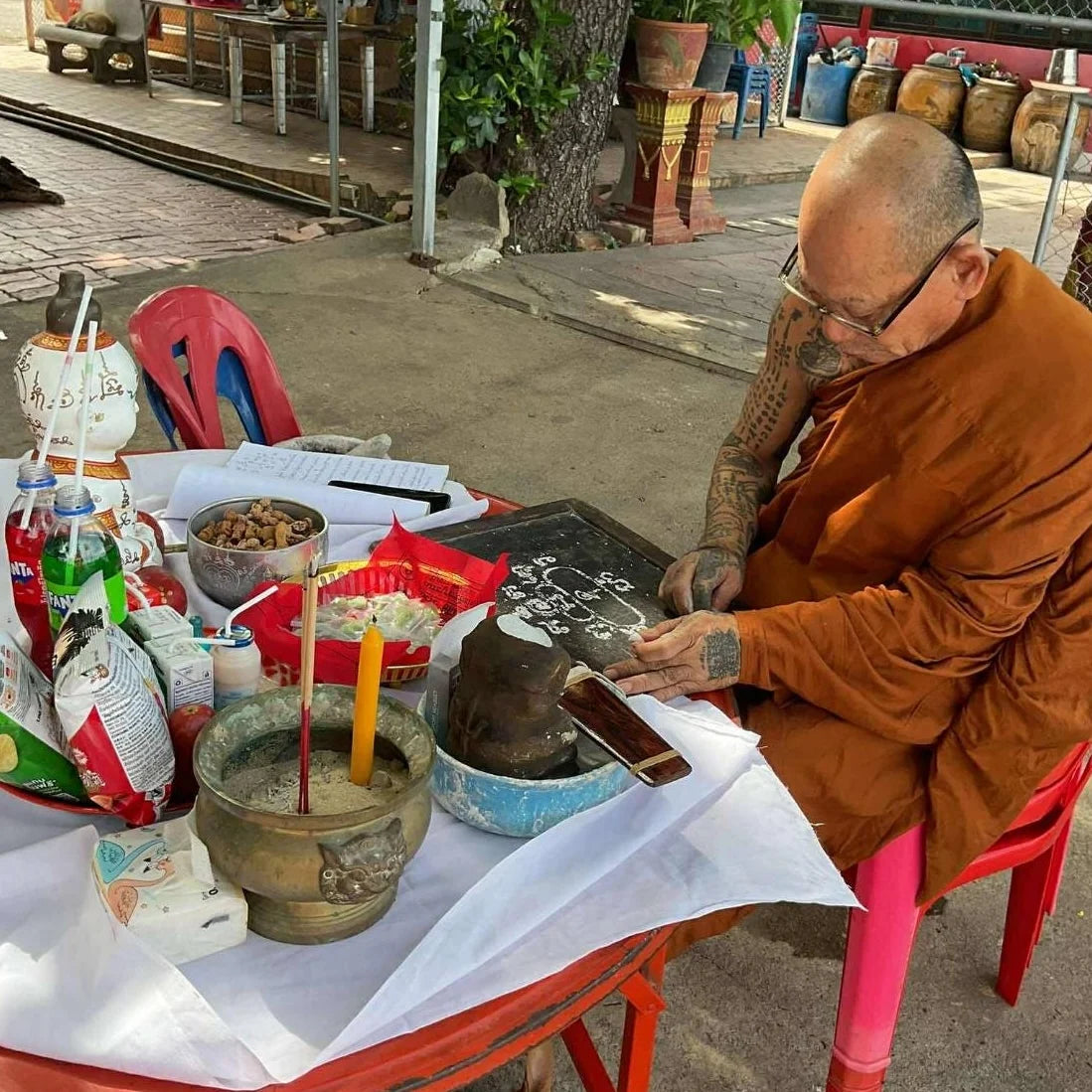
After casting, LP Anucha consecrated the Suer through the Suer Wicha transmitted through his teachers.
His broader occult education is associated principally with LP Sanga of Wat Nong Muang, together with additional teachings received through other respected masters and traditional lineages.
Within Suer Wicha, the physical tiger is only the vessel. Consecration establishes the intended qualities of the form: courage, commanding presence, protection, firmness and the ability to withstand intimidation.
It was during this stage, according to the temple account, that the defining event occurred.
As LP Anucha chanted the Suer Wicha, several of the cast figures reportedly experienced separation of their heads.
Those examples became the Suer Hua Khad.
The episode consequently gave the affected pieces a ritual identity that was not present when the molten alloy first entered the mould.
Blessings and Effects
Within traditional belief, the Suer Hua Khad is principally associated with courage, protection, authority and survival under pressure.
Its qualities are understood somewhat differently from those of a Suer prepared primarily for Metta or commercial attraction.
Maha Amnaj concerns commanding presence and the ability to stand firmly when challenged.
Baramee concerns personal weight, credibility and the respect naturally given to someone perceived as possessing inner strength.
Klaew Klaad concerns avoidance of danger and escaping situations that might otherwise result in harm.
Kong Grapan Chadtri, within traditional belief, concerns physical and spiritual resilience.
The Headless Suer adds another psychological symbolism: freedom from paralysing fear and hesitation.
For this reason, its modern interpretation should not be one of seeking confrontation. Its stronger lesson is remaining composed when pressure arrives.
Power without discipline becomes recklessness.
Power held under discipline becomes authority.
Modern Application
The old Headless Suer originated from a social world very different from contemporary professional life, yet its underlying symbolism remains surprisingly relevant.
Modern conflict is often not physical.
It may take the form of workplace politics, hostile negotiations, commercial competition, intimidation, difficult clients or situations in which a person must make an important decision while under considerable pressure.
In such settings, Suer Hua Khad symbolism concerns holding one's ground.
It is particularly meaningful for business owners, managers, negotiators, sales professionals, security personnel and those working in highly competitive environments where hesitation or intimidation can have consequences.
The old warrior principle therefore becomes a modern one:
Do not create unnecessary conflict. Do not allow fear to control the response when conflict arrives.
Physical Details
This example is a compact Lor Bolan metal Roop Lor depicting the body of a Suer without its head. The aged alloy displays a warm brass-bronze character with areas of darker oxidation and natural patina. Sacred characters and markings appear across the body, while the paws and muscular posture remain clearly defined.
The base bears temple-related inscriptions, identifying the piece with Wat Pho Ratchaburana. The irregular upper surface where the head is absent is particularly important, as this is the physical characteristic from which the Suer Hua Khad acquired its name and identity.
Because these pieces were individually pour-cast using traditional methods, differences in metal flow, patina, surface texture and the exact form of the head separation are expected.
Recommended Pairing
The Suer Hua Khad already carries a strong emphasis on courage, authority and protection, so pairing is best used to introduce qualities that balance rather than simply duplicate its character.
A Phra Somdej can provide a calmer Baramee foundation, balancing the fierce symbolism of the Suer with Buddhist composure and spiritual authority.
Phra Sivali is particularly suitable for business owners and travellers who want to combine the Suer’s firmness with traditional qualities of sustenance, favourable journeys and livelihood.
A Nang Kwak can shift the overall combination towards commerce and customer attraction, while the Suer remains the element associated with confidence and authority.
The principle is complementary:
Nang Kwak attracts.
Sivali sustains.
Somdej establishes Baramee.
Suer stands its ground.
Personal Notes
The most interesting aspect of this piece is that LP Anucha apparently did not set out to create a Headless Suer.
The mould produced a Suer.
The consecration produced the story.
Whether a collector interprets the separation of the heads as a spiritual phenomenon, an unusual consequence of traditional casting, or a combination of circumstances given meaning by those who witnessed it, the event became inseparable from the identity of the surviving pieces.
That is what distinguishes them from a Suer deliberately designed without a head.
Older Headless Suer traditions were sometimes surrounded by severe stories of fighters, criminals and men living close to violence. But the more enduring interpretation is not aggression.
It is controlled fearlessness.
The strongest Suer is not necessarily the one that attacks.
It is the one that can remain still when threatened, cannot easily be intimidated, and possesses enough discipline to release its strength only when truly necessary.
For the Suer Hua Khad of LP Anucha, that is perhaps the most appropriate interpretation:
fear removed, strength retained, power controlled.

-
Free Shipping for Singapore| $15 Worldwide | $60 USA For Items Below $350