

OOBThaiAmulets
LP Anucha - Wat Pho Ratchaburana
LP Anucha - Wat Pho Ratchaburana
Couldn't load pickup availability
ANU01
Palakit Pumpui
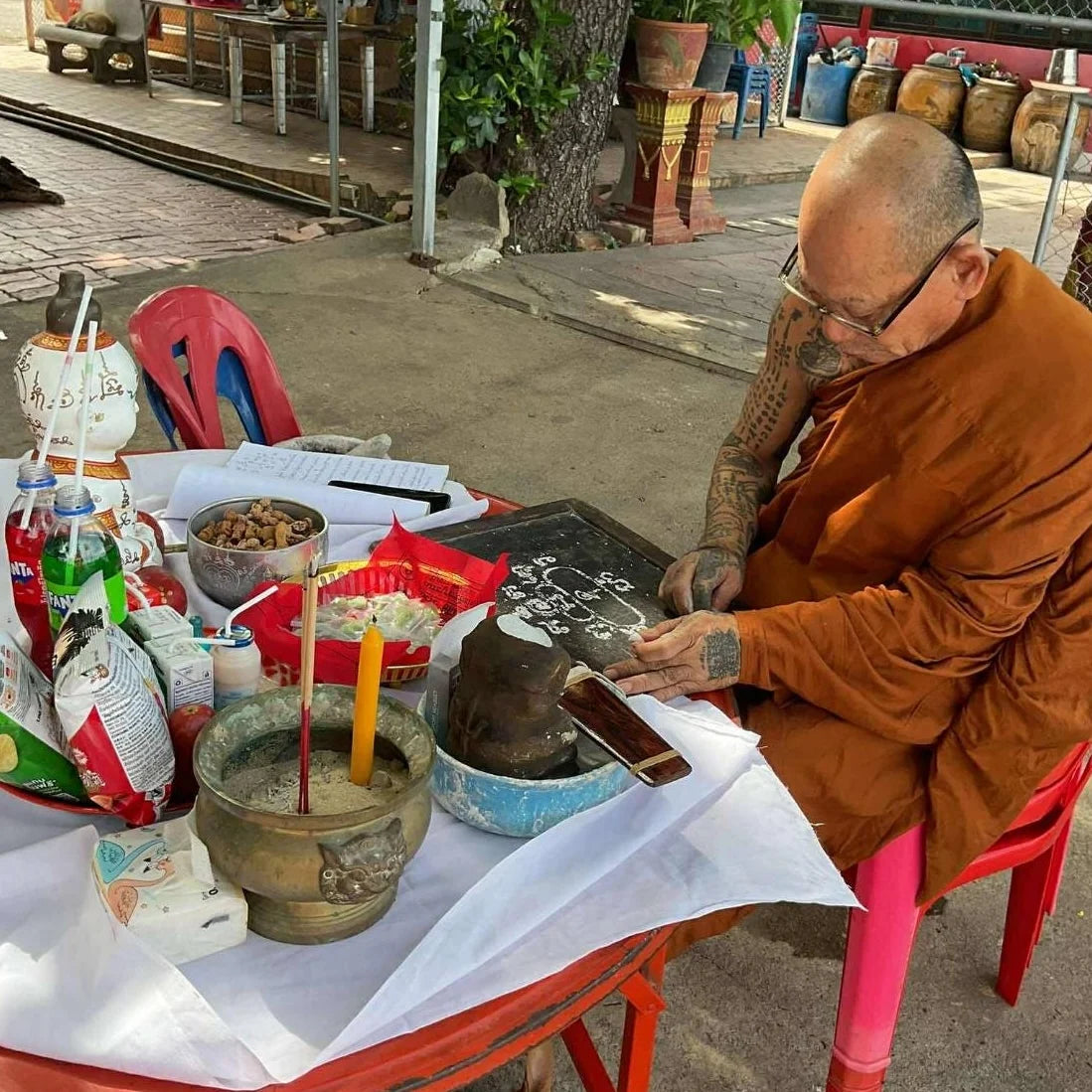
LP Anucha • Wat Pho Ratchaburana, Ratchaburi
3 Inches
Mainstream Artifact
Bio of LP Anucha: click here
Sacred Craftsmanship
Among the different Palakit forms created by LP Anucha of Wat Pho Ratchaburana, the Palakit Pumpui is immediately recognisable for its deliberately short, thick and rounded body.
Pumpui conveys the idea of something plump, full and well-filled. In this Palakit, the unusual proportion is not merely decorative. Its form reflects the principal intention of the piece: abundance, accumulation and the multiplication of wealth.
Money enters.
Money remains.
Money grows.
Wealth multiplies.
Each Palakit was individually carved from prepared natural wood and subsequently hand-inscribed. Differences in grain, colour, proportions, carving and Yant therefore form part of the individual character of every piece.
Personal Experiences Shared by Luksits
One recurring observation surrounding LP Anucha's Palakit is that collectors often did not stop after obtaining their first example.
Several followers later returned to Wat Pho Ratchaburana searching for other Palakit in different sizes, materials and designs.
For some, this was connected with their personal experiences after beginning to keep or carry his pieces.
Shop owners spoke of good and continuing business, while people working in sales described periods in which they were able to meet their targets with greater regularity. Others simply described their livelihood as becoming smoother, with customers, transactions and opportunities continuing to move.
The Palakit Pumpui naturally appealed to this group because its purpose was particularly concentrated upon wealth flow and multiplication.
Rather than necessarily being worn, some owners kept such wealth-oriented Palakit close to their commercial activities — beside a cash register, inside a safe, near money drawers, or wherever business takings and valuables were normally kept.
Summary
The Palakit Pumpui is a wealth-oriented interpretation of the traditional Palakit.
Its identity is created through three principal elements:
Mai Koon — associated with increase, prosperity and multiplication.
Pumpui form — short, rounded and deliberately full, symbolising abundance rather than scarcity.
Wealth Yant — sacred inscriptions directing the consecrated purpose towards money, livelihood and financial circulation.
It is therefore less centred upon the overt Saneh character found in some Palakit and more strongly associated with Maha Lap, Chok Larp, Kaa Khaay, Riak Sap and Pokasap — fortune, commerce, attracting resources and accumulating wealth.
The underlying idea is not simply to receive money once.
It is to encourage a cycle in which wealth enters, circulates, returns and gradually multiplies.
Historical Background
Palakit is among Thailand's oldest and most recognisable forms of Kruang Rang.
Its phallic form carries associations with fertility, vitality and generative power, while its development within Thai folk and Buddhist ritual traditions gradually produced numerous specialised branches.
Some Palakit became renowned primarily for Kong Grapan Chadtri and Klaew Klaad.
Others emphasised Metta Maha Niyom and Saneh.
For merchants, specialised formulas developed around Kaa Khaay, Maha Lap and Riak Sap — successful commerce, fortune and the attraction of wealth.
The Pumpui belongs naturally within this latter tradition.
Its plump form turns the older symbolism of fertility and generative force towards a financial interpretation: what is received should reproduce, expand and become plentiful.
LP Anucha's Palakit Lineage
LP Anucha's Palakit practice was not developed in isolation. His broader Wiccha draws upon knowledge received through several respected teachers and associated traditions.
His principal early teacher was LP Sanga of Wat Nong Muang, under whom he received foundations in sacred Yant, chanting, consecration and traditional Buddhist Wiccha.
Further branches of his studies included LP Non of Wat Khao Phran Thup, associated with traditions of Metta, Saneh, consecration and Palakit knowledge; LP Boonkham of Wat Chaiyapheri, whose lineage is connected with the celebrated Palakit tradition of LP Ei of Wat Sattahip; and LP Od of Wat Bang Muang, associated with another stream of traditional protective Wiccha.
Related traditions also connect this body of knowledge with the famous Palakit Wiccha of LP Yid.
These different transmissions gave LP Anucha a broad foundation from which he could prepare Palakit for different purposes rather than treating every example as possessing exactly the same emphasis.
Origins of the Materials
Mai Koon
The choice of Mai Koon is fundamental to understanding this particular Palakit.
Within the traditional interpretation surrounding the material, Mai Koon is considered an auspicious wood for increase and multiplication. It is consequently used in sacred objects intended to encourage prosperity, advancement and the expansion of existing fortune.
The symbolism is especially suitable for someone who already has a livelihood but wants it to grow rather than diminish.
A merchant wants today's customer to return.
A salesperson wants one successful transaction to lead to another.
A business owner wants today's earnings to become tomorrow's working capital.
A family wants accumulated savings to increase rather than continually disappear.
In this sense, Mai Koon is not merely interpreted as a material for obtaining sudden wealth. Its deeper symbolism concerns growth from what one already possesses.
When combined with the deliberately abundant Pumpui form, the material and the carving reinforce the same message.
Fullness becoming greater fullness.
Ritual
The preparation begins with the selection of suitable Mai Koon before the wood is carved into the distinctive short and rounded Pumpui form.
The unusual proportions are intentional.
Where a conventional Palakit may be elongated, the Pumpui is made thick and full-bodied to embody the visual language of abundance and accumulation.
After carving, LP Anucha inscribes the surface with sacred Yant, with particular emphasis upon formulas associated with wealth and prosperity.
The inscriptions are not treated merely as decoration. Within traditional Wiccha, the Yant provides the ritual framework through which the intended qualities of the artifact are directed.
The completed Palakit then undergoes consecration according to the Palakit knowledge transmitted through LP Anucha's teachers and lineage.
Material, shape, Yant and consecration therefore work together:
Mai Koon — multiplication.
Pumpui — fullness.
Palakit — generative force.
Wealth Yant — financial direction.
Consecration — activation of the complete Kruang Rang.
Blessings and Effects
The Palakit Pumpui is principally associated with wealth rather than aggression or domination.
Its traditional applications centre upon several closely related qualities.
Riak Sap — Calling Wealth
Associated with drawing financial resources and encouraging money to enter one's sphere of activity.
Pokasap — Accumulation of Wealth
Not merely receiving money, but keeping and building what has already been obtained.
Maha Lap / Chok Larp — Fortune
Associated with favourable opportunities and beneficial turns of circumstance.
Kaa Khaay — Commerce
Particularly appropriate for shops, businesses and people whose livelihood depends upon regular transactions.
Metta Maha Niyom — Goodwill
Supports the human side of commerce: customers returning, people being comfortable dealing with the owner, and favourable relationships developing around one's livelihood.
Multiplication is perhaps the most distinctive theme of the Pumpui. The intention is that one source of income may lead towards another rather than ending after a single transaction.
Modern Application
Unlike Palakit designed principally to be carried on the body, the Palakit Pumpui can be understood particularly well as a business or wealth-place talisman.
Traditionally appropriate locations include a cash register, money drawer, office safe, shop counter, business desk or cabinet where money and valuables are kept.
For a shop owner, it may be kept where daily takings are received.
For an entrepreneur, it may be placed near the financial centre of the business.
For someone working from home, it can be kept where accounts, contracts or business funds are managed.
For a salesperson, it may also be carried as a personal Palakit, particularly where income depends upon commission and repeated transactions.
Its symbolism is particularly suited to people who prefer the idea of steady financial circulation and accumulationrather than speculative windfalls.
Physical Details
The Palakit Pumpui is distinguished by its short, rounded and deliberately plump profile, markedly different from the longer proportions commonly associated with Palakit.
Carved from natural Mai Koon, each example retains individual variations in wood grain, tone and carving. Sacred wealth Yant are inscribed directly onto the prepared surface, making the ritual writing an integral part of the finished artifact rather than a separate decorative addition.
The compact Pumpui form also makes the piece practical for placement in a cash drawer, safe, shop counter or other relatively confined wealth-storage area.
Recommended Pairing
For a shop or retail business, Nang Kwak provides the most natural pairing. Nang Kwak traditionally calls customers towards the business, while Palakit Pumpui represents the accumulation and multiplication of the wealth produced from those customers.
Phra Sivali complements the piece where the emphasis is continued livelihood, resources and freedom from shortage.
A Salika may be added for businesses dependent heavily upon conversation, negotiation and closing sales.
For owners who also require stronger leadership and competitive authority, a Suer provides a complementary quality: the Suer establishes presence and protects one's position, while Pumpui concentrates upon financial growth.
The combination can therefore be understood simply:
Nang Kwak calls the customer.
Salika opens the conversation.
Suer holds the position.
Palakit Pumpui gathers and multiplies the wealth.
Personal Notes
What makes the Palakit Pumpui interesting is that its meaning can be understood almost immediately from its form.
It is not thin.
It is not empty.
It is deliberately full.
The plump body transforms a traditional symbol of generative life-force into an image of financial abundance. Mai Koon strengthens the same theme through its traditional association with multiplication and prosperity, while the wealth Yant give the piece its specific ritual direction.
This also explains why such an artifact was commonly placed where money actually changed hands.
At the cash register, the intention is for customers and money to keep arriving.
Inside the safe, the emphasis changes from attraction to retention and accumulation.
Where wealth is stored, the Pumpui symbolically sits among that wealth with the intention that what is already present should continue to increase.
The experiences shared by LP Anucha's collectors fit naturally into this philosophy. Shopkeepers spoke about good business. Salespeople spoke about reaching targets. Existing owners returned to the temple searching for other Palakit forms because they felt these objects had become useful companions in their everyday livelihood.
The Palakit Pumpui is therefore not best understood simply as another unusual Palakit design.
Its entire construction communicates one concentrated idea:
Let the livelihood remain full.
Let money continue to flow in.
Let what enters be retained.
And let what is retained multiply.

-
Free Shipping for Singapore| $15 Worldwide | $60 USA For Items Below $350