

OOBThaiAmulets
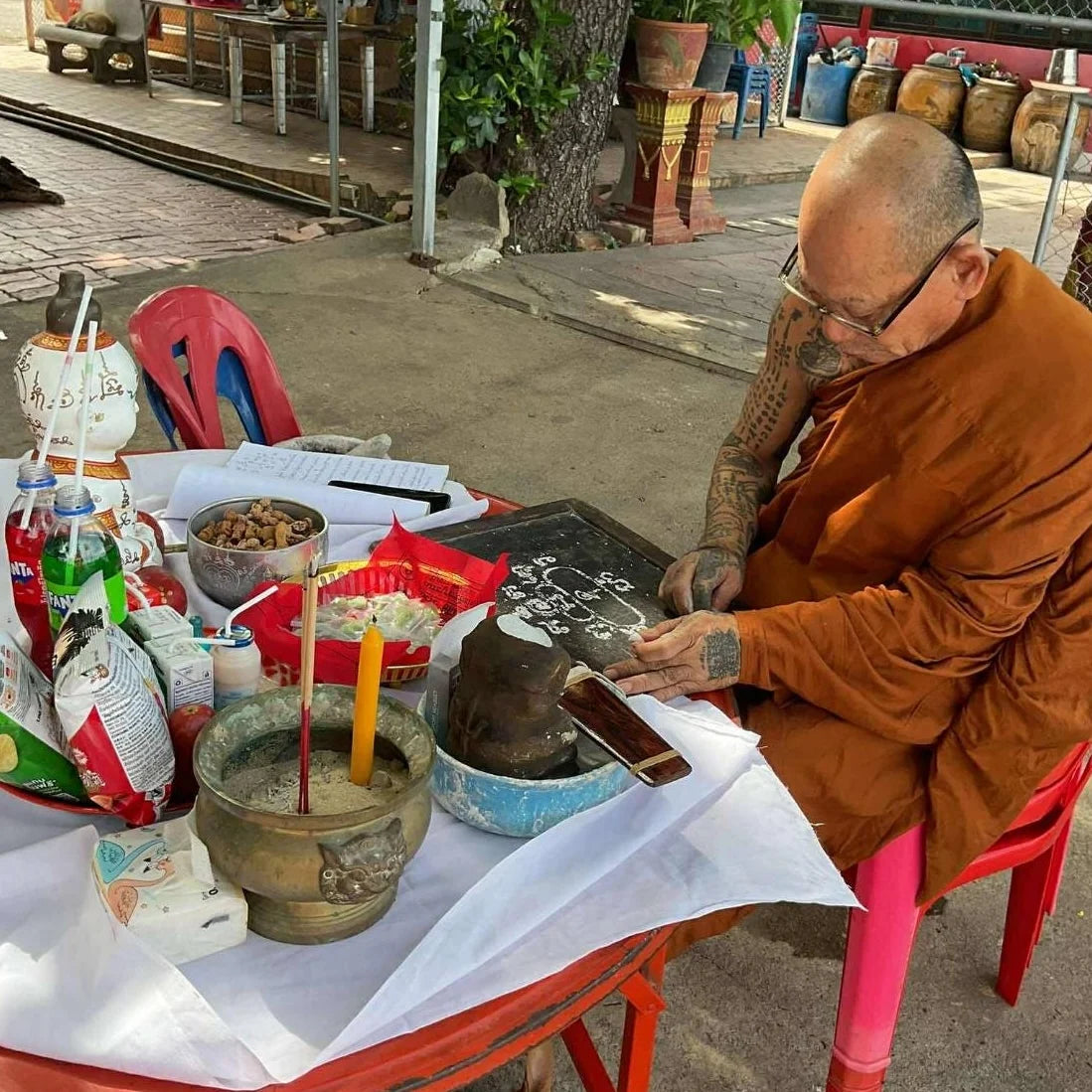
LP Anucha - Wat Pho Ratchaburana
LP Anucha - Wat Pho Ratchaburana
Couldn't load pickup availability
ANU01
Palakit Ling Kot Sap
LP Anucha • Wat Pho Ratchaburana, Ratchaburi
7cm
MAinstream Artifact
Bio of LP Anucha: click here
Sacred Craftsmanship
The Palakit Ling Kot Sap is one of the more distinctive forms within LP Anucha's Palakit tradition, combining the ancient symbolism of the Palakit with the lively, opportunistic character of the Ling — monkey.
Each artifact is individually handmade from natural Graduk and subsequently hand-inscribed. Differences in colour, texture, carving, age marks and Yant placement are natural characteristics of the process, making every piece unique.
Personal Experiences Shared by Luksits
One of the more interesting observations surrounding LP Anucha's Palakit is the behaviour of collectors after obtaining their first piece.
Several devotees subsequently returned to Wat Pho Ratchaburana to find additional Palakit in different sizes and designs.
Their reason was straightforward: they felt the objects had already brought a positive influence into their everyday lives.
Among the accounts shared were shop owners who felt that business had become consistently better, with healthier customer movement and sales. Salespeople similarly spoke of reaching their sales targets more regularly after carrying LP Anucha's Palakit.
The repeated return of existing collectors is an important part of the modern history surrounding LP Anucha's Palakit.
Summary
The Palakit Ling Kot Sap is fundamentally an artifact concerned with movement and acquisition.
The Palakit represents vitality, prosperity, protection and attraction.
The Ling represents intelligence, agility, adaptability and the ability to seize an opportunity.
Kot Sap directs that symbolism towards wealth — gathering, grasping and retaining favourable opportunities rather than allowing them to pass.
Graduk Kwai contributes another quality entirely: endurance.
The result is therefore particularly relevant to people involved in sales, business and occupations where income depends upon customers, opportunities, negotiation and personal initiative.
Its traditional qualities centre upon Maha Lap, Kaa Khaay, Metta Maha Niyom, Saneh, Klaew Klaad and the ability to recognise and secure opportunity.
Historical Background
Palakit belongs among Thailand's oldest and most recognisable forms of traditional Kruang Rang.
Its phallic form is commonly understood through the meeting of older fertility and life-force traditions with Indic symbolism associated with the lingam. Across generations, the Palakit developed beyond its original fertility symbolism and became associated with protection, vitality, prosperity, attraction and commerce.
Different teachers subsequently developed their own methods of inscription and consecration.
Some Palakit traditions became particularly associated with Kong Grapan and protection.
Others emphasised Metta and Saneh.
Still others became strongly connected with Kaa Khaay — commerce and successful trade.
LP Anucha's Palakit Lineage
LP Anucha's knowledge does not derive from a single isolated branch.
His principal early teacher was LP Sanga of Wat Nong Muang, under whom he received a foundation in traditional Wiccha, sacred inscriptions and consecration.
Further studies expanded this foundation through LP Non of Wat Khao Phran Thup, whose teachings included Metta, Saneh, sacred Yant and Palakit-related knowledge.
LP Anucha also received instruction from LP Boonkham of Wat Chaiyapheri, associated with the lineage of LP Ei of Wat Sattahip, and from LP Od of Wat Bang Muang.
These streams of teaching gave LP Anucha a broad foundation for preparing Palakit rather than simply reproducing a decorative traditional form.
Origins of the Materials
Graduk Kwai
The Graduk used for this Palakit came from a water buffalo said to have passed naturally from old age.
After its death, the material was given to LP Anucha for sacred-object making.
Within older agricultural communities, the water buffalo was inseparable from livelihood. It worked the fields, endured difficult conditions and supported the farming household over many years.
Consequently, Graduk Kwai naturally carries associations with strength, patience, endurance, work and the ability to withstand hardship.
This symbolism fits the commercial character of Ling Kot Sap particularly well.
Fortune alone may appear and disappear.
Business requires endurance.
Sales require repeated effort.
The monkey provides the instinct to seize opportunity, while the buffalo contributes the strength to continue pursuing it.
Ritual
The Graduk Kwai is first selected and prepared before being individually carved into the required Palakit Ling Kot Sap form.
Once the carving has been established, LP Anucha applies the sacred Yant by hand.
This is clearly an important part of the piece. The inscriptions are distributed across the surface rather than confined to a single token marking, turning the carved Graduk itself into the carrier of the ritual script.
The completed artifact is then consecrated according to the Palakit Wiccha received through his teachers.
Within this traditional method, form, material and inscription each serve a different purpose.
Graduk Kwai provides endurance.
Palakit provides vitality and attraction.
Ling provides agility and opportunity.
Kot Sap directs the symbolism towards gathering wealth.
Yant establishes the Wiccha.
Consecration completes the artifact.
Blessings and Effects
The Palakit Ling Kot Sap is traditionally approached as a multi-purpose piece, although its strongest character is naturally connected with commerce and opportunity.
Maha Lap concerns incoming fortune and unexpected beneficial opportunities.
Kaa Khaay relates specifically to selling, customer movement and commercial activity, making the piece particularly relevant to shopkeepers and salespeople.
Metta Maha Niyom concerns goodwill — encouraging people to receive the keeper favourably and making interpersonal dealings easier.
Saneh adds personal attraction and magnetism. In a modern commercial context, this may be interpreted through customer rapport, networking and the ability to leave a favourable impression.
Klaew Klaad represents avoidance of danger and troublesome circumstances.
The Ling symbolism contributes quick thinking and adaptability. When one path closes, the monkey does not remain still; it finds another route.
Graduk Kwai contributes the opposite but complementary quality — persistence.
One moves quickly.
The other refuses to give up.
Modern Application
The character of this artifact is particularly well suited to business owners, salespeople, commission-based professionals and entrepreneurs.
A shop owner may approach it principally through Kaa Khaay and Maha Lap — customer movement, transactions and continuing business.
A salesperson may identify more strongly with Ling: reading the situation quickly, adapting the approach, communicating effectively and recognising when an opportunity is ready to be closed.
For entrepreneurs, the combination is broader.
Modern business requires both agility and endurance.
Markets change. Customers change. Competitors appear. Plans that worked yesterday may no longer work tomorrow.
The symbolism of Ling Kot Sap is therefore not simply "money arriving".
It is about seeing opportunity, moving towards it and successfully holding onto what has been gained.
Physical Details
This Palakit Ling Kot Sap is a slender, elongated carving made from naturally aged Graduk Kwai, showing warm brown tones with lighter areas following the grain and surface of the material.
The carving is strongly three-dimensional rather than a simple flat talisman. The Ling element emerges along the Palakit form, with individually worked anatomical contours giving the piece its distinctive character.
Numerous hand-inscribed sacred characters remain visible across both sides, extending from the upper portion through the central body and towards the lower end.
The hand-carved surface retains small irregularities, changes in colour and natural characteristics of the Graduk. It is presently housed within a long fitted clear casing that allows both faces and the unusual profile of the carving to remain visible.
Recommended Pairing
For someone carrying this primarily for business, Nang Kwak forms a natural companion. Nang Kwak calls customers; Ling Kot Sap symbolically recognises and gathers the resulting opportunities.
Phra Sivali is particularly appropriate where continuing livelihood, resources and smooth commercial movement are desired.
For professions dependent upon communication, Salika strengthens the speech and negotiation side of the combination.
A Suer can be added where business involves strong competition or leadership: Palakit Ling Kot Sap for opportunity and commerce, Suer for authority and protection.
For a calmer Buddhist foundation, Phra Somdej provides Baramee, mindfulness and balance alongside the more active character of the Palakit.
Personal Notes
What makes Palakit Ling Kot Sap interesting is that its symbolism is not passive.
The monkey does not sit and wait for something to arrive.
It observes.
It moves.
It reaches.
And when it finds something valuable, it grasps it.
This makes the Ling an unusually appropriate symbol for people working in sales and business. Opportunity is often available to many people at the same time; the difference lies in who recognises it and acts upon it.
The Graduk Kwai adds an equally important lesson.
The buffalo represents the opposite kind of strength. It is patient, persistent and capable of carrying a burden for a long time.
One gives speed.
The other gives stamina.
And the Palakit brings these qualities into a traditional framework of vitality, prosperity, attraction and protection.
Perhaps this also explains why some of LP Anucha's collectors returned to the temple after carrying their first Palakit. For them, the object was not merely something unusual to collect. They associated it with positive changes they were already experiencing in their shops, sales work and daily livelihood.
The character of the piece can therefore be expressed simply:
Ling sees the opportunity.
Palakit attracts the opportunity.
Graduk Kwai provides the strength to pursue it.
Kot Sap holds onto what has been gained.

-
Free Shipping for Singapore| $15 Worldwide | $60 USA For Items Below $350