
OOBThaiAmulets
Wat Rakang Roy Pii
Wat Rakang Roy Pii
Couldn't load pickup availability
MS04
Phra Somdej Kanaen
Wat Rakang Kositaram
B.E. 2515 (1972)
100th Anniversary Memorial Edition
Samakom Card
Sacred Craftsmanship
The Phra Somdej Anusorn Roy Pii was created according to the traditional pressed-powder method associated with Somdej amulets. Sacred powders and prepared binding materials were blended before the individual amulets were pressed into their respective moulds.
The Pim Kanaen is distinguished by its compact proportions. Despite its smaller dimensions, the familiar Somdej composition remains clearly expressed: the Buddha seated in meditation beneath the sacred arch upon a three-tiered base.
Each amulet was individually pressed from carefully prepared sacred materials, so natural differences in powder distribution, surface texture, colour, mould pressure and ageing make every surviving piece unique.
Personal Experiences Shared by Luksits
Among Thai collectors, Somdej Wat Rakang Roy Pii B.E. 2515 has long been regarded as one of the important modern generations associated with the Baramee of Somdej Toh.
Luksits traditionally speak particularly of Metta Maha Niyom. Those carrying the amulet often describe smoother relationships with customers, colleagues and senior figures, with conversations becoming easier and assistance appearing when needed.
Business owners have also associated the Roy Pii with gradual improvements in customer traffic and livelihood. Rather than being viewed only as a wealth piece, its character is often described as Metta opening the way for opportunity.
There are equally longstanding accounts concerning Klaew Khlaad. Some collectors recount accidents or potentially dangerous situations in which the outcome was unexpectedly minor, strengthening the reputation of the series as an all-round Somdej suitable for daily wear.
For many collectors, the attraction of the Kanaen is precisely this balance — a small amulet carrying the traditional qualities of Metta, protection, livelihood and Baramee associated with the Somdej tradition.
Summary
This is the Phra Somdej Wat Rakang Roy Pii, Pim Kanaen, created in B.E. 2515 (1972) to commemorate the 100th anniversary of the passing of Somdej Phra Putthachan Toh Phromrangsi.
“Roy Pii” literally refers to 100 years, and the series has consequently become widely known amongst collectors simply as Somdej Roy Pii.
The Kanaen, meaning “score” or “counting” mould, is the smaller format within the celebrated centenary series. Its compact dimensions have made it particularly desirable amongst collectors who favour smaller early Somdej pieces for everyday wearing.
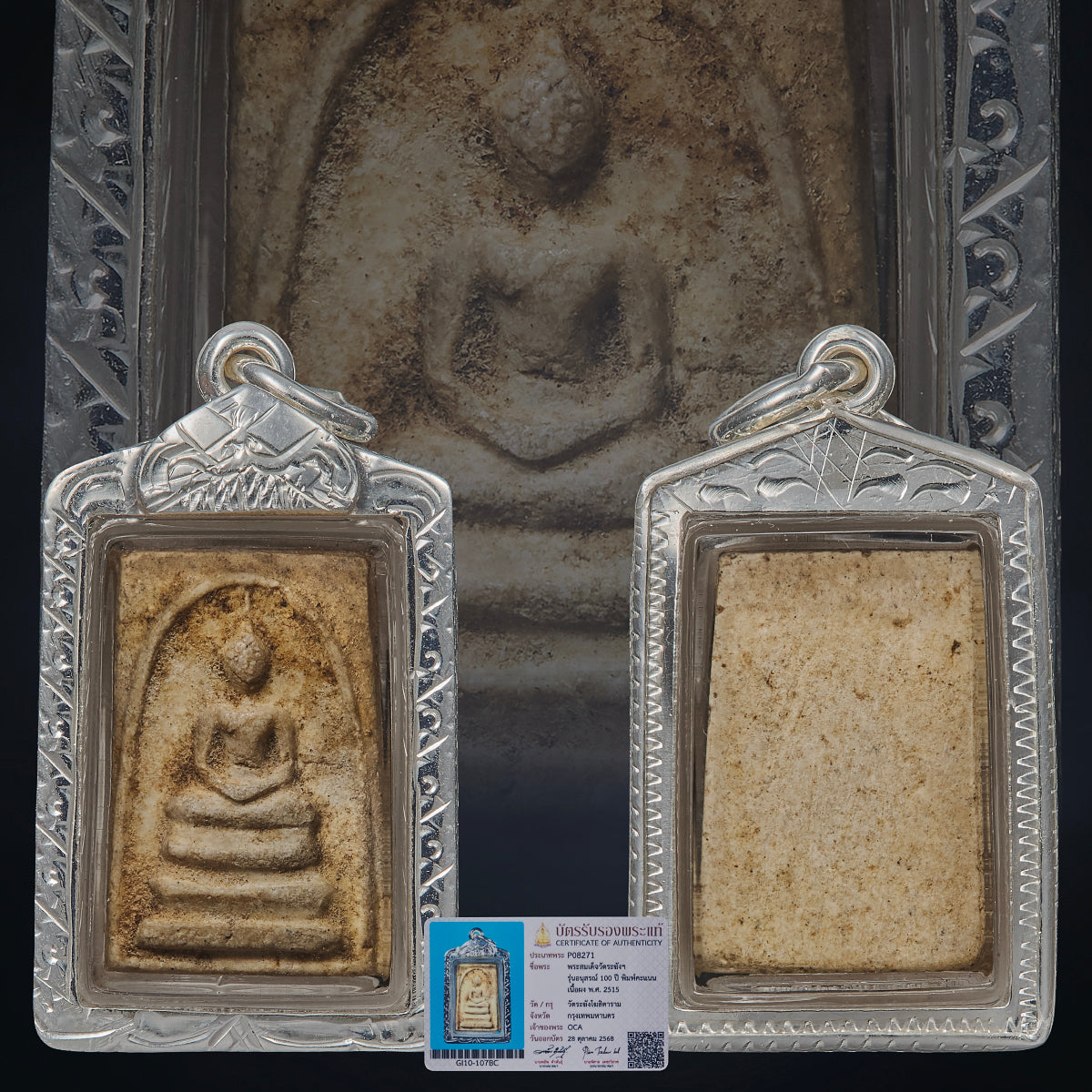
The front presents the classic Somdej composition of the Buddha seated beneath an arch upon a three-tiered base. The reverse remains plain, allowing the natural character of the sacred powder to be clearly observed.
This example retains an aged cream-coloured surface with naturally developed brown toning and is presently housed within an engraved silver casing. It is accompanied by a Samakom authentication card.
Historical Background
Somdej Phra Putthachan Toh Phromrangsi remains one of the most influential monks in the history of Thai sacred objects.
His name became inseparable from the Phra Somdej tradition, particularly the celebrated amulets associated with Wat Rakang.
Somdej Toh passed away in B.E. 2415 (1872). A century later, in B.E. 2515 (1972), Wat Rakang organised an important commemorative project marking 100 years since his passing.
The resulting series became known as:
Phra Somdej Wat Rakang Anusorn 100 Pii — Somdej Roy Pii.
The project served both as a memorial to Somdej Toh and as a means of supporting restoration and religious activities at Wat Rakang.
Several mould families were produced, creating an extensive field of study amongst later collectors. Among these, Pim Kanaen developed its own following because of its distinctive compact format.
Today, the Roy Pii generation occupies an important position between the historic nineteenth-century Somdej tradition and the major temple-produced Somdej series of modern Thailand.
Origins of the Materials
Considerable attention was given to the sacred powder mixture used for the Roy Pii project.
Traditional collector records describe the inclusion of old sacred powders and fragments associated with earlier Somdej traditions, together with newly prepared materials specifically assembled for the centenary creation.
These are commonly recorded as including old sacred powder material connected with Wat Rakang, together with fragments and powders associated with other historically important Somdej traditions.
Traditional binding ingredients and sacred substances were incorporated into the mixture, producing the characteristic cream, beige and pale brown appearance encountered amongst surviving examples.
Over more than five decades, these materials may naturally develop darker deposits, fine surface lines, changes in tone and small variations within the powder body.
Such characteristics form an important part of the physical study of genuine old powder amulets.
Ritual
The Roy Pii project was prepared through several important ritual stages extending from B.E. 2514 into B.E. 2515.
An early ceremony was held for the preparation and blessing of sacred materials, followed by further rites connected with the casting of commemorative sacred images.
The principal consecration took place at Wat Rakang in B.E. 2515, commemorating the centenary of Somdej Toh's passing.
A large gathering of respected monks and meditation masters from different lineages participated in the consecration.
This collective blessing is one of the reasons the Roy Pii series became highly regarded. The amulets were created at Somdej Toh's own historic temple, commemorated his centenary, incorporated sacred materials associated with the Somdej tradition and received a major formal consecration.
The result was a modern Wat Rakang issue carrying unusually strong historical continuity with the older Somdej lineage.
Blessings and Effects
The Somdej Roy Pii is traditionally regarded as an all-round Buddhist amulet, with particular emphasis upon:
Metta Maha Niyom — goodwill, acceptance and favourable relationships.
Baramee — personal presence, credibility and the respect of others.
Klaew Khlaad — protection from accidents, danger and unexpected difficulties.
Serm Duang — supporting favourable changes when life circumstances become difficult.
Career & Business — encouraging smoother dealings, customer support and progress through work.
Choke Lap & Livelihood — supporting opportunities and greater stability in one's financial affairs.
Peace of Mind — encouraging composure, mindfulness and confidence during uncertain periods.
Its qualities are traditionally considered broad, making the Roy Pii suitable for collectors seeking one principal Somdej for everyday use.
Modern Application
The compact Pim Kanaen is particularly practical as a daily amulet.
Business owners may wear it for Metta when meeting customers, negotiating or building long-term relationships.
Professionals may carry it when seeking cooperation from colleagues and senior figures, particularly where calm communication and personal credibility are important.
Those who travel regularly may appreciate the traditional protective reputation associated with Somdej amulets.
It is equally suitable for students, managers and individuals beginning new stages of life where both opportunity and stability are desired.
Its small dimensions allow it to be worn discreetly while retaining the broad traditional qualities of the larger Somdej form.
Physical Details
This example is the Pim Kanaen of the Wat Rakang Anusorn Roy Pii B.E. 2515 series.
The front displays a compact Buddha seated beneath a rounded arch upon three clearly defined bases. The smaller format gives the image a particularly concentrated and simple appearance.
The material has matured to an aged cream and beige colour, with naturally developed brown toning concentrated around the recessed portions of the mould.
Small darker particles and variations are visible throughout the powder body, while the raised areas have softened naturally with age.
The reverse is plain and retains the original powder texture, with scattered age-related tonal variation across the surface.
This example is presently protected within a hand-engraved silver casing, allowing both sides to remain visible, and is accompanied by a Samakom authentication card.
Recommended Pairing
The Somdej Roy Pii Kanaen works particularly well as a principal Metta and Baramee piece.
For business and sales, it may be paired with Choke Lap, wealth or Metta Maha Niyom amulets, creating a combination centred upon opportunity, customer relationships and livelihood.
It may also be worn alongside the Roop Lor of a respected meditation master where guidance, Baramee and personal spiritual connection are desired.
The Roy Pii is equally complete when worn alone, particularly for collectors who prefer the broad and balanced qualities traditionally associated with Phra Somdej.
Personal Notes
The Pim Kanaen represents an interesting side of the Roy Pii series.
Its physical dimensions are modest, yet its historical background is substantial.
It connects Wat Rakang, the memory of Somdej Toh, the centenary of his passing, traditional Somdej sacred materials and one of the important collective consecrations of B.E. 2515 within a single compact amulet.
More than fifty years of natural ageing have also given surviving examples an individual character impossible to reproduce through the original manufacturing process alone.
For collectors who appreciate historically important modern Somdej amulets, the Phra Somdej Kanaen Anusorn Roy Pii B.E. 2515 remains one of the most recognisable compact forms from the celebrated Wat Rakang centenary generation.
-
Free Shipping for Singapore| $15 Worldwide | $60 USA For Items Below $350