
OOBThaiAmulets
Wat Phraya Suren - Kru Bueng Phraya Suren
Wat Phraya Suren - Kru Bueng Phraya Suren
Couldn't load pickup availability
MS04
Phra Somdej - Pim Than Saem
Kru Bueng Phraya Suren • Wat Phraya Suren • Bangkok
Pim Than Saem
Samakom card
Each amulet was individually hand-pressed from traditionally prepared sacred powders, resulting in natural variations in colour, density, surface texture and mould definition. Long-term storage within the Kru has also created unique ageing patterns and mineral deposits, making every surviving example distinct.
Personal Experiences Shared by Luksits
Among collectors of old Bangkok Kru amulets, Phra Somdej Wat Bueng Phraya Suren has long been associated with strong experiences of protection, Klaew Klaad, Metta and favourable opportunities.
Its reputation became especially well known through accounts connected to the old cache discoveries during the early 20th century, when amulets from the Kru were circulated among devotees and, in some traditions, even distributed during times of hardship. These stories helped establish the well-known collector expression “Somdej Khiao Niao Jing”, referring to the green-toned Somdej regarded as exceptionally powerful in protection.
Beyond protective situations, devotees also carried these amulets in daily life for work, travel and business. The combination of Metta Maha Niyom, Maha Saneh and Maha Lap made them suitable for interactions with customers, superiors and people encountered in everyday circumstances.
For many collectors, the appeal of this Somdej lies in its compact form containing deep historical Wicha from an important old Bangkok Kru lineage. It is small, simple, and highly practical for daily wear, yet carries a strong traditional reputation.
Summary
This is a Phra Somdej Wat Bueng Phraya Suren, Pim Than Saem, from the historic Kru Bueng Phraya Suren at Wat Phraya Suren, Bangkok.
The mould is known as Pim Than Saem, a stepped-base form distinguished by its layered pedestal structure beneath the seated Buddha image.
The amulets are traditionally attributed to Chao Phraya Suren Ratchasena, who is remembered in collector tradition as having been directly involved in the preparation of sacred powders, mould creation and early production of the amulets.
Their consecration lineage is also associated with LP Thong Ayana of Wat Ratchayotha, an important meditation master of the era.
The Kru is widely respected for its traditional qualities of Kong Krapan, Klaew Klaad, Khum Khrong, Metta Maha Niyom, Maha Saneh and Maha Lap.
Historical Background
Wat Phraya Suren was originally known as Wat Bueng Phraya Suren, named after the large natural pond that once existed beside the temple grounds.
Although the pond was later filled and the temple name shortened, the original designation remains preserved in collector tradition through the term Kru Bueng Phraya Suren.
The temple is historically linked to Chao Phraya Suren Ratchasena, a high-ranking military official during the reign of King Rama V.
In later life, he became increasingly devoted to meditation and religious practice. Traditional accounts state that he personally participated in the creation of sacred objects, including the preparation of powders, mould carving and pressing of amulets.
Some pieces were distributed to devotees, while others were enshrined within temple structures, later forming the caches discovered by subsequent generations.
LP Thong Ayana & Consecration Lineage
The consecration of the Bueng Phraya Suren amulets is traditionally associated with LP Thong Ayana of Wat Ratchayotha (Wat Lat Bua Khao).
LP Thong was a respected meditation monk known for his long monastic life, disciplined practice and knowledge of traditional sacred Wicha.
His involvement is considered an important part of the Kru's spiritual lineage.
For collectors, the significance of this tradition lies in the combination of old handmade production, sacred powder preparation and blessing by an established meditation master.
This contributes to the continued respect for these amulets even long after their discovery.
The Two Kru Discoveries
Two main discoveries are traditionally associated with the Bueng Phraya Suren lineage.
The first is the Kru Kao (old cache), believed to have been discovered around B.E. 2485 (1942) within the chedi near the old pond. Traditional accounts state that these amulets were later distributed during wartime periods, contributing to their strong protective reputation.
The second is the Kru Mai (new cache), discovered in B.E. 2512 (1969) beneath the principal Buddha image in the ordination hall. These were distributed through merit-making activities supporting temple restoration.
Because the two caches were stored in different environments, surviving examples often show different levels of ageing, staining and surface deposits.
Pim Than Saem – The Stepped Base Mould
Pim Than Saem is one of the recognised moulds within the Somdej Wat Bueng Phraya Suren tradition.
It is characterised by a stepped or layered base structure, giving the amulet a more defined architectural appearance compared to simpler forms.
The Buddha sits centrally above the stepped base, enclosed within a simple arched frame. The design is intentionally minimal, reflecting early powder casting techniques and traditional mould-making methods.
The stepped base is considered symbolically significant, representing stability and layered spiritual foundation.
Recognised Moulds
Collector tradition generally recognises several main forms within the Kru:
-
Pim Sam Chan — three-tiered base
-
Pim Than Saem — stepped layered base
-
Pim Prok Pho — Buddha beneath Bodhi canopy
-
Pim Phra Chao Ha Phra Ong — Five Buddha form
-
Pim Leb Mue / Pim Sum Kor — compact rounded form
These represent the core classification system used by collectors when studying Bueng Phraya Suren Somdej amulets.
Sacred Powder Material
The amulets are traditionally associated with a sacred powder known as:
Nuea Phong Si Khiao Om Thao — grey-green sacred powder
Over time, the material can change significantly in appearance due to humidity, burial conditions, mineral absorption and natural ageing.
Colours may range from green-grey to beige, pale grey or darker earth tones depending on storage history.
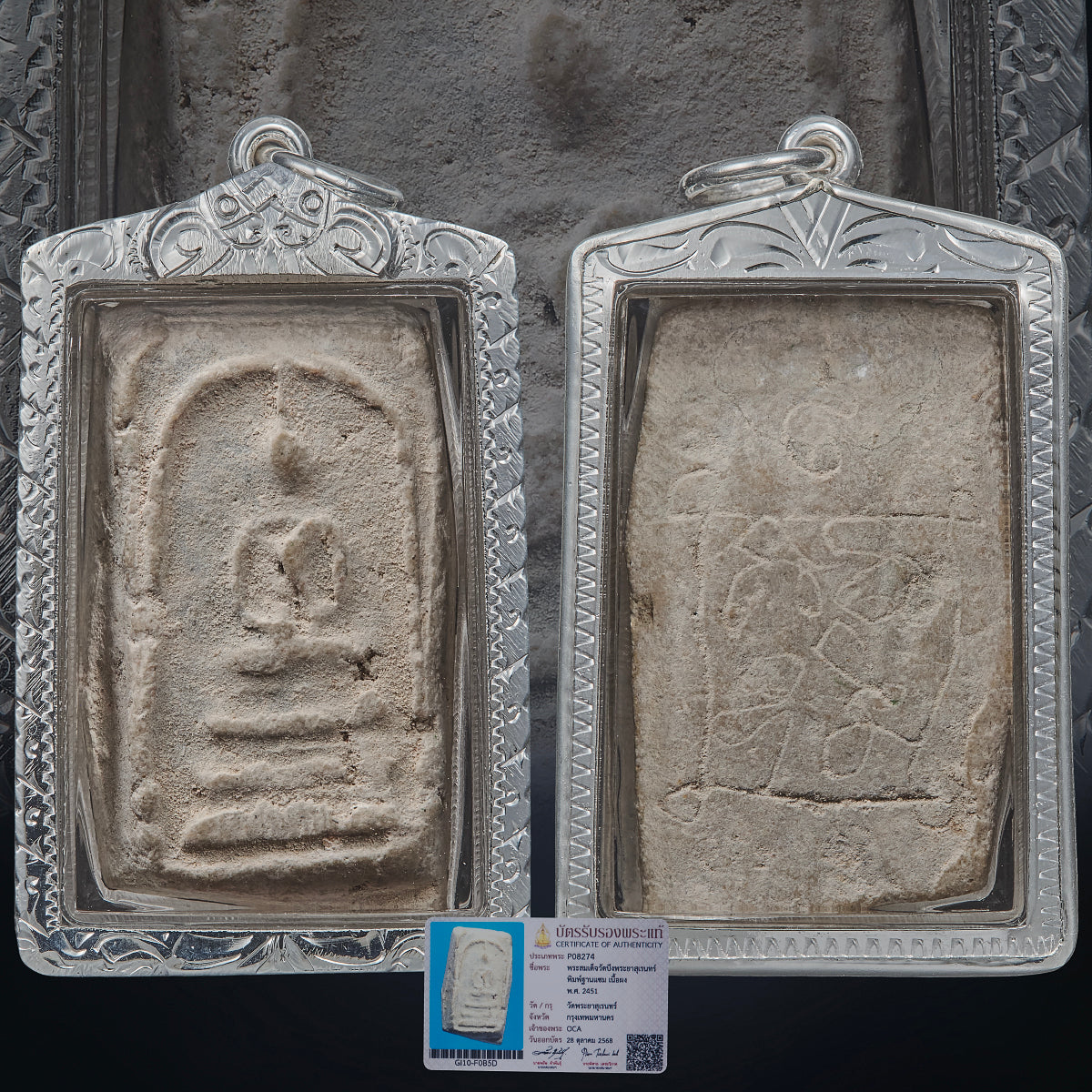
This example shows a light aged grey-beige surface with visible Kru deposits, especially in recessed areas of the mould.
The stepped base and Buddha image remain clearly visible beneath the natural surface accumulation.
Kru Surface & Natural Ageing
A defining feature of this example is its naturally aged surface.
Fine powder deposits remain across the Buddha figure and stepped base, while darker tones appear in deeper recesses of the mould.
These characteristics are typical of long-term Kru storage, where environmental conditions gradually alter the surface of the sacred powder.
The reverse is plain and shows natural uneven density and ageing patterns consistent with early handmade powder amulets.
Such features should be understood as part of the amulet’s historical development rather than imperfections.
Sacred Inscriptions
Some Bueng Phraya Suren amulets may include sacred inscriptions or Yant on the reverse.
A traditional Kata associated with certain examples is:
Ti Ti U Ni
Other pieces may feature Unalome or additional sacred markings.
However, plain-backed examples are also widely recognised within the tradition.
Traditional Blessings & Qualities
The Somdej Wat Bueng Phraya Suren tradition is associated with a wide range of blessings:
Kong Krapan — resilience and protection from harm
Klaew Klaad — avoidance of danger and accidents
Khum Khrong — general protective influence
Metta Maha Niyom — goodwill and acceptance from others
Maha Saneh — charm and ease in communication
Maha Lap & Choke Lap — fortune and favourable opportunities
While its wartime reputation is well known, the amulet has long been used in everyday life for work, relationships and personal stability.
Modern Application
The Pim Than Saem remains suitable for daily wear, especially for those seeking a balance of protection and supportive Metta energy.
Its Klaew Klaad and Khum Khrong qualities make it appropriate for travel, work environments and unpredictable situations.
For professionals and business users, its Metta and Maha Lap aspects support communication, negotiation and opportunity development.
Its understated appearance also appeals to collectors who value historical authenticity and natural ageing over decorative presentation.
Physical Details
This example is the Pim Than Saem stepped-base mould, featuring a seated Buddha above a clearly defined layered pedestal.
The front shows extensive aged Kru deposits with a light grey-beige tone. The Buddha figure and stepped base remain visible beneath the natural surface accumulation.
The reverse is plain, with subtle variations in texture and density consistent with early powder pressing techniques.
The amulet is preserved within a protective silver casing, allowing both sides to be viewed while safeguarding the fragile aged powder structure.
Recommended Pairing
The Pim Than Saem can be worn independently as a primary daily amulet.
For enhanced Baramee and authority, it pairs well with Roop Lor or portrait amulets of respected masters.
For livelihood and prosperity focus, it may be combined with Nang Kwak, Choke Lap or wealth-oriented pieces, allowing the Somdej to provide a protective foundation.
For collectors of old Kru traditions, it also pairs naturally with other Bueng Phraya Suren moulds, forming a cohesive lineage set.
Personal Notes
What makes this Phra Somdej particularly appealing is its clear stepped-base structure combined with strong natural ageing.
The surface shows authentic Kru development, with no artificial enhancement, reflecting long-term preservation within an old sacred environment.
Behind its simple appearance lies a deep historical lineage involving Chao Phraya Suren Ratchasena, LP Thong Ayana, and one of Bangkok’s respected early Kru traditions.
For collectors who appreciate early 20th-century Somdej craftsmanship, natural powder ageing and historically significant Bangkok temple lineages, the Pim Than Saem remains a highly meaningful example.
-
Free Shipping for Singapore| $15 Worldwide | $60 USA For Items Below $350