
OOBThaiAmulets
Wat Phraya Suren - Kru Bueng Phraya Suren
Wat Phraya Suren - Kru Bueng Phraya Suren
Couldn't load pickup availability
MS04
Phra Somdej - Pim Leb Mue
Kru Bueng Phraya Suren • Wat Phraya Suren • Bangkok
Pim Leb Mue / Pim Sum Kor
Samakom card
Each amulet was individually hand-pressed from traditionally prepared sacred powder, resulting in natural differences in colour, density, surface texture and mould definition. Long periods within the Kru also produced individual ageing and mineral deposits, making every surviving example unique.
Personal Experiences Shared by Luksits
Among collectors of old Bangkok Kru amulets, Phra Somdej Kru Bueng Phraya Suren has long been remembered for strong experiences concerning protection, Klaew Klaad, Metta and favourable opportunities.
Its protective reputation became particularly established through accounts surrounding the old cache discovered during the wartime period, when quantities were traditionally said to have been distributed among soldiers. This gave rise to the well-known collector expression “Somdej Khiao Niao Jing”, referring to the green Somdej as exceptionally strong in protective qualities.
Outside hazardous situations, devotees also carried these pieces for ordinary work, travel and business. The combination of Metta Maha Niyom, Maha Saneh and Maha Lap made them equally relevant for dealing with customers, employers, senior figures and people encountered in daily life.
For many long-time collectors, the attraction of the Pim Leb Mue lies in how much old Wicha is contained within such a compact powder amulet. It is small enough for comfortable daily wear, yet carries the broader reputation of one of Bangkok's interesting old Kru lineages.
Summary
This is a Phra Somdej Pim Leb Mue from Kru Bueng Phraya Suren, associated with the old Wat Bueng Phraya Suren, today known as Wat Phraya Suren in Bangkok.
The mould is called Pim Leb Mue, literally “fingernail mould”, referring to its small rounded shrine-like form. It is also known among collectors as Pim Sum Kor.
The amulets are traditionally attributed to Chao Phraya Suren Ratchasena, who is remembered in collector history as having prepared sacred powders, carved moulds and participated personally in their creation.
Their consecration lineage is importantly connected with LP Thong Ayana of Wat Ratchayotha.
The Kru subsequently gained a respected reputation for Kong Krapan, Klaew Klaad, Khum Khrong, Metta Maha Niyom, Maha Saneh and Maha Lap.
Historical Background
Wat Phraya Suren was originally known as Wat Bueng Phraya Suren, named after the large pond that once stood beside the temple.
Although the pond was later filled and the temple name shortened, the original name remains preserved among collectors through the term Kru Bueng Phraya Suren.
The temple is historically associated with Chao Phraya Suren Ratchasena, an important military official during the reign of King Rama V.
In later life, he became increasingly devoted to meditation and religious practice. Traditional accounts state that he personally became involved in creating sacred objects for the temple.
He is remembered as having carved moulds, prepared sacred powders and herbs, pressed the amulets and participated in their ritual preparation.
Some were distributed to devotees, while others were placed within temple structures for preservation, eventually forming the caches discovered by later generations.
LP Thong Ayana & the Consecration Lineage
The consecration of the Bueng Phraya Suren amulets is traditionally associated with LP Thong Ayana of Wat Ratchayotha, also historically known as Wat Lat Bua Khao.
LP Thong belonged to an older generation of highly respected monks and was remembered for his meditation practice, long monastic life and knowledge of traditional sacred Wicha.
His involvement became one of the most important elements of the Bueng Phraya Suren tradition.
For collectors, the significance lies in the combination of carefully prepared sacred powders, old handmade production and the blessing of an established meditation master.
This helps explain why these relatively simple-looking powder amulets continued to be respected long after their discovery.
The Two Kru Discoveries
Two principal discoveries are traditionally associated with this lineage.
The earlier group became known as the Kru Kao, or old cache.
Around B.E. 2485 (1942), amulets stored within the chedi near the old pond were discovered. Traditional accounts state that quantities were subsequently distributed to soldiers during the wartime period.
Experiences associated with these pieces helped establish the Kru's famous protective reputation.
The second major discovery took place in B.E. 2512 (1969).
The temple officially opened the cache beneath the principal Buddha image within the ordination hall. These pieces became known as the Kru Mai, or new cache, and were distributed through merit donations to support temple restoration.
Because the two groups were stored in different environments, surviving examples can display noticeably different deposits, staining and surface ageing.
Pim Leb Mue – The Fingernail Mould
Pim Leb Mue is one of the recognised moulds of the Bueng Phraya Suren Somdej family.
The amulet has a compact rounded outline resembling a fingernail, giving rise to its name.
Collectors also call the mould Pim Sum Kor because its surrounding outline resembles a small sacred arch or shrine.
The Buddha sits centrally within the arch upon a layered base. The modelling is deliberately simple, giving genuine old examples a distinctly archaic appearance.
Its compact proportions made this mould particularly practical for everyday wear.
Recognised Moulds
Collector tradition generally recognises several main forms within the Kru:
-
Pim Sam Chan — three-tiered base
-
Pim Than Saem — stepped layered base
-
Pim Prok Pho — Buddha beneath Bodhi canopy
-
Pim Phra Chao Ha Phra Ong — Five Buddha form
-
Pim Leb Mue / Pim Sum Kor — compact rounded form
These represent the core classification system used by collectors when studying Bueng Phraya Suren Somdej amulets.
Sacred Powder Material
The Bueng Phraya Suren Somdej are traditionally associated with a compact sacred powder commonly described as:
Nur Phong Si Khiao Om Thao — greyish-green sacred powder.
The original material may vary considerably in appearance today.
Age, humidity, prolonged burial, mineral deposits, handling and previous storage can change the visible colour from green-grey through pale grey, beige or considerably darker tones.
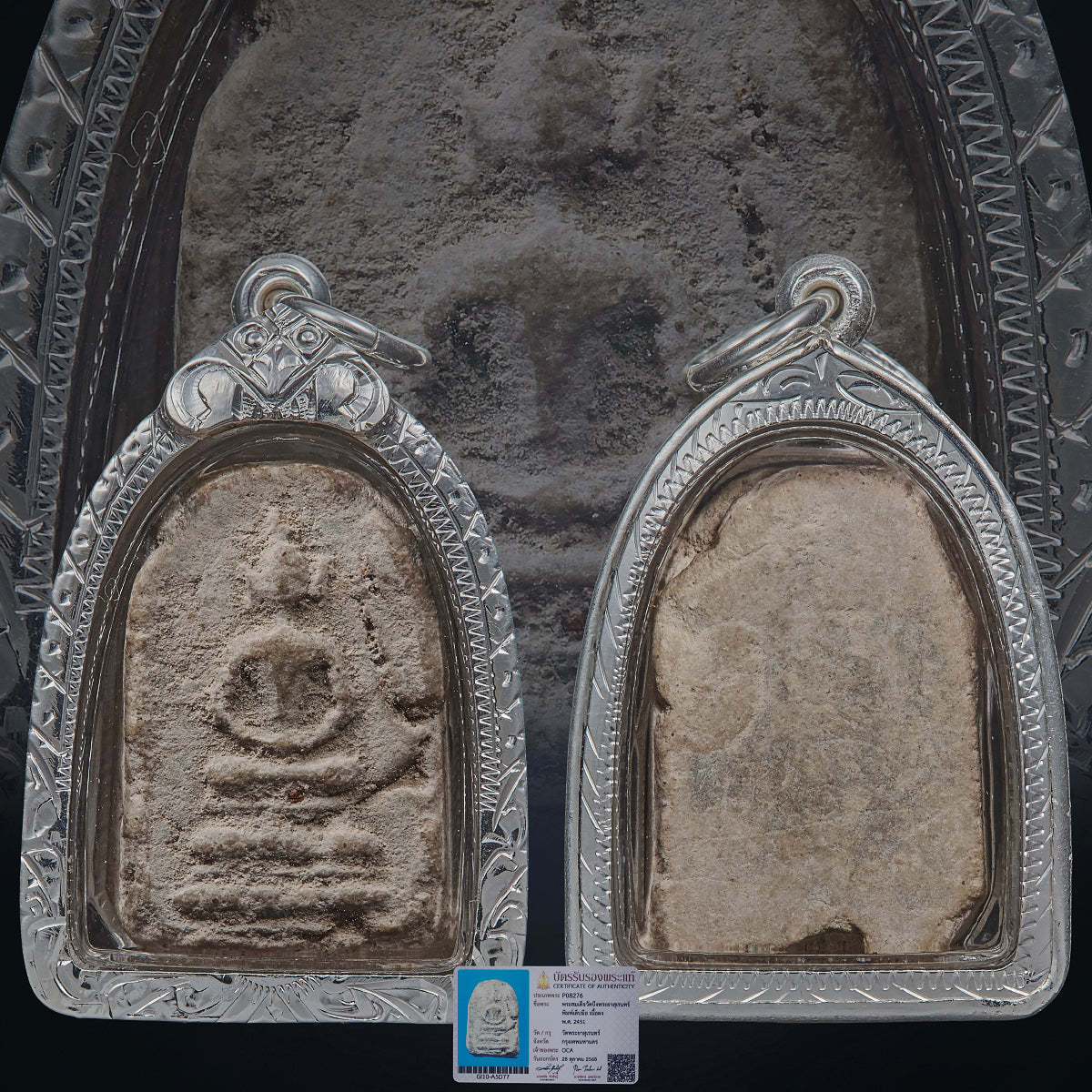
This particular example presents a light aged grey-beige surface with substantial old Kru deposits, especially across the front.
The raised Buddha image remains visible beneath the naturally accumulated surface material, giving the piece a distinctly archaeological character.
Kru Surface & Natural Ageing
One of the most noticeable characteristics of this example is its extensive aged surface.
Fine powder deposits remain across the Buddha, arch and base, while darker areas are visible within recesses of the mould.
Such surface development can occur through prolonged storage within an enclosed Kru environment, where humidity and contact with surrounding materials gradually affect the exposed powder.
The reverse is considerably simpler and remains plain, displaying the natural density and uneven ageing of the original material.
For old powder amulets, these surface characteristics should be studied as part of the entire object rather than viewed independently from the mould and material.
Sacred Inscriptions
Some Bueng Phraya Suren amulets may include sacred inscriptions or Yant on the reverse.
A traditional Kata associated with certain examples is:
Ti Ti U Ni
Other pieces may feature Unalome or additional sacred markings.
However, plain-backed examples are also widely recognised within the tradition.
This particular example has a plain reverse, consistent with early production styles where simplicity was common.
Traditional Blessings & Qualities
The Bueng Phraya Suren Somdej tradition is associated with a particularly broad range of blessings.
Kong Krapan — strength and resilience against harmful circumstances.
Klaew Klaad — avoidance of accidents and danger.
Khum Khrong — general protection surrounding the wearer.
Metta Maha Niyom — goodwill, acceptance and favourable treatment from others.
Maha Saneh — personal attraction, charm and ease of communication.
Maha Lap & Choke Lap — fortune, beneficial opportunities and favourable circumstances.
The wartime reputation remains the most famous aspect of the Kru, but devotees have traditionally carried these pieces just as much for ordinary work, livelihood and human relationships.
Modern Application
Today, the Pim Leb Mue remains particularly suitable for those wanting a compact old Buddhist amulet covering several areas of daily life.
Its Klaew Klaad and Khum Khrong traditions make it suitable for frequent travel or demanding working environments.
For business people and professionals, Metta Maha Niyom and Maha Lap complement situations involving customers, negotiation and the support of others.
The quiet appearance of the amulet also appeals to collectors who favour old sacred powder pieces whose importance lies in their history and lineage rather than elaborate decoration.
Physical Details
This example displays the traditional Pim Leb Mue / Pim Sum Kor form, with the seated Buddha contained within a narrow rounded arch.
The front retains extensive pale Kru deposits and natural age-related surface material. Beneath this layer, the simple Buddha image and tiered lower base remain clearly identifiable.
The original powder has aged into a light grey-beige appearance with darker areas naturally present around recessed portions of the mould.
The reverse is plain and relatively smooth, showing variations in powder density and surface tone accumulated through age.
The amulet is now preserved within a custom silver casing, protecting the fragile old powder body while allowing both front and reverse to remain visible.
Recommended Pairing
The Pim Leb Mue is balanced enough to serve independently as a principal daily Buddhist amulet.
For greater emphasis on Baramee and authority, it pairs naturally with the Roop Lor of a respected monk.
Those focusing on livelihood may combine it with Nang Kwak, Choke Lap or wealth-oriented pieces, allowing the Somdej's protective and Metta traditions to provide the foundation.
For collectors interested particularly in older protective lineages, it also pairs well with traditional Klaew Klaad and Kong Krapan pieces.
Its compact size makes it especially easy to integrate within a multiple-amulet arrangement.
Personal Notes
What makes this particular Phra Somdej attractive is its unmistakably old character.
The Buddha image is simple and heavily matured, with much of the front still carrying accumulated Kru deposits. There is no attempt at refinement or decorative complexity. Instead, the appearance reflects the long storage history of an old handmade powder amulet.
Behind that simplicity is a much deeper tradition involving Chao Phraya Suren Ratchasena, LP Thong Ayana, an old Bangkok temple and two important cache discoveries.
The wartime stories gave Kru Bueng Phraya Suren its celebrated protective reputation, while later generations continued carrying the amulets for Metta, fortune and everyday protection.
For collectors who appreciate old Kru powder, natural ageing and historically significant Bangkok Somdej traditions, the Pim Leb Mue remains a particularly interesting and approachable mould.
-
Free Shipping for Singapore| $15 Worldwide | $60 USA For Items Below $350