
OOBThaiAmulets
Wat Mahathat, Nakhon Si Thammarat - Hua Namo
Wat Mahathat, Nakhon Si Thammarat - Hua Namo
Couldn't load pickup availability
MS6
Hua Namo – Wat Mahathat, Nakhon Si Thammarat
B.E. 2547 Blessing Lineage
Personal Notes
Hua Namo is one of the few Southern Thai sacred objects whose reputation extends well beyond ordinary collectors. For generations, it has been carried not only by everyday devotees, but also by members of royalty, senior government officials, military officers and prominent business figures who value its long-standing association with protection, auspiciousness and opportunity.
Early Hua Namo from respected lineages have become highly sought after by collectors, with desirable older examples often commanding prices of S$5,000–6,000 or more. This B.E. 2547 lineage offers collectors the opportunity to own a piece blessed during one of the most respected consecration periods of the 2540s, with the participation of Ajarn Khun Pan, Ajarn Ko Pong and Luang Nui, together with an extensive monastic blessing tradition.
Another feature that makes this piece especially practical is its size. Measuring approximately 0.8 cm, it can be attached almost anywhere without being intrusive. Many owners wear it as a discreet pendant, while others attach it to a necklace as a side charm, a keychain, a handbag, a wallet or even place it inside a car or on an office desk.
Its compact form allows the blessings to accompany you throughout the day without requiring a dedicated amulet case, making it an exceptionally versatile sacred object for both collectors and everyday wearers.
For such a small piece, Hua Namo carries an extraordinary history—one that has been treasured in Southern Thailand for centuries and continues to be sought by those hoping for protection, favourable opportunities and the quiet good fortune that seems to arrive at exactly the right moment.
Summary
After wearing this amulet, many whom collect pieces from this Wat Mahathat blessing lineage experienced an unusual combination of luck, protection and opportunities opening at precisely the right moment—a business negotiation unexpectedly turning in their favor, an influential person deciding to help, a dangerous situation narrowly avoided, or a career opportunity appearing when advancement had previously seemed impossible.
For someone chasing a pay raise, promotion, important contract or breakthrough in business, Hua Namo is especially attractive because its traditional reputation is not limited to one specific blessing. In Nakhon Si Thammarat belief, Hua Namo has long been regarded as an almost ครอบจักรวาล — “all-encompassing” sacred object, associated with Metta Maha Niyom, good fortune and Klaew Klaad protection.
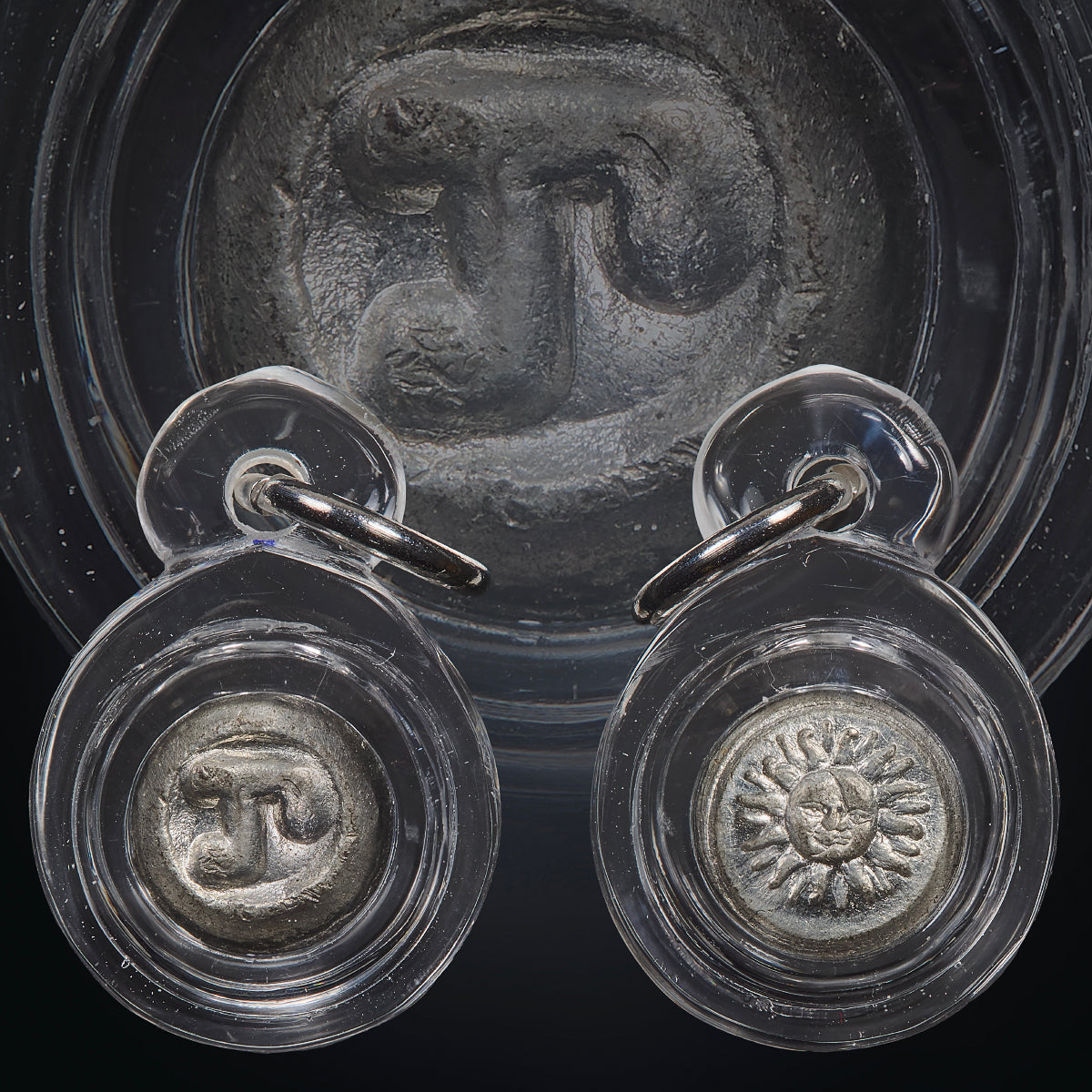
This particular piece is an individual Hua Namo amulet, encased separately for wearing. The front carries the unmistakable sacred “Na” glyph, while the reverse features a striking Sun God image, surrounded by radiating solar rays.
The Sun God reverse gives the amulet an additional layer of symbolism associated with illumination, success, authority, vitality and overcoming darkness or obstruction. Combined with Hua Namo's traditional protective and auspicious qualities, the design makes this version especially appealing for those seeking progress in career, business and personal fortune.
The B.E. 2547 Wat Mahathat lineage is described as having undergone an extensive consecration involving Ajarn Khun Pan, Luang Nui and Ajarn Ko Pong, together with more than 108 monks participating in chanting during the Buddhist Lent period.
Historical Background
Hua Namo is much older than the modern Thai amulet market.
Its history is intimately connected with Nakhon Si Thammarat, where Hua Namo has been known for centuries. Historical traditions describe the original Hua Namo as small sacred metal objects associated with the ancient Tambralinga / Nakhon Si Thammarat region and bearing a character derived from ancient Indian script.
According to famous local tradition, during an epidemic, King Si Thamma Sokarat had Hua Namo ritually consecrated and distributed around the city. The epidemic was believed to have subsequently subsided.
The tradition became deeply embedded in Southern Thai culture, and Hua Namo developed from an ancient sacred object into one of Nakhon Si Thammarat's best-known protective talismans.
Later traditions also relate that Hua Namo was again consecrated during periods of epidemic and danger.
It should therefore be understood as much more than a modern amulet design.
It represents a Southern Thai sacred tradition extending back many centuries.
Origins of the Materials
Traditional Hua Namo were small metal objects often produced from mixed sacred metals or bronze-like alloys.
Their defining feature was not an elaborate Buddha image, but the sacred Na character impressed or formed upon the metal.
The B.E. 2547 Wat Mahathat series also included Hua Namo produced in silver and other wearable forms.
The importance of the metal is inseparable from the sacred Na symbol.
Rather than being treated merely as decoration, the character is regarded within Southern Thai wicha as a concentrated sacred syllable carrying mantra, blessing and protective intention.
This is why such a small object can possess such a large spiritual reputation.
In this version, the reverse carries a Sun God motif, adding solar symbolism to the traditional Hua Namo form.
The sun has long represented light overcoming darkness, authority, energy, clarity and the power to make hidden things visible. For collectors seeking career recognition or business success, that symbolism is particularly attractive.
Ritual
The B.E. 2547 Wat Mahathat lineage is especially interesting because its blessing tradition describes a prolonged consecration rather than a short ceremonial blessing.
According to lineage information associated with the series, Ajarn Khun Pan, Luang Nui and Ajarn Ko Pongparticipated in the consecration.
The ritual reportedly continued through the Buddhist Lent period, with more than 108 monks participating in chanting and a cycle involving 108 sacred kathas.
The intention was to combine numerous dimensions of blessing rather than creating an object with only one narrow purpose:
Protection.
Luck.
Metta.
Baramee.
Authority.
Opportunity.
Wealth.
In this sense, Hua Namo can be understood almost as a compressed yantra—a small sacred object carrying a broad range of intentions.
The Sun God reverse adds another symbolic layer: the wish that the wearer's path becomes bright, visible and difficult to suppress.
Blessings and Effects
The traditional reputation of Hua Namo is unusually broad.
It is commonly associated with protection from danger, Klaew Klaad, Metta Maha Niyom, good fortune, prosperity and general auspiciousness.
The B.E. 2547 lineage further emphasizes protection, wealth generation and enhancement of luck.
For the modern wearer, these blessings translate especially well into three areas.
Money and opportunity: wear it when seeking the chance that could meaningfully improve your finances—the unexpected customer, successful negotiation, new job, commission, contract or promotion.
People and authority: its Metta and Baramee qualities are traditionally sought when dealing with employers, influential people, customers or decision-makers whose support can determine an outcome.
Protection: Hua Namo retains its ancient association with avoiding danger and passing safely through periods of uncertainty.
The Sun God reverse adds a particularly strong symbolic connection with recognition and advancement.
If someone has worked hard but continually remains unseen, the solar imagery represents the opposite condition: becoming visible, noticed and impossible to overlook.
For someone pursuing a promotion or salary increase, that is an especially compelling meaning.
Modern Application
Imagine being overlooked for promotion year after year.
Your work is good, but somehow the right person never notices it.
You begin wearing Hua Namo before an important period at work.
Soon afterward, a senior manager unexpectedly notices a project you completed. You are invited into a meeting you normally would not attend. That meeting leads to greater responsibility, and several months later the responsibility becomes a promotion and meaningful salary increase.
That is exactly the type of experience collectors seek from Hua Namo: circumstances beginning to align so naturally that the eventual result almost feels impossible in hindsight.
The Sun God reverse strengthens that modern interpretation beautifully.
It represents having your efforts brought out of the shadows and into the light.
For business owners, the same principle can apply when pitching a major client, opening a shop, negotiating a contract or asking an influential person for assistance.
The desired effect is not simply money appearing from nowhere.
It is:
being noticed by the right person,
being given the right opportunity,
and receiving the right answer at the right moment.
For someone interested in windfall or lottery luck, Hua Namo can also be worn as a broad luck enhancer.
Sometimes the greatest windfall is not a lottery ticket.
It is one customer, one introduction or one telephone call that changes your income for years.
Physical Details
This example is an individual Hua Namo amulet, not a necklace.
The front displays the characteristic sacred Na symbol in raised relief. The surface has an aged metallic appearance that gives the piece a strong traditional character.
The reverse features a distinctive Sun God image.
At the center is a stylized human face surrounded by radiating rays, producing a clear solar motif. The design resembles a radiant sun disk, making the reverse visually very different from many conventional Hua Namo issues.
This Sun God motif may be appreciated symbolically as representing:
illumination, vitality, authority, recognition, success and the triumph of light over darkness.
For career use, this is particularly meaningful—the wearer seeks not only opportunity, but also visibility and acknowledgement.
For business, it can symbolize having one's name, products or services brought into greater prominence.
The amulet is housed inside a clear oval protective casing with a metal suspension ring, allowing it to be worn while protecting the metal surface.
The photographed example shows both sides clearly: the sacred Hua Namo Na on the front and the Sun God on the reverse.
Recommended Pairing
Hua Namo already possesses broad traditional blessings, so it does not necessarily require another amulet. Pairing becomes useful when the wearer has one very specific objective.
For promotion, salary increase and authority, pair Hua Namo with a strong Maha Amnaj or Baramee amulet. The Hua Namo and Sun God symbolism support opportunity and recognition, while Maha Amnaj strengthens personal authority and influence.
For business and sales, pair it with Nang Kwak or Metta Maha Niyom. The aim is to attract customers while making the wearer or business more noticeable and appealing.
For lottery or unexpected money, combine it with a dedicated Chok Lap or Lap Loi amulet. Hua Namo provides broad luck and auspiciousness, while the companion piece concentrates specifically on windfall fortune.
For protection, pairing it with Takrut Kasatorn creates a strong conceptual combination: Hua Namo brings luck, opportunity and favorable people, while Kasatorn is intended to push danger and obstruction away.
For career use, the symbolism is especially powerful:
Hua Namo opens the opportunity.
The Sun God brings you into the light.
Maha Amnaj makes people recognize your authority.
Personal Notes
What makes this particular Hua Namo especially attractive is the combination of two very different ideas.
The Hua Namo represents an old Southern Thai tradition of protection, luck and favorable circumstances.
The Sun God represents light, recognition and forward movement.
Together, they create a very natural amulet for someone who feels that success has been close—but continually hidden behind bad timing, lack of recognition or other people receiving the opportunity first.
After wearing this amulet, the kind of experience collectors hope for is not simply finding money on the street.
It is something potentially much more valuable.
Your manager suddenly remembers your name when a senior position becomes available.
A customer who ignored your proposal for months unexpectedly calls back.
Someone influential introduces you to a person you could never have reached on your own.
A business opportunity that appeared finished suddenly returns.
Or after years of doing good work unnoticed, the right person finally sees what you are capable of—and your salary, position and future change with it.
That is where the symbolism of the Sun God becomes especially fitting:
what was hidden is illuminated.
What was overlooked becomes visible.
What appeared blocked begins moving again.
And when one unexpected opportunity changes your financial life, it can feel just shy of a miracle.
-
Free Shipping for Singapore| $15 Worldwide | $60 USA For Items Below $350