
OOBThaiAmulets
Wat Mahathat - Hua Namo
Wat Mahathat - Hua Namo
Temple-sourced certified artifacts since 2005. Questions before you buy? WhatsApp us at +65 9155 7000.
Couldn't load pickup availability
Hua Namo B.E. 2547 (2004) batch
- Master / Lineage: Wat Mahathat Blessing Lineage (blessing attended by Ajarn Khun Pan, Luang Nui and Ajarn Ko Pong)
- Temple: Wat Mahathat Woramahawihan, Nakhon Si Thammarat
- Year: B.E. 2547 (2004)
- Materials: Brass
- Size: Approx. 0.8 cm
- Casing: No casing – original from the temple, meant to be worn as is (comes with jump ring)
Personal Notes
Hua Namo is one of the few Southern Thai sacred objects whose reputation reaches far beyond ordinary collectors. For generations it has been carried by everyday devotees, and also by members of royalty, senior government officials, military officers and prominent business figures who value its long association with protection, good fortune and opportunity.
Early Hua Namo from respected lineages have become highly sought after by collectors, with desirable older examples often commanding prices of S$5,000–6,000 or more. This B.E. 2547 (2004) piece gives collectors the chance to own a Hua Namo blessed in one of the most respected consecration periods of the 2540s, with Ajarn Khun Pan, Ajarn Ko Pong and Luang Nui taking part alongside an extensive monastic blessing tradition.
Measuring approximately 0.8 cm and made to be worn just as it came from the temple, it can go almost anywhere without being intrusive. Many owners wear it as a discreet pendant. Others attach it to a necklace as a side charm, or to a keychain, handbag or wallet, or keep it in the car or on an office desk.
Having visited Wat Mahathat in Nakhon Si Thammarat myself, what impressed me most was the atmosphere of the temple: a distinct sense of calm, dignity and spiritual presence that Thai collectors simply call Baramee. Today it is a UNESCO World Heritage Site and one of Southern Thailand's foremost religious centres, and standing within its grounds, you begin to understand why the Hua Namo tradition has lasted so long.
Summary
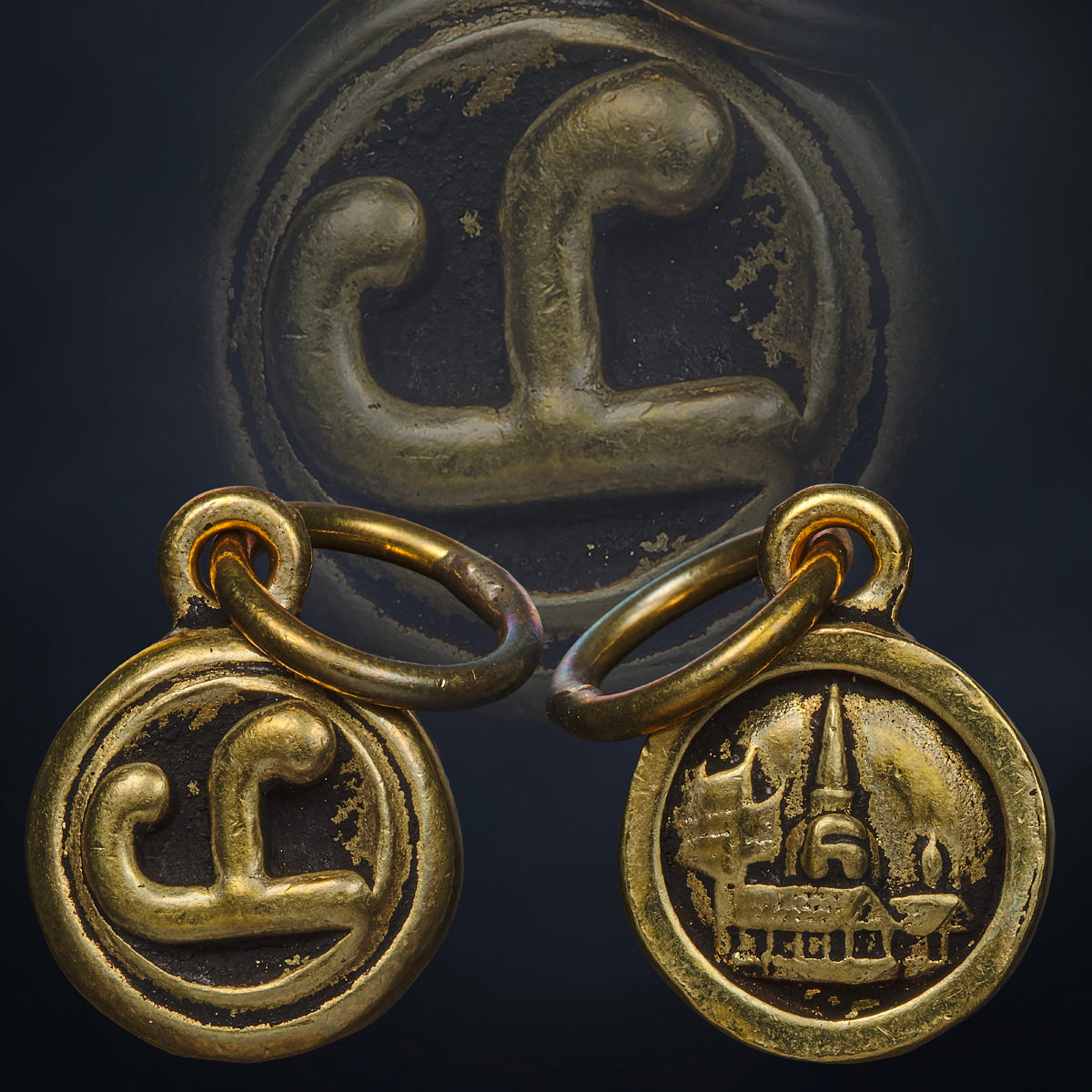
This B.E. 2547 (2004) Hua Namo from Wat Mahathat, Nakhon Si Thammarat is an individual Hua Namo amulet. The front carries the unmistakable sacred "Na" glyph in raised relief, and the reverse depicts Wat Mahathat temple and its great chedi, linking the piece visually with the spiritual heart of Nakhon Si Thammarat.
In Nakhon Si Thammarat belief, Hua Namo has long been regarded as an almost "all-encompassing" sacred object, associated with:
- Metta Maha Niyom and favourable treatment
- Chok Lap and good fortune
- Klaew Klaad and avoidance of danger
- Protection
- Prosperity and opportunity
- Baramee and personal standing
This piece comes from the B.E. 2547 (2004) Wat Mahathat lineage. It received an extensive consecration involving Ajarn Khun Pan, Luang Nui and Ajarn Ko Pong, with more than 108 monks chanting during the Buddhist Lent period.
Struck in brass with a warm golden tone, the piece comes with its own hanging loop and jump ring.
Historical Background
Hua Namo is much older than the modern Thai amulet market. Its history is closely connected with Nakhon Si Thammarat, where it has been known for centuries. Historical traditions describe the original Hua Namo as small sacred metal objects from the ancient Tambralinga / Nakhon Si Thammarat region, bearing a character derived from Pallava, an ancient Indian script.
According to a famous local tradition, during an epidemic King Si Thamma Sokarat had Hua Namo ritually consecrated according to Brahmanical rites and scattered around the city, and the epidemic was believed to have subsided. Local accounts also relate that when cholera broke out again during the reign of King Rama IV, Hua Namo were once more consecrated and scattered according to the old tradition.
Hua Namo is therefore much more than a modern amulet design. It represents a Southern Thai protective tradition reaching back many centuries, and it is still consecrated at Wat Mahathat in ceremony after ceremony today.
Origins of the Materials
Traditional Hua Namo were small metal objects, often made from mixed sacred metals or bronze-like alloys. Their defining feature is not an elaborate Buddha image but the sacred Na character formed on the metal.
In Southern Thai wicha, the Na is not decoration. It is a concentrated sacred syllable, a compact representation of mantra and blessing. That is why such a small object carries such a large reputation.
Ritual
The B.E. 2547 (2004) Wat Mahathat lineage is especially notable because it was consecrated over a long period rather than in a single short ceremony. Ajarn Khun Pan, Luang Nui and Ajarn Ko Pong took part in the blessing, and it is the presence of Ajarn Khun Pan in this ceremony that makes these pieces so efficacious. The chanting continued throughout the Buddhist Lent period, with more than 108 monks taking part in daily and nightly chanting and a cycle of 108 sacred kathas.
The intention was to bring together many blessings in one object: protection, luck, Metta, Baramee, authority, opportunity and wealth. This makes Hua Namo something like a compressed yantra: a very small sacred object that carries a remarkably broad range of traditional blessings.
Blessings and Effects
Nakhon Si Thammarat tradition associates Hua Namo with protection against danger and illness, Metta Maha Niyom, good fortune and Klaew Klaad, along with wealth and enhanced luck.
- Money and opportunity: for the chance that changes your financial position, such as a new customer, a successful negotiation, a new job, a commission, a contract or a promotion.
- People and authority: its Metta helps decision-makers, customers, employers and influential people view you favourably.
- Protection: its ancient reputation is deeply connected with avoiding danger and coming safely through uncertain times.
It is a true multi-purpose sacred object, ideal for anyone who would rather not wear five different amulets for five different purposes.
Modern Application
Imagine being overlooked for promotion year after year. Your work is good, but the right person never seems to notice. You begin wearing Hua Namo before an important period at work. Soon afterwards, a senior manager notices a project you completed and invites you into a meeting you would not normally attend. That meeting leads to greater responsibility, and a few months later to a promotion and a meaningful increase in salary.
The same applies in business: before pitching a major client, opening a new shop, negotiating a contract or asking someone influential for help. The aim is not money appearing from nowhere. It is being in the right place, meeting the right person and receiving the right opportunity at exactly the right moment. Its association with Chok Lap also makes it a good general luck enhancer.
Recommended Pairing
Hua Namo is broad enough in its blessings to be worn on its own. Pairing helps when you have one very specific goal:
- Promotion, salary increase and authority: pair with a Maha Amnaj or Baramee piece.
- Business and sales: pair with Nang Kwak or a strong Metta Maha Niyom piece.
- Lottery and unexpected money: pair with a dedicated Chok Lap / Lap Loi amulet.
- Protection: pair with Takrut Kasatorn. Hua Namo brings opportunity, luck and Metta, while Kasatorn pushes away obstacles and danger.
In simple terms: Hua Namo helps the right things find you, and helps the wrong things pass you by.
-
SG: Free | Worldwide except USA: $20 Registered | USA: $25 Registered / $100 Courier (SGD)