
OOBThaiAmulets
Wat Mahathat - Hua Namo
Wat Mahathat - Hua Namo
Couldn't load pickup availability
MS6
Hua Namo
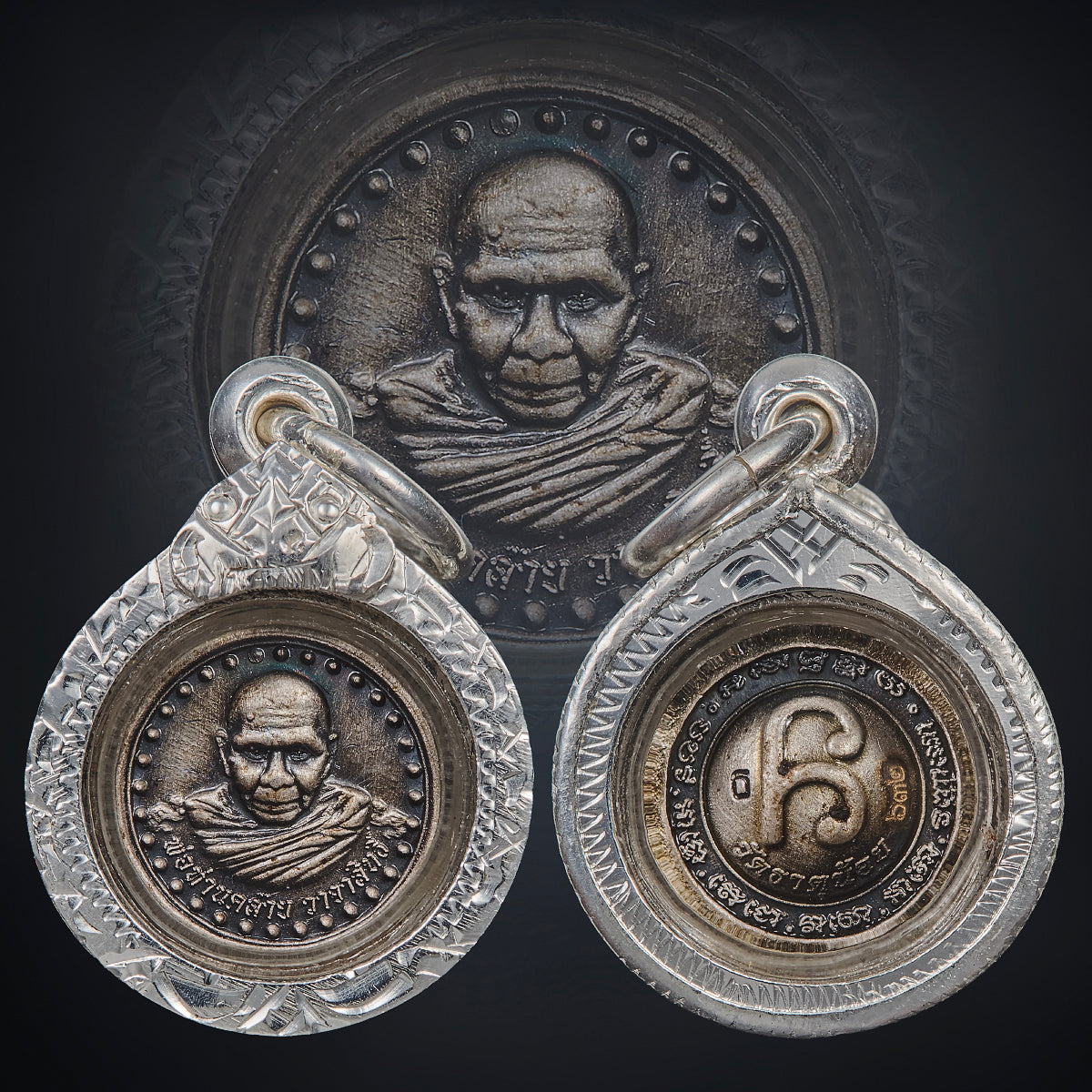
Wat Mahathat, Nakhon Si Thammarat • B.E. 2547 • Por Tan Klai Portrait / Sacred Namo
Personal Experiences
Among Southern Thai collectors, Hua Namo has a reputation that extends far beyond the usual descriptions of Metta or good fortune. It is one of those sacred objects that appears repeatedly around the necks of ordinary working people, particularly business owners throughout Nakhon Si Thammarat and the surrounding southern provinces.
One observation that has remained with me from visiting the South is just how common this amulet is. Walk into almost any long-established family shop and ask to see the owner's amulets, and there is a good chance that a Hua Namo will be among them. Shopkeepers, traders and market vendors often wear one daily, not necessarily because they expect sudden wealth, but because it has become a trusted companion believed to bring protection, goodwill and steady prosperity throughout their working lives.
Many reported experiences naturally centre upon safety. Southern Thailand has experienced periods of political unrest over the years, and collectors have long shared accounts of narrowly avoiding danger. Some describe unexpectedly changing their travel route, leaving an area moments before an incident occurred, or deciding to postpone a journey for reasons they could not explain, only to later discover that trouble had arisen where they would otherwise have been. Whether viewed as faith, coincidence or divine protection, such stories have become deeply woven into the modern reputation of Hua Namo.
Others speak of quieter but equally meaningful experiences. A business that had been slow begins attracting regular customers again. Long-time clients return unexpectedly. Negotiations become smoother, and people who were previously indifferent become noticeably more receptive. Rather than dramatic overnight changes, many collectors describe a gradual sense that life begins to flow with fewer unnecessary obstacles.
These accounts remain personal experiences rather than guarantees. Nevertheless, the consistency with which similar stories are shared over many years has helped establish Hua Namo as one of Southern Thailand's most respected all-purpose sacred objects.
Personal Notes
Having had the opportunity to visit Wat Mahathat in Nakhon Si Thammarat myself, one aspect that impressed me was the atmosphere of the temple. It is difficult to describe in words, but there is a distinct sense of calm, dignity and accumulated spiritual presence that can only really be appreciated in person. Today recognised as a UNESCO World Heritage Site, Wat Mahathat has served as one of Southern Thailand's foremost religious centres for centuries, and standing within its grounds, one begins to understand why the Hua Namo tradition has remained so enduring.
For me, the feeling there is what Thai collectors often describe simply as Baramee—not an overwhelming or dramatic sensation, but a quiet spiritual authority that seems to permeate the temple. It is unlike many places I have visited, and it left a lasting impression.
Perhaps this is one reason why Hua Namo continues to be recreated and consecrated at Wat Mahathat in ceremony after ceremony. The wiccha has never faded from local practice. Each new generation preserves it, ensuring that one of Southern Thailand's oldest sacred traditions remains very much alive.
What makes this B.E. 2547 Por Tan Klai Hua Namo particularly appealing is the way its two sides tell different parts of the same Southern Thai story. The front honours one of the region's most respected monks, while the reverse preserves a sacred symbol whose history reaches back many centuries.
Together they create far more than a commemorative medal. They unite a revered master's lineage with one of Thailand's oldest continuously practised protective traditions—a combination that explains why Hua Namo remains one of the most widely recognised and respected sacred objects in Southern Thailand today.
Summary
This B.E. 2547 Hua Namo from Wat Mahathat, Nakhon Si Thammarat brings together two deeply respected elements of Southern Thai sacred tradition: the image of Por Tan Klai and the ancient Hua Namo symbol.
The front bears the portrait of Por Tan Klai, one of the most revered monks associated with Southern Thailand. The reverse carries the sacred Namo, or Na, symbol surrounded by inscriptions.
The Hua Namo tradition itself reaches much further back than the modern Thai amulet market. Within Nakhon Si Thammarat belief, the symbol has long been associated with a broad range of auspicious qualities, particularly:
- Metta Maha Niyom and favourable treatment
- Chok Lap and good fortune
- Klaew Klaad and avoidance of danger
- protection
- prosperity and opportunity
- Baramee and personal standing
The B.E. 2547 Wat Mahathat lineage is traditionally described as having received an extensive consecration involving Ajarn Khun Pan, Luang Nui and Ajarn Ko Pong, together with more than 108 monks participating in chanting during the Buddhist Lent period.
For collectors, the appeal is therefore twofold. The portrait of Por Tan Klai represents the virtue and spiritual standing of a revered Southern master, while the Namo on the reverse preserves one of Nakhon Si Thammarat's most enduring sacred symbols.
Historical Background
Hua Namo is much older than the familiar portrait medals and commercial amulets of modern Thailand.
Its history is intimately connected with Nakhon Si Thammarat, an important religious and cultural centre of Southern Thailand whose earlier history is associated with the ancient Tambralinga region.
Traditional Hua Namo were small metal objects bearing a distinctive sacred character. The symbol is commonly connected with an ancient script tradition derived from Pallava, which reached Southeast Asia from Southern India many centuries ago.
Over time, the character acquired a sacred identity extending beyond ordinary writing.
Within local tradition, it became associated particularly with protection and auspiciousness.
One of the best-known stories concerns King Si Thamma Sokarat. According to Nakhon Si Thammarat tradition, during a serious epidemic the king ordered Hua Namo to be ritually prepared according to Brahmanical rites and distributed or scattered around the city.
The epidemic was subsequently believed to have subsided.
The story should be understood as local sacred history rather than modern medical evidence, but it demonstrates how deeply the Hua Namo became connected with ideas of protection during periods of uncertainty.
Later accounts relate that Hua Namo were again prepared when cholera affected the region during the reign of King Rama IV.
Whether approached historically, spiritually or as a collector, Hua Namo therefore represents something considerably older than a single modern amulet issue.
It belongs to a long Southern Thai tradition of sacred protection.
Por Tan Klai and the Southern Tradition
The portrait on the front adds another important dimension to this example.
Por Tan Klai is remembered as one of Southern Thailand's highly revered monks, particularly respected for his spiritual discipline, meditation and the confidence placed in his blessings by generations of devotees.
His image appears on the obverse in a traditional portrait-medal format.
For collectors, the pairing is particularly appropriate.
Por Tan Klai represents the living monastic tradition of the South, while Hua Namo represents an older sacred tradition deeply embedded within the history of Nakhon Si Thammarat.
One side honours the master.
The other preserves the symbol.
Together they give the amulet a distinctly Southern Thai identity.
Origins of the Materials
Traditional Hua Namo were produced from metal, often described in historical and collector traditions as mixed-metal or bronze-like alloys.
The defining feature was never elaborate sculptural decoration. Instead, importance rested upon the Namo character impressed into the metal and subsequently consecrated.
Later Hua Namo issues naturally developed into many different forms.
They may appear as individual pieces, components of necklaces, commemorative medals or sacred symbols incorporated into larger amulets.
This B.E. 2547 example follows the commemorative medal tradition.
Its physical construction allows two distinct sacred identities to occupy the same object:
- Por Tan Klai on the front
- Hua Namo on the reverse
The metal acts as the permanent carrier for both.
Within traditional understanding, however, the physical alloy alone does not make an object sacred. Its importance develops through the relationship between material, sacred design, lineage and consecration.
The Meaning of Namo
The Namo on the reverse should not be treated simply as a decorative emblem.
Within Southern Thai tradition, the character functions almost as a condensed sacred formula.
A complicated yantra may contain many characters, diagrams and inscriptions. Hua Namo reduces this idea to something much more immediate: a single recognisable sacred form carrying generations of ritual association.
Its simplicity is part of its character.
Collectors traditionally associate Namo with several complementary qualities:
- protection
- Metta
- auspiciousness
- Klaew Klaad
- Chok Lap
- prosperity
- personal Baramee
This breadth explains why Hua Namo has sometimes been described as almost ครอบจักรวาล — all-encompassing in its traditional application.
It is not restricted to one narrow purpose.
Ritual
The B.E. 2547 Wat Mahathat lineage is particularly interesting because its traditional history describes an extended period of consecration rather than a brief blessing ceremony.
According to information associated with the Wat Mahathat Hua Namo series, the consecration involved Ajarn Khun Pan, Luang Nui and Ajarn Ko Pong, together with a large assembly of monks.
The traditional account describes:
- more than 108 monks participating
- chanting during the Buddhist Lent period
- repeated day and night recitation
- a cycle associated with 108 sacred kathas
- blessing for several complementary purposes
The significance of such a ceremony lies in repetition.
Rather than concentrating solely upon wealth, protection or Metta, the intention was to establish a broad auspicious foundation.
Protection and Klaew Klaad.
Metta and favourable relationships.
Baramee and standing.
Opportunity and prosperity.
Good fortune.
This broad character is particularly appropriate to Hua Namo, whose traditional reputation has never been confined to a single blessing.
Blessings and Effects
Protection and Klaew Klaad
Protection is perhaps the oldest quality associated with Hua Namo.
The historical traditions surrounding epidemics in Nakhon Si Thammarat placed the symbol firmly within a protective context.
Modern collectors commonly extend this association towards:
- safer travel
- avoidance of accidents
- protection during uncertain circumstances
- Klaew Klaad
- general spiritual reassurance
The emphasis is traditionally upon passing safely through danger, rather than confronting it.
Metta Maha Niyom
Metta concerns the goodwill and favourable disposition of others.
For someone whose work depends upon relationships, this can be particularly relevant.
Collectors commonly carry Hua Namo when dealing with:
- employers and senior management
- customers
- business partners
- officials
- clients
- influential people
The traditional intention is simple: that interactions proceed with greater goodwill and fewer unnecessary obstacles.
Career and Authority
The combination of Por Tan Klai's portrait and Hua Namo also makes this example particularly interesting for career use.
Someone approaching a promotion, interview or important meeting may carry the amulet with the intention of being seen favourably and judged fairly.
The desired circumstances might be quite ordinary.
A manager notices previously overlooked work.
An important person remembers your name.
You are invited into a meeting outside your normal responsibilities.
A new responsibility gives you an opportunity to demonstrate your ability.
Over time, small changes of this kind may contribute to promotion, greater authority or improved income.
Within the tradition, such developments are associated less with forcing an outcome than with creating favourable conditions around one's own effort.
Business and Prosperity
Hua Namo is also traditionally associated with commerce and prosperity.
Its Metta aspect naturally complements business because commercial success usually depends upon other people.
Suitable intentions include:
- attracting useful opportunities
- encouraging repeat customers
- improving negotiations
- meeting beneficial contacts
- securing contracts
- maintaining steady commercial activity
The emphasis is therefore not simply upon acquiring money.
It is upon creating the relationships and opportunities through which prosperity develops.
Chok Lap and Unexpected Fortune
Hua Namo is also associated with Chok Lap, or unexpected good fortune.
Collectors interpret this in many ways.
It might be an unexpected commission, a forgotten debt being repaid, a useful introduction, an unforeseen business opportunity or simply being in the right place when something beneficial occurs.
Some collectors also carry Hua Namo when seeking lottery or windfall luck.
As with all such traditions, these associations are matters of belief and personal experience rather than guaranteed outcomes.
Sometimes the most valuable form of Chok Lap is not a winning number.
It is an unexpected opportunity that continues producing benefit long after the original moment has passed.
Modern Application
Despite the antiquity of the Hua Namo tradition, its broad symbolism translates easily into contemporary life.
A professional may wear it when attending an important interview.
A business owner may carry it while negotiating a contract.
Someone beginning a new career may wear it while establishing relationships with colleagues and management.
Practical situations include:
- job interviews
- promotion reviews
- important negotiations
- opening a business
- meeting new clients
- travelling
- entering unfamiliar environments
- periods of financial uncertainty
Consider someone who has been overlooked for advancement at work.
Rather than asking simply for a promotion, the traditional intention might be:
“May the right people recognise honest effort, and may beneficial opportunities arise at the proper time.”
A senior colleague notices a successful project. That recognition leads to a new responsibility. The responsibility provides greater visibility, and eventually the greater visibility contributes to advancement.
Whether the wearer regards such events as blessing, coincidence or a combination of faith and effort remains personal.
The amulet accompanies the journey; it does not replace the work.
Physical Details
This example is an individual B.E. 2547 portrait medal, separately encased for wearing.
The front depicts Por Tan Klai in raised relief.
His portrait occupies almost the entire central field, with the folds of his monastic robes clearly modelled beneath the face. A ring of small raised beads frames the upper portrait, while Thai inscriptions identify the master and issue around the lower perimeter.
The reverse changes character completely.
At its centre is the large sacred Namo or Na symbol, boldly rendered in raised relief.
Additional Thai sacred inscriptions surround the central character, creating a circular composition in which the Namo remains the unmistakable focal point.
The two sides therefore perform different roles visually and symbolically:
Front — Por Tan Klai and the lineage of the revered master.
Reverse — Hua Namo and the ancient sacred tradition of Nakhon Si Thammarat.
The metal displays an aged dark bronze tone, with lighter areas naturally highlighting the raised portrait, inscriptions and Namo.
The photographed example is housed within a clear protective casing and fitted with a metal suspension ring for necklace wear.
Recommended Pairing
Hua Namo is traditionally regarded as a broad-purpose sacred object, so it does not necessarily require another amulet.
Pairing becomes useful when the wearer wishes to concentrate upon a particular objective.
For Career and Promotion
Pair with Maha Amnaj or Baramee.
Hua Namo contributes Metta, auspicious circumstances and general opportunity, while Maha Amnaj concentrates more specifically upon authority, recognition and leadership.
This is particularly suitable for management, government service or anyone approaching an important career transition.
For Business
Pair with Nang Kwak.
Hua Namo provides broad Metta and favourable circumstances, while Nang Kwak is traditionally associated specifically with calling customers and encouraging commerce.
The combination is therefore especially natural for shopkeepers, traders and business owners.
For Communication and Negotiation
Pair with Salika.
Hua Namo supports favourable reception, while Salika traditionally concentrates upon pleasing speech, communication and persuasion.
This combination suits salespeople, agents, consultants and anyone whose income depends heavily upon conversation.
For Chok Lap
A dedicated Chok Lap or Lap Loi piece may be added when unexpected fortune is the principal objective.
Hua Namo provides the broad auspicious foundation, while the companion amulet gives greater emphasis to windfall and unexpected opportunity.
For Protection
Pairing with a protective Takrut Kasatorn creates a more defensive combination.
Hua Namo traditionally supports Klaew Klaad and favourable circumstances, while the Takrut provides a more concentrated protective element according to its lineage.
Personal Experiences
Collectors often describe Hua Namo through ordinary events that acquire greater significance because of their timing.
The change may initially appear small.
A person who had ignored a proposal suddenly replies.
A manager begins paying attention.
An old customer returns.
A difficult negotiation becomes unexpectedly cooperative.
A journey passes safely despite circumstances that could easily have become troublesome.
Commonly described experiences centre upon:
- improved treatment from others
- renewed business opportunities
- career recognition
- unexpected introductions
- fortunate timing
- avoidance of troublesome situations
These accounts remain individual experiences rather than guarantees.
Within the collector tradition, however, this pattern of good timing, favourable people and avoided difficultycaptures much of what Hua Namo has come to represent.
Personal Notes
What makes this B.E. 2547 Por Tan Klai Hua Namo particularly appealing is the way its two sides tell different parts of the same Southern Thai story.
The front belongs to the world of the revered monk.
Por Tan Klai represents discipline, spiritual accomplishment and the continuing respect given to the great masters of Southern Thailand.
Turn the amulet over and the imagery reaches much further into the past.
The Namo belongs to an older tradition of Nakhon Si Thammarat—one associated for generations with protection, auspiciousness and the hope that misfortune may pass without touching the bearer.
Neither side feels secondary.
One represents the master.
The other represents the sacred symbol.
Together, they create an amulet with an unusually strong regional identity and a broad traditional purpose.
For the collector, this is what gives the piece its character. It is not simply a portrait medal bearing a sacred mark on the reverse; it is a meeting point between Southern Thailand's monastic lineage and one of Nakhon Si Thammarat's most enduring protective traditions.
Its traditional purpose may be summarised simply:
to encourage protection, goodwill, favourable opportunity and steady auspiciousness through the combined remembrance of a revered master and the ancient Hua Namo tradition.
-
Free Shipping for Singapore| $15 Worldwide | $60 USA For Items Below $350