
OOBThaiAmulets
Wat Kamphaeng
Wat Kamphaeng
Couldn't load pickup availability
MS04
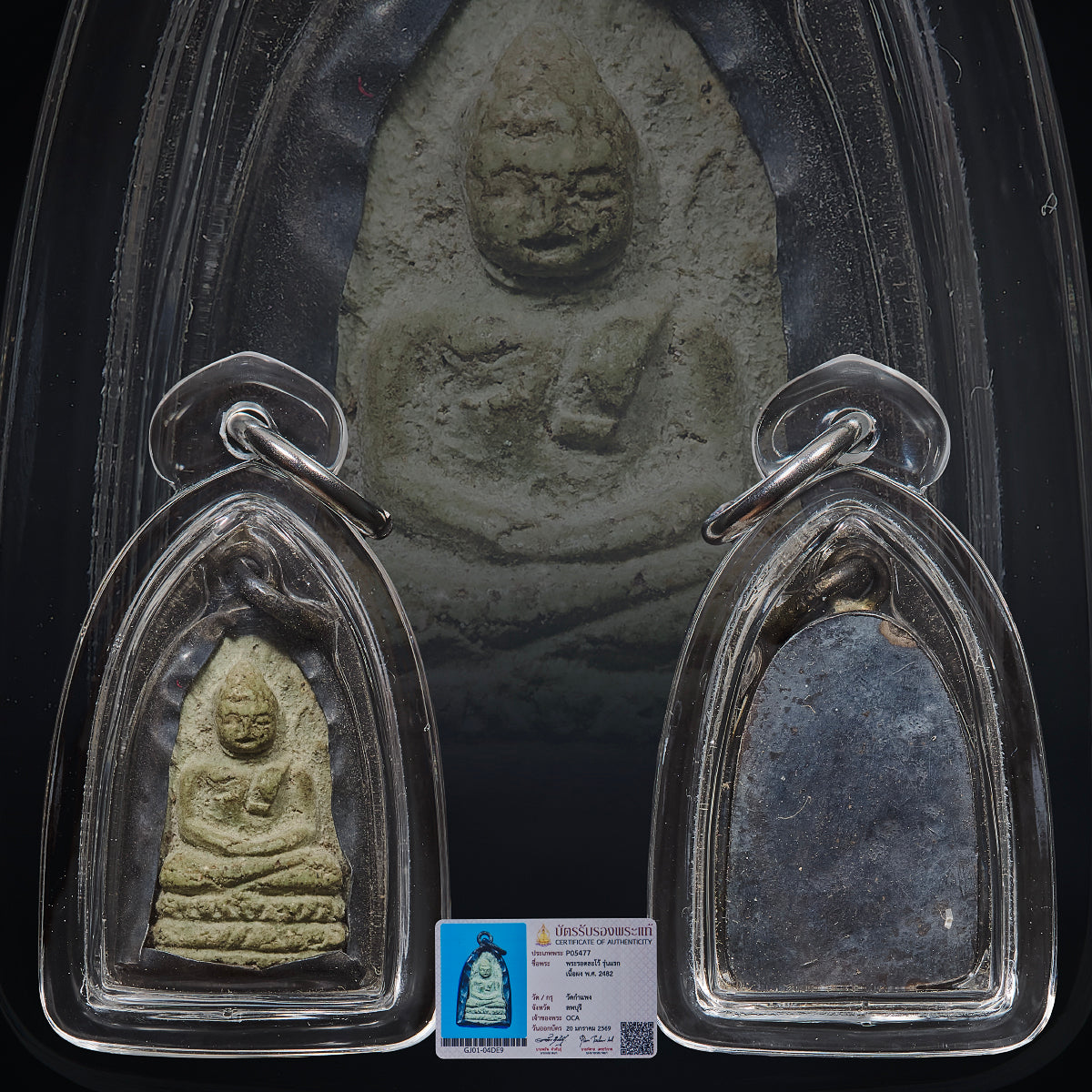
Phra Rod
Wat Kamphaeng • Lopburi Province • B.E. 2482 (1939)
Samakom card
Each powder amulet was individually pressed from traditionally prepared sacred material, resulting in natural differences in colour, texture, surface definition and form. These variations are characteristic of early handmade powder amulets and make every surviving example individually distinct.
Personal Experiences Shared by Luksits
Among older collectors, the B.E. 2482 Wat Kamphaeng amulets are highly regarded because their history connects several important masters and consecration traditions within a single creation.
The powder version holds particular interest. After undergoing the principal Wat Kamphaeng ceremony, traditional accounts record that these powder amulets were subsequently taken to Wat Nong Pho for LP Derm to bless again.
Some were distributed from Wat Nong Pho, and older devotees consequently came to know them as “Phra Phong LP Derm” — LP Derm powder amulets.
Luksits traditionally associated pieces from this lineage with Klaew Klaad, protection, Kong Krapan, Metta, Baramee and support during difficult circumstances. Their reputation developed through decades of practical wear rather than being created solely as collector pieces.
For devotees of LP Derm, the powder version is especially interesting because it combines the major Wat Kamphaeng group consecration with a further direct connection to LP Derm at Wat Nong Pho.
Summary
This is a rare first-edition Phra Rod powder amulet of Wat Kamphaeng, Lopburi, created in B.E. 2482 (1939).
The powder amulets followed the same sacred mould tradition as the better-known metal editions. They were created as part of an important temple project organised to raise funds for the completion of Wat Kamphaeng's Sala Kan Parian, or sermon and assembly hall.
The edition has significant historical connections with Wat Suthat, Somdet Phra Sangharaj Phae, Chao Khun Si Son, LP Phring of Wat Bang Pakok and LP Derm of Wat Nong Pho, together with numerous other respected monks.
The principal consecration at Wat Kamphaeng extended across three nights and two days, with five ritual sessions.
Most importantly for this powder edition, traditional temple history records that the pieces were later brought to Wat Nong Pho for an additional blessing by LP Derm.
Historical Background
The creation of this batch began with Phra Maha Phong, a monk originally from Lopburi.
He had undertaken the construction of a Sala Kan Parian at Wat Kamphaeng, but considerable funds were still required to complete the building.
After consultation with the abbot and temple community, the decision was made to create sacred objects as commemorative pieces for devotees contributing towards the project.
Phra Maha Phong subsequently searched older ritual texts for an appropriate method of production. His research led him to an important sacred-object manual preserved at Wat Sam Pluem, where he had previously spent a rains retreat.
Wat Sam Pluem held an important place within older Bangkok sacred-image traditions and was associated with knowledge surrounding the creation of Phra Kring and Phra Chaiwat.
To ensure that the project followed the proper traditional methods, Chao Khun Si Son was invited to serve as adviser and ritual supervisor.
The project proved successful, raising sufficient funds for the completion of the Sala Kan Parian at Wat Kamphaeng.
Connection with Somdet Phra Sangharaj Phae
Traditional accounts record that Phra Suthipong Muni consulted Somdet Phra Sangharaj Phae regarding both the sacred metal formula and the appropriate ritual procedures for the edition.
Somdet Phae subsequently entrusted Chao Khun Si Son of Wat Suthat with assisting and supervising the project.
Chao Khun Si Son had inherited important knowledge concerning the creation of sacred cast images within the Wat Suthat tradition.
This connection explains why the forms of the B.E. 2482 Wat Kamphaeng amulets display noticeable similarities to sacred images associated with Wat Suthat.
Although this particular example is the powder version, it belongs to the same broader sacred-object project and mould tradition.
The Great B.E. 2482 Consecration
The principal ceremony took place at Wat Kamphaeng, Lopburi.
According to the recorded tradition, consecration began on the Tuesday corresponding to 19 March B.E. 2482 (1939).
The ceremony continued through the 11th, 12th and 13th waxing-moon days of the fourth lunar month.
Altogether, the consecration extended across three nights and two days, divided into five separate ritual sessions.
Phra Suthipong Muni, himself originally from Lopburi, played an important role in organising the creation and ceremony, while Phra Athikan Thongdam, then abbot of Wat Kamphaeng, served as president of the project.
It was a major collective consecration involving a distinguished assembly of old-generation masters.
Masters of the Consecration
Wat Kamphaeng's recorded tradition names several respected monks who participated in the blessing, including:
-
Chao Khun Si Son – Wat Suthat
-
LP Phring – Wat Bang Pakok
-
Chao Khun Thammathanachan – Wat Rakang
-
Phra Khru Pamokkha Muni – Wat Pa Mok, Ang Thong
-
Chao Khun Sangkhapharawaha Muni – Wat Sao Thong Thong, Lopburi
-
LP Derm – Wat Nong Pho
-
Together with numerous other respected monks of the period
For collectors, this assembly forms one of the strongest aspects of the edition's historical appeal.
It brings together several important streams of Central Thai sacred-object knowledge within a single old temple ceremony.
Phra Rod
The Phra Rod design belongs to the sacred identity of Lopburi.
The compact seated form follows an old protective Buddhist amulet tradition, while the B.E. 2482 interpretation reflects the influence of the Wat Suthat school involved in the project's preparation.
The metal Phra Rod is traditionally recorded in several mould variations, including broad and slender forms, versions with differences in the halo, and the exceptionally scarce double-sided type.
The powder amulets followed the same general mould tradition, creating a direct relationship between the powder and metal pieces of the edition.
The Nine Sacred Powder Colours
An unusual characteristic of the powder edition is its range of colours.
Although they are sometimes simply described as being made in “many colours”, older production accounts describe nine principal colours.
Seven were associated with the traditional colours corresponding to the seven days of the week.
Two additional colours — black and white — completed the nine-colour group.
The surviving tone of each piece can vary considerably today because of age, storage, handling and the natural characteristics of the sacred powder mixture.
This example displays an aged pale green-grey tone, with darker deposits remaining naturally within recessed areas of the mould.
Additional Blessing by LP Derm
The most significant distinction of the powder edition occurred after the principal Wat Kamphaeng ceremony.
Traditional accounts state that the powder Phra Rod were taken to Wat Nong Pho, where LP Derm performed an additional consecration.
Some were subsequently distributed from Wat Nong Pho itself.
Because of this direct association, devotees of that period began referring to the pieces as:
“Phra Phong LP Derm” — LP Derm Powder Amulets.
This does not remove their original Wat Kamphaeng identity. Instead, it describes the additional stage in their ritual history.
For collectors today, this dual provenance is one of the most interesting features of the powder edition: Wat Kamphaeng creation and major group consecration, followed by further blessing within LP Derm's Wat Nong Pho lineage.
Traditional Blessings & Qualities
The Phra Rod powder amulet is traditionally associated with the broad protective qualities expected from an old multi-master consecration.
Khum Khrong — general protection surrounding the wearer.
Klaew Klaad — avoidance of accidents, danger and harmful circumstances.
Kong Krapan — resilience and protection traditionally valued by people facing hazardous environments.
Metta Maha Niyom — goodwill, acceptance and favourable treatment from others.
Baramee — confidence, personal presence and spiritual support.
Choke Lap — beneficial circumstances and unexpected opportunities.
Life Stability — traditionally carried during travel, demanding work and periods of uncertainty.
The additional LP Derm connection makes the piece particularly meaningful to collectors who appreciate his renowned protective Wicha.
Modern Application
Today, this Phra Rod is particularly suitable for collectors seeking an old Buddhist powder amulet with a strong historical lineage.
It may be worn as an everyday protective piece, particularly by those who travel frequently, work in unpredictable environments or simply prefer a balanced amulet covering protection, Metta and general support.
It also has strong appeal as a lineage piece.
Collectors of LP Derm, Wat Suthat sacred objects or old Lopburi amulets can each find an important historical connection within the same B.E. 2482 creation.
Physical Details
This example is formed from aged sacred powder in the traditional Phra Rod mould, with the seated sacred image positioned beneath a pointed arch.
The powder has matured into a muted pale green-grey colour. Age-related surface wear and small irregularities remain visible throughout, giving the piece the characteristic appearance of an early hand-pressed powder amulet.
The reverse is plain, preserving the simple functional construction typical of many early powder pieces.
It is presently housed within a clear protective casing, allowing the original surface to remain visible while protecting the fragile powder body.
Recommended Pairing
This Phra Rod can comfortably serve as a principal Buddhist amulet because its traditional qualities already cover protection, Metta and general Baramee.
For devotees of LP Derm, it pairs naturally with his Roop Lor, Rian or other Wat Nong Pho sacred objects, strengthening the historical connection between the pieces.
It may also be combined with wealth-oriented amulets when additional emphasis on livelihood is desired, or with a Roop Lor of a respected master to reinforce the teacher-disciple aspect of daily veneration.
For collectors who prefer old multi-master amulets, however, the B.E. 2482 Phra Rod is already a remarkably complete piece on its own.
Personal Notes
What makes this first-batch powder Phra Rod especially interesting is the depth of history contained within such a modest-looking object.
Its creation began with a practical purpose: to complete Wat Kamphaeng's Sala Kan Parian.
The project then brought together old ritual texts, the Wat Suthat sacred-object tradition, the guidance associated with Somdet Phra Sangharaj Phae, Chao Khun Si Son and a remarkable gathering of respected masters.
The powder pieces travelled one stage further.
They were brought to Wat Nong Pho and blessed again by LP Derm, with some subsequently distributed there and remembered locally as Phra Phong LP Derm.
For me, this is precisely the character that makes older Thai amulets so fascinating. Behind a simple powder image can be a chain of temples, masters, ceremonies and acts of merit extending back almost a century.
The B.E. 2482 first-batch Phra Rod is a fine example of that older tradition.
-
Free Shipping for Singapore| $15 Worldwide | $60 USA For Items Below $350