
OOBThaiAmulets
Por Sala Tan
Por Sala Tan
Couldn't load pickup availability
PST07
Phra Ngan
Por Sala Tan
1.5 Inches
Barang Artifact
Sacred Craftsmanship
Each artifact was individually prepared from natural relic materials. Variations in the Gaduk Chang, cemetery soil, Paneang and ritual finishing mean that differences in texture, colour and form are natural characteristics of each piece.
Personal Experiences Shared by Luksits
Among Por Sala Tan's luksits, this type of Meditating Phra Ngan was generally regarded as a wish and manifestation piece, particularly when the desired outcome depended upon another person's response.
Some carried it when meeting customers, negotiating business or attempting to open a conversation that had previously remained difficult. Rather than expecting money simply to appear, they regarded the Ngan as helping circumstances move in a direction where an opportunity could arise.
Others associated it more strongly with Seneh. They described becoming more noticeable, finding conversations easier to begin, or receiving a warmer response from people who had previously seemed distant.
The meditating posture was also important to some keepers. Instead of continually changing their wishes, they would concentrate upon one clear intention and carry the Ngan quietly, allowing the same purpose to remain fixed over time.
Summary
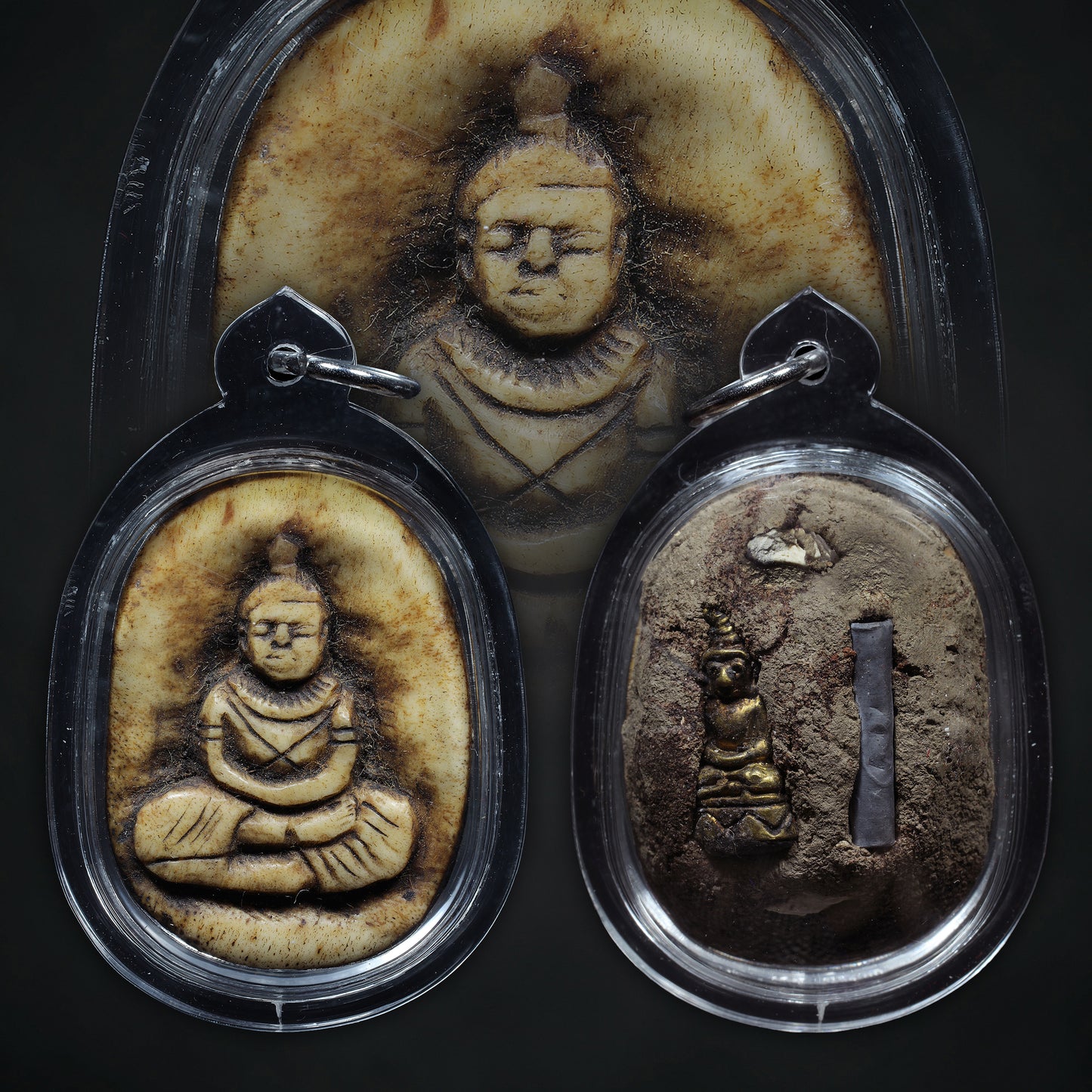
This Meditating Phra Ngan combines Gaduk Chang with seven cemetery soils, a Mae Prai Paneang relic, Takrut and additional sacred material on the reverse.
Its traditional purpose centres upon manifestation and Seneh — strengthening intention while supporting attraction, influence and favourable human response.
The combination is particularly suited to situations where success depends upon people: customers choosing to buy, someone agreeing to a proposal, assistance arriving at the appropriate moment, or a personal relationship becoming more receptive.
At 1.5 inches, it remains discreet enough to wear or carry in a pocket.
It is a small Barang piece, but its construction brings together several distinct currents within a single working.
Historical Background
Phra Ngan occupies an unusual position within Thai and neighbouring esoteric traditions.
Unlike conventional Buddhist imagery, Ngan belongs more closely to the world of folk wicha and Barang, where the sacred object is traditionally approached as an active intermediary between the keeper's intention and the circumstances surrounding that intention.
Por Sala Tan's Ngan workings frequently combined this older concept with materials carrying their own ritual histories.
In this example, the seated meditating form is significant.
The figure is not presented in an aggressive posture. It sits quietly, suggesting concentration and the fixing of intention. Within the understanding surrounding the piece, manifestation begins by establishing a clear objective rather than continually scattering one's attention between different wishes.
The Ngan therefore became associated not only with attraction, but with focused desire directed towards an outcome.
Origins of the Materials
The main body was prepared from Gaduk Chang.
Within Por Sala Tan's tradition, elephant relic material is valued for Baramee, strength, stability and its capacity to support heavier ritual workings. Its presence gives the artifact a substantial foundation rather than relying entirely upon the Prai component.
Into this were incorporated seven cemetery soils.
Each soil originated from a different cemetery environment. Bringing seven sources together was intended to create a broader ritual foundation than soil taken from a single location.
The reverse contains a small piece of Paneang from a Mae Prai relic.
This is one of the most important components of the working. The Paneang connects the piece with the Prai current and supports the Seneh, attraction and manifestation qualities traditionally associated with the Ngan.
The Takrut provides another layer, carrying Por Sala Tan's wicha alongside the physical relic materials.
Ritual
The ritual structure centres upon bringing materials of very different characters into harmony.
The Gaduk Chang provides the heavier foundation. The seven cemetery soils introduce the cemetery current, while the Mae Prai Paneang supplies the more active yin and Seneh element.
The Takrut gives direction to this combination.
Rather than allowing these materials to remain as separate relics, Por Sala Tan's working was intended to bring them together around the Meditating Ngan form, concentrating their function upon intention, attraction and manifestation.
For the keeper, elaborate daily ritual is not considered necessary.
Offerings may be made according to personal practice, but they are optional. Greater importance is traditionally placed upon maintaining a clear and consistent intention rather than repeatedly changing one's request.
Blessings and Effects
The principal blessing is manifestation — traditionally understood as helping intention find a practical route towards fulfilment.
Its second major current is Seneh, supporting attraction, personal magnetism and favourable attention.
Metta Maha Niyom is also relevant where the desired result depends upon goodwill. This may include customers, employers, business contacts, partners or people whose cooperation is necessary.
The traditional qualities of the piece therefore centre upon manifestation, Seneh, favourable human response, opportunity, persuasion and the opening of previously difficult paths.
Because Gaduk Chang forms the foundation, the working also carries an element of Baramee and stability, helping distinguish it from a purely yin attraction piece.
Modern Application
The Meditating Phra Ngan is particularly appropriate where a person's livelihood depends upon interaction with other people.
For sales, it may be carried when meeting customers or pursuing an important account. For business owners, it can be kept close during negotiations or periods when new opportunities are needed.
Those working in customer service, property, insurance, entertainment, commission-based work or other relationship-driven professions may similarly relate to its traditional function.
For personal matters, it may be carried for Seneh and relationship intentions.
Its manifestation aspect is best understood practically: fix the objective clearly, then continue doing the worldly work required to reach it.
The Ngan accompanies that intention rather than replacing action.
Physical Details
At1.5 inches in size, this is a compact Meditating Phra Ngan formed from Gaduk Chang and associated sacred materials. The front presents the seated Ngan in meditation, while the reverse contains seven-cemetery-soil material together with a small Mae Prai Paneang relic, Takrut and sacred image. The piece is enclosed within a protective casing and is sufficiently compact for discreet wear or pocket carry.
Recommended Pairing
This Phra Ngan already contains an unusual degree of balance because the Gaduk Chang contributes Baramee while the Mae Prai Paneang contributes the stronger yin and Seneh current.
It can therefore be carried independently.
For stronger business use, pairing it with a dedicated Baramee or authority amulet can reinforce confidence, respect and professional standing while allowing the Ngan to concentrate upon attraction and opportunity.
For wealth objectives, a Chok Larp or Maha Pokasap piece makes a logical companion: the Ngan supports the human and opportunity side, while the wealth piece concentrates upon financial movement.
There is little need to surround it with numerous additional Prai or Seneh pieces.
Its construction is already deliberately layered — Gaduk Chang for foundation, seven cemetery soils for the Barang current, Mae Prai Paneang for Seneh, and the Takrut for direction.
-
Free Shipping for Singapore| $15 Worldwide | $60 USA For Items Below $350