
OOBThaiAmulets
Por Sala Tan
Por Sala Tan
Couldn't load pickup availability
PST07
Phra Ngan
Por Sala Tan
2.5 Inches
Barang Artifact
Sacred Craftsmanship
Each old ritual artifact develops its own surface through age, repeated ritual applications and later reinforcement. Variations in coating, cloth, texture and form are therefore integral to the individual character of the piece.
Personal Experiences Shared by Luksits
Among luksits familiar with Por Sala Tan's stronger yin-based works, this type of Phra Ngan was generally approached as an active Seneh piece, rather than something carried simply for general blessing.
Feedback surrounding comparable workings often centred on human interaction. Owners spoke of people becoming easier to approach, conversations lasting longer and prospective customers appearing more receptive when discussions involved sales or negotiation.
In personal relationships, the experience was sometimes described as becoming more noticeable. Rather than people simply passing without interest, the wearer might receive greater attention, longer eye contact or unexpected conversation.
Por Sala Tan's followers traditionally regarded this as the combined expression of Seneh and directed human influence. The purpose was not merely physical attraction; it could also be applied where being liked, remembered and listened to affected practical outcomes.
Because of the strongly yin character of the piece, experienced luksits generally preferred carrying it together with sufficient Baramee, rather than continually adding further Seneh pieces.
Summary
This Cambodian–Lanna Phra Ngan is an old cross-border ritual artifact estimated within its lineage at approximately 150–200 years of age.
It originated within a Cambodian master lineage and later passed to Por Sala Tan through exchanges with practitioners around the Sa Kaeo border region.
Por Sala Tan preserved the original Ngan while introducing it into his own Lanna framework through a controlled fire ceremony. Tidjai relics were applied directly across the body, while ceremonial ash mixed with Nur Hom, prepared corpse cloth and the final surface sealing formed the later ritual structure.
Its principal traditional qualities concern Seneh, attraction, favourable human response, persuasion and social influence.
Despite its age and dense construction, it remains a practical wearable or carry piece.
Historical Background
The Thai–Cambodian borderlands have long allowed religious, magical and animist traditions to cross geographical boundaries.
According to the history accompanying this piece, periods of instability in Cambodia caused some practitioners to move towards border areas. Within these communities, ritual knowledge and sacred materials continued to circulate through trusted relationships rather than formal institutions.
The Sa Kaeo region became part of this exchange.
Por Sala Tan's own practice brought him into contact with masters from traditions beyond Northern Thailand. Materials could be exchanged, techniques discussed, and occasionally an important old object would be entrusted from one practitioner to another.
This Phra Ngan is said to have entered his possession through such an exchange.
Its transfer was therefore more than the acquisition of an old artifact. Within the traditional understanding of these objects, accepting an established spirit-based piece also meant accepting responsibility for its continued ritual care.
Por Sala Tan consequently did not attempt to erase its Cambodian identity.
He worked to stabilise and integrate it into his own lineage.
Origins of the Materials
At the centre remains the original Cambodian Phra Ngan, traditionally estimated at 150–200 years old.
Its aged surface had already accumulated ritual applications before it came into Por Sala Tan's hands.
The defining later material is Tidjai.
Tidjai relic material was smeared directly over the figure rather than simply being placed underneath or hidden within the casing. Within Por Sala Tan's working, this created the principal active layer associated with the Ngan's Seneh current.
A second layer came from the fire ceremony.
Ceremonial ash was blended with Nur Hom and worked onto the artifact. The mixture provided a medium through which the older Ngan, Tidjai application and Por Sala Tan's later ritual could be brought into one structure.
Prepared corpse cloth was then incorporated around the body.
Rather than being decorative, the cloth belongs to the containment aspect of the construction — enclosing and directing what was understood within the lineage as a particularly dense yin current.
Ritual
Por Sala Tan performed a dedicated fire ceremony after receiving the Ngan.
Fire in this context served as a method of transition and integration. The intention was not to destroy the older Cambodian current, but to bring the existing artifact into alignment with the Lanna ritual structure under which Por Sala Tan worked.
The Tidjai relics formed the active catalyst.
Ash produced during the ceremony was combined with Nur Hom and applied while the working remained active. Prepared corpse cloth was subsequently bound around the figure, creating another layer of ritual containment.
The final coating sealed these materials against the body.
The resulting artifact therefore retains several distinct stages of history: an old Cambodian foundation, generations of earlier ritual custody, Por Sala Tan's Tidjai application, and finally the Lanna fire working used to stabilise the whole.
Blessings and Effects
The dominant traditional quality of this Phra Ngan is Seneh.
It is associated with increasing personal magnetism and making the bearer more noticeable within social situations. In the traditional understanding, this can extend beyond romantic attraction into ordinary human receptiveness — people becoming more willing to speak, listen, assist or continue a relationship.
A second quality concerns Metta Maha Niyom, particularly where favourable treatment from other people is important.
The piece is therefore traditionally associated with:
- Seneh and opposite-sex attraction
- Metta Maha Niyom and favourable human response
- Greater visibility and personal presence
- Persuasion and social influence
- Customer and client interaction
- Relationship building and networking
The Tidjai layer is regarded as the principal catalyst behind the stronger attraction current, while Por Sala Tan's later ritual structure was intended to keep that current directed and contained.
The piece may be carried by either men or women.
Modern Application
The character of this Phra Ngan makes it particularly relevant to occupations where human response directly affects results.
Salespeople may carry it when meeting prospective customers. Business owners may use it where repeat customers, referrals and personal relationships matter. Those working in negotiation, hospitality, entertainment or other public-facing roles may similarly appreciate the traditional emphasis on visibility and receptiveness.
Its Seneh character also makes it applicable to personal relationships and social situations.
The important distinction is that this is not principally a wealth-fetching artifact.
Its traditional route towards worldly improvement is through people — being noticed, liked, remembered, listened to and given an opportunity.
For many modern owners, this makes the piece as relevant to business as it is to attraction.
Physical Details
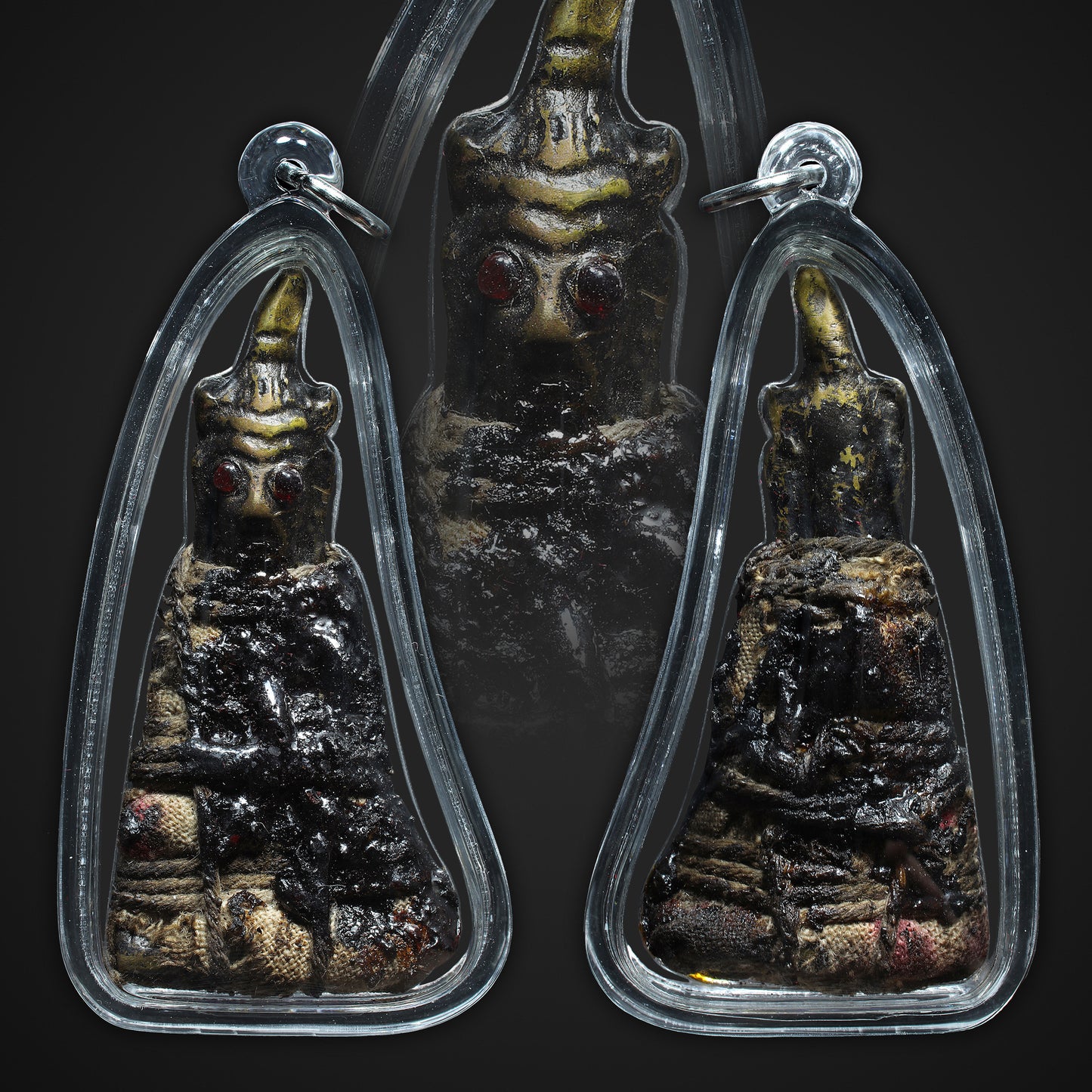
Approximately 3 inches in size, the artifact retains an aged Cambodian Phra Ngan figure beneath extensive later ritual applications. Tidjai relic material is smeared across the body, with fire-ceremony ash and Nur Hom incorporated into the surface. Prepared corpse cloth surrounds the lower structure, and the working has been sealed with an enamel-like protective coating. The aged, layered and irregular appearance reflects both the earlier artifact and Por Sala Tan's subsequent reinforcement.
Recommended Pairing
Because this Phra Ngan is strongly yin and Seneh orientated, a Baramee-based amulet is the most natural companion.
A strong Buddha image, Lersi piece or other Baramee-building sacred object can provide the authoritative foundation behind the attraction current.
Within Por Sala Tan's framework, the distinction is important.
Seneh draws people towards you; Baramee gives weight to what happens once they arrive.
For business use, this combination is particularly appropriate. The Phra Ngan supports approachability, attention and favourable interaction, while the Baramee piece provides steadiness, authority and respect.
There is little need to overload the arrangement with several additional Seneh pieces. This Phra Ngan already carries a concentrated attraction current; pairing it with a strong Baramee foundation creates the more balanced configuration.
-
Free Shipping for Singapore| $15 Worldwide | $60 USA For Items Below $350