
OOBThaiAmulets
Por Sala Tan
Por Sala Tan
Couldn't load pickup availability
PST07
Sacred Cave Stone Amulets
Por Sala Tan
2 Inches
Mainstream Artifact
Sacred Craftsmanship
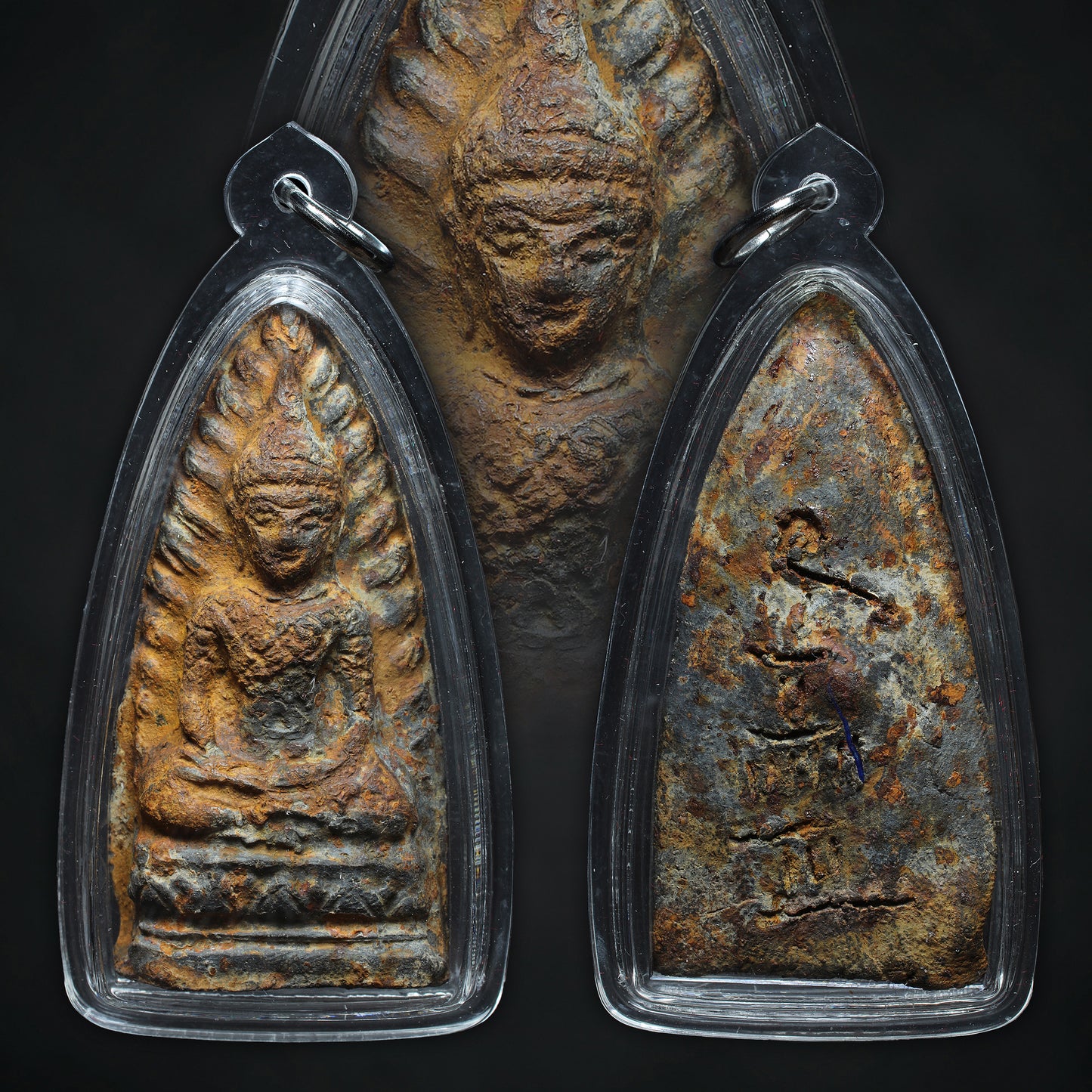
Each artifact was individually carved from natural stone, and centuries of mineral exposure have further altered its texture, colour and form. Differences in carving, erosion, deposits and surface condition are therefore part of the individual character of every surviving piece.
Personal Experiences Shared by Luksits
Among Por Sala Tan's luksits, these cave-stone pieces were regarded differently from amulets made specifically for wealth, Seneh or direct protection.
They were primarily understood as Baramee pieces.
Practitioners who carried several different types of amulets sometimes used one of these stones as the foundation of their arrangement. Rather than expecting an immediate or dramatic result, they regarded the cave stone as something that helped bring the different currents together.
Some luksits described becoming calmer when carrying it, particularly during periods when they were working with stronger spirit-based pieces. Others preferred keeping it close during meditation, prayer or ritual work because of what they described as its heavy and settled character.
The recurring observation was not that the stone produced one narrow effect, but that it seemed to provide stability, spiritual weight and continuity.
For this reason, some senior collectors regarded it as the kind of artifact one keeps for the long term rather than continually changing according to immediate needs.
Summary
These Sacred Cave Stone Amulets occupy an unusual position within Por Sala Tan's lineage.
They were not originally created by him.
According to the lineage history, they were discovered within the deeper chambers of Wat Tham Payanak, Chiang Rai, during one of his meditation retreats and were believed to have been carved by earlier forest practitioners approximately two to three centuries ago.
Their rediscovery occurred only one day before a major gathering of Lersi and spiritual masters at the cave.
The pieces were subsequently placed within that ceremony and received the collective chanting and blessing of the assembled practitioners. A number were distributed amongst participating masters, while Por Sala Tan retained several and later returned with them to Fang.
There, he immersed his pieces within his personal holy-water vessel used for sacred charging, allowing them to remain within his own ritual environment.
Their principal character is therefore Baramee — spiritual weight, stability, grounding and support for other sacred objects.
Historical Background
During a retreat in Chiang Rai, Por Sala Tan entered the cave temple identified in the lineage account as Wat Tham Payanak.
The cave had long been associated locally with Payanak current and elemental forces connected with the land. As with many older cave environments used for meditation, its importance came not merely from the temple structure but from the deeper chambers where practitioners could remain isolated for extended periods.
While meditating towards the rear of the cave, Por Sala Tan sensed what he understood to be an unusually concentrated current within the surrounding stone.
He subsequently asked younger Ajarns accompanying the group to examine the deeper recesses.
A concealed group of old carved stone amulets was discovered.
Their timing proved particularly important.
A gathering of Lersi hermits and spiritual masters had already been arranged for the following day. Instead of treating the discovery as an isolated archaeological curiosity, Por Sala Tan brought the pieces into the coming ceremony.
The old stone artifacts therefore passed from an earlier, largely unknown period of cave practice into the living ritual lineage surrounding Por Sala Tan.
Origins of the Materials
The material is natural stone originating from the cave itself.
According to the lineage account, the figures were carved from the stone of the cave by earlier practitioners rather than being brought there as ordinary manufactured amulets.
Their estimated age of approximately 200–300 years places their original manufacture well before Por Sala Tan's period.
Who precisely carved them is no longer known.
Within the oral history surrounding the discovery, their workmanship was associated with earlier forest monks, hermits or ascetic practitioners who had used the cave for meditation.
The stone itself shows extensive ageing. Mineral staining, uneven colour, softened relief and surface deterioration differ considerably between individual examples.
This physical irregularity forms an important part of their character.
They are not uniform objects from a conventional batch. Each represents a piece of cave material individually worked and subsequently altered by a long period within the environment from which it originated.
Ritual
The first major ritual after their rediscovery took place the following day.
The cave stones were positioned amongst the sacred objects present during the gathering of Lersi and other spiritual practitioners.
Multiple masters participated in the ceremony.
Within the lineage understanding, this was important because the pieces already carried the weight of their age and cave origin. The ceremony was therefore not simply intended to create power in newly manufactured objects, but to awaken and reconnect old sacred artifacts with a living lineage.
Following the ceremony, participating masters received a small number of pieces.
Por Sala Tan retained several and returned with them to Fang.
His pieces were subsequently placed into his personal holy-water vessel, a container reserved for sacred charging. They remained immersed within this ritual environment, receiving the accumulated chanting and workings associated with the vessel.
The history of these amulets consequently contains three distinct layers: the original cave practitioners, the later collective Lersi ceremony, and finally Por Sala Tan's personal ritual current in Fang.
Blessings and Effects
The principal quality associated with these cave stones is Baramee.
Rather than being directed towards a single worldly objective, Baramee provides the underlying spiritual weight from which other practices may be supported.
For meditation, the stone is traditionally regarded as grounding, helping the practitioner settle rather than continually chase changing sensations.
For spiritual practice, it supports steadiness, discipline and continuity.
When carried with other amulets, its role is traditionally understood as stabilising the overall arrangement, particularly where several different currents are being combined.
The cave origin contributes grounding.
The old sacred imagery contributes lineage continuity.
The collective Lersi ceremony contributes teacher-current.
Por Sala Tan's subsequent immersion of the pieces within his holy-water vessel connects them directly with his own practice.
For this reason, the piece is better understood as a foundation than as an amulet devoted exclusively to wealth, attraction or protection.
Modern Application
This type of artifact is particularly suitable for those who already keep or wear several sacred objects.
A person carrying wealth, Metta or Seneh pieces may use the cave stone as the Baramee foundation behind them.
Meditators may carry it during retreats or place it near their meditation area as a reminder of the generations of cave practice associated with its history.
For business owners or professionals, its purpose is less about directly calling customers or money and more about maintaining stability, judgement and spiritual weight behind other workings.
It is also appropriate for collectors interested in the older cave and Lersi traditions connected with Northern Thailand.
Unlike highly specialised Barang pieces, this is a relatively broad foundational artifact.
Physical Details
Carved from natural cave stone and showing considerable surface ageing, the surviving pieces vary in sacred imagery, carving depth, mineral staining and erosion. Examples include Buddha and ascetic or hermit forms, while the reverse may retain old script, incised symbols and yantra-like markings. The weathered brown, grey and ochre surfaces are part of the individual condition of each piece. Modern protective casing allows the old stone to be worn without further direct handling.
Recommended Pairing
This is principally a Baramee foundation piece, making it particularly useful alongside more specialised amulets.
With wealth and Chok Larp pieces, Baramee is traditionally understood to provide the spiritual foundation behind opportunity and material movement.
With Metta Maha Niyom, it adds weight and credibility to the softer current of goodwill and favourable human relationships.
With Seneh or yin-orientated artifacts, its grounded character can provide balance behind a more active attraction current.
It is especially relevant when worn with Prai, Jinn or other spirit-based Barang, where Por Sala Tan's tradition places importance on sufficient Baramee to support and regulate the relationship between keeper and artifact.
Within a larger arrangement, the cave stone does not need to compete with the other pieces.
The specialised amulets provide their individual functions; the cave stone provides the Baramee foundation beneath them.
-
Free Shipping for Singapore| $15 Worldwide | $60 USA For Items Below $350