
OOBThaiAmulets
Por Sala Tan
Por Sala Tan
Couldn't load pickup availability
PST07
Phra Piyu
Por Sala Tan
2 Inches
Barang Artifact
Sacred Craftsmanship
Each artifact was individually formed from prepared sacred and relic materials. Natural variations in surface, colour, ritual matter, takrut placement and finish are therefore inherent to the construction and make each handmade piece individually distinctive.
Personal Experiences Shared by Luksits
Luksits who kept stronger martial pieces of this nature generally did not describe them in terms of ordinary Metta or attraction.
The experiences were more commonly connected with pressure, competition and difficult people.
Some spoke of entering situations where another party had initially been openly hostile, only to find that the confrontation gradually lost momentum. People who had been particularly aggressive became less direct, while obstacles created by others appeared to weaken.
Business owners described using such pieces during periods of intense competition, especially when they believed rivals were deliberately interfering with customers, contracts or negotiations.
Others associated the artifact with difficult workplace environments. They felt more composed when dealing with dominant personalities and less easily intimidated when placed under pressure.
Rather than creating aggression in the wearer, the traditional purpose was understood as holding one's ground.
The strongest feedback therefore concerned situations where confrontation could not simply be avoided — negotiations, disputes, professional rivalry and periods when the keeper needed sufficient presence to withstand sustained opposition.
Summary
This Phra Piyu was created through a single uninterrupted night of ritual work involving Por Sala Tan and fellow Lersi practitioners from his Samnak.
Its origin lies in an old Northern battlefield environment where multiple wandering presences were believed to remain connected with violent death, territorial attachment and unresolved martial oaths.
Por Sala Tan's purpose was not to enslave these entities.
The ceremony was described as a liberation working, guiding the accumulated presences away from their restless Prai condition and stabilising the resulting current into what the lineage described as a higher Jinn-level function.
Phra Piyu therefore carries a distinctly martial character associated with Maha Amnaj, suppression of hostility, competitive advantage, protection and maintaining authority under pressure.
It is not principally an attraction artifact.
Its traditional purpose is to help the keeper remain standing when others attempt to push him down.
Historical Background
Northern Lanna history contains long periods of warfare, shifting territorial control and conflict along routes connecting what are now Northern Thailand, Myanmar and neighbouring regions.
Within local oral traditions, places associated with violent death could retain another history alongside the documented one. Battlefields, abandoned settlements and old travelling routes sometimes became associated with the spirits of commanders, ordinary soldiers and oath-bound warriors whose deaths were considered unresolved.
The lineage account surrounding this Phra Piyu begins at one such location.
During a period of solitary meditation near the former conflict area, Por Sala Tan encountered what he understood as multiple wandering presences connected with the battlefield remains.
These were not treated as ordinary individual Prai.
According to the account, prolonged attachment to violent death, territorial memory, broken oaths and the collective presence of other dead had changed their character. Rather than a single wandering spirit, Por Sala Tan encountered an accumulated martial current.
The entities were understood to be seeking release rather than continued attachment to the location.
This became the foundation of the Phra Piyu working.
Origins of the Materials
The principal binding substance was Paneang associated with a Mae Prai who had died violently.
Within the ritual logic of the piece, this material was selected because it could contain a high-pressure spiritual working without allowing the different currents to become dispersed.
Materials from the old battlefield environment were then incorporated.
These included earth, fragmented relic matter and residue gathered from the surrounding site. Rather than keeping each element separate, the materials were brought together to create the ritual body surrounding the internal structure.
An important feature is the fully Yanted lead frame.
Lead was worked into the internal construction and inscribed before being incorporated into the piece. It therefore served two purposes: physically strengthening the artifact and establishing a defined ritual structure around the materials.
The numerous takruts visible around the reverse were not merely decorative additions. Each belonged to a particular stage of the subsequent working.
Ritual
The ceremony was completed over one uninterrupted night.
Por Sala Tan worked together with fellow Lersi practitioners from his Samnak. The purpose was described specifically as liberation rather than command or enslavement.
As the rite progressed, takruts were inserted individually.
Each insertion corresponded with a stage of the liberation process, gradually establishing structure around what had previously been a dispersed collection of battlefield presences.
According to the lineage account, the spiritual character changed as the work progressed.
What began as restless martial Prai was eventually considered stabilised into a more ordered state, described by Por Sala Tan's tradition as operating at a Jinn-like level rather than remaining as wandering Prai.
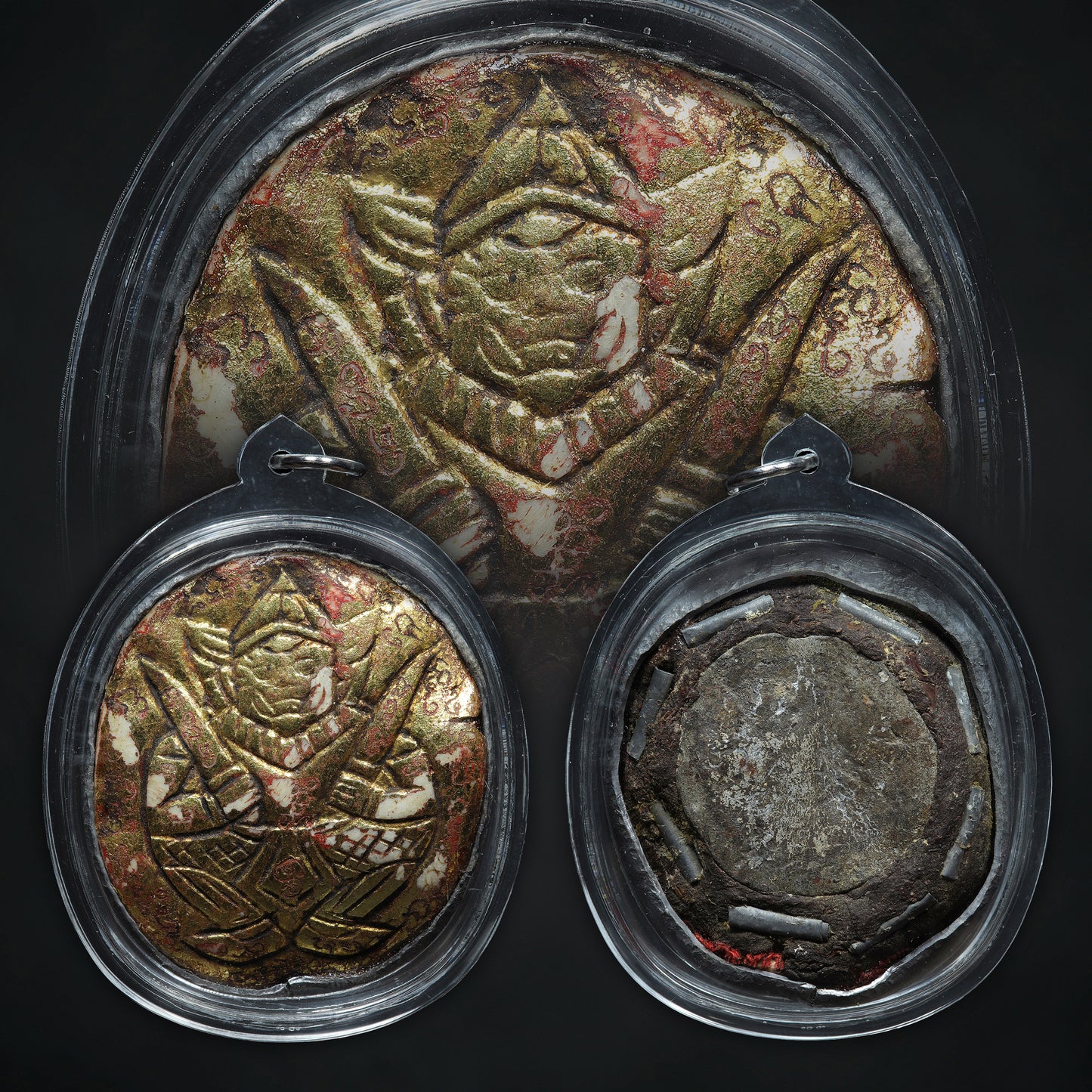
The image of Phra Piyu represented this transformation.
The figure is martial, but seated.
Power remains present, yet it is restrained.
This distinction lies at the heart of the piece: force brought under discipline rather than force allowed to wander without direction.
The entire sequence was completed before the night ended and the same working was not repeated.
Blessings and Effects
Phra Piyu is principally associated with pressure dominance.
Its traditional function is not to make everyone like the keeper, but to strengthen his position when faced with opposition.
Maha Amnaj supports authority, presence and the ability to stand firmly during confrontation.
The martial current is traditionally approached for the suppression of hostile intention, particularly where jealousy, rivalry, back-stabbing or deliberate obstruction has become persistent.
In negotiations, the piece is associated with maintaining psychological composure and preventing an opposing party from easily controlling the situation.
For professional competition, it is traditionally used to strengthen one's position when pursuing contracts, promotions, customers or influence within a difficult environment.
Protection forms another important aspect, particularly against hostile human intention and unseen disturbances associated with conflict.
Its principal traditional qualities can therefore be understood as Maha Amnaj, authority, protection, competitive strength, suppression of hostility, resilience and maintaining one's position under sustained pressure.
Modern Application
Although its origins are martial, the modern application of Phra Piyu is primarily professional.
Today's battlefield may be a boardroom, negotiation table, competitive sales environment or workplace where several individuals are struggling for the same position.
For business owners, it may be carried during difficult negotiations or periods when competitors are aggressively attempting to take market share.
For executives and managers, the emphasis is on remaining composed while handling internal rivalry, criticism or resistance to authority.
Those working in highly competitive industries may similarly understand its symbolism: do not retreat merely because pressure has increased.
The piece may also be carried when dealing with persistent back-stabbing or situations where the keeper feels continually obstructed by the same individuals.
It is less appropriate as a general charm for popularity or casual social attraction. Its character is considerably firmer.
Phra Piyu belongs to circumstances where resolve, protection and controlled authority are required.
Physical Details
Approximately 2.5 inches, with the front depicting Phra Piyu in a seated martial form, highlighted with aged gold and red detailing. The construction uses a Paneang-based ritual body together with battlefield materials and an internal fully Yanted lead structure. The reverse exposes a large central circular component surrounded by multiple individually inserted takruts and prepared ritual material. The piece is fully encased and suitable for wear or personal carry.
Recommended Pairing
No pairing is required.
Phra Piyu was constructed as a complete working, with its internal Yanted structure, battlefield materials, takruts and liberation ritual all serving a defined purpose.
For this reason, the piece is traditionally best understood on its own rather than as one component within a larger combination.
Its current is already highly structured and strongly orientated towards authority, protection and competitive pressure.
Where other artifacts may benefit from Metta, Baramee or wealth reinforcement, Phra Piyu was created for a narrower task:
to hold one's position, suppress hostile pressure and remain composed when confronted by determined opposition.
-
Free Shipping for Singapore| $15 Worldwide | $60 USA For Items Below $350