
OOBThaiAmulets
Por Sala Tan
Por Sala Tan
Couldn't load pickup availability
PST07
Phra Pidta
Por Sala Tan
1 Inch
Barang Artifact
Sacred Craftsmanship
Each artifact was individually fashioned from natural relic material and cave substances. Variations in texture, colour, porosity, form and surviving surface make every piece naturally unique.
Personal Experiences Shared by Luksits
Among Por Sala Tan's luksits, small relic pieces such as this were often appreciated because they could be carried quietly.
There was no need for a large necklace or an elaborate display.
At approximately two centimetres, this Phra Pidta could simply be kept in a shirt pocket, trouser pocket, small pouch or personal bag.
Some luksits regarded Pidta pieces particularly highly when entering situations involving difficult people, negotiations or environments where they preferred not to attract unnecessary hostility.
Rather than understanding the protection as confrontation, they described the character differently:
trouble passes without attaching itself to you.
Others carried Pidta during periods of business uncertainty, particularly when they felt surrounded by gossip, competition or people whose intentions were difficult to read.
Practitioners of meditation approached the piece differently again. For them, the importance was the connection between Pidta, Samadhi and the relic of an ascetic whose life had been devoted to secluded practice.
Summary
This Phra Pidta brings together three closely related elements.
The first is the relic of the unnamed holy man, believed to have passed away during deep practice within a secluded cave.
The second is soil from that same cave, preserving the physical connection between the relic and its original meditation ground.
The third is Por Sala Tan's Pidta Wicha, through which the relic was transformed into a portable sacred object.
Its traditional qualities centre upon protection, concealment from hostility, Baramee, wealth and opportunity, stability, concentration and meditative clarity.
Its diminutive size is also important.
This is a highly personal Phra Pidta intended to be carried close and discreetly rather than displayed prominently.
Historical Background
Phra Pidta is immediately recognised by the characteristic gesture of covering the eyes.
Within sacred interpretation, however, Pidta does not simply mean that the Buddha or sacred figure cannot see.
The closed senses represent withdrawal.
The practitioner temporarily turns away from external distraction, desire, conflict and the endless movement of the outside world in order to concentrate upon what lies within.
This makes the form particularly appropriate for an artifact connected with an ascetic discovered in a cave.
The cave itself represents withdrawal from ordinary society.
The relic represents the impermanence of the physical body.
Pidta represents the closing away of external distraction.
And Samadhi represents the concentration that becomes possible when those distractions are quietened.
Por Sala Tan's decision to create a Pidta from this particular relic therefore gives the artifact a meaning beyond protection alone.
It becomes a small representation of seclusion, concentration and the spiritual discipline of turning inward.
Origins of the Materials
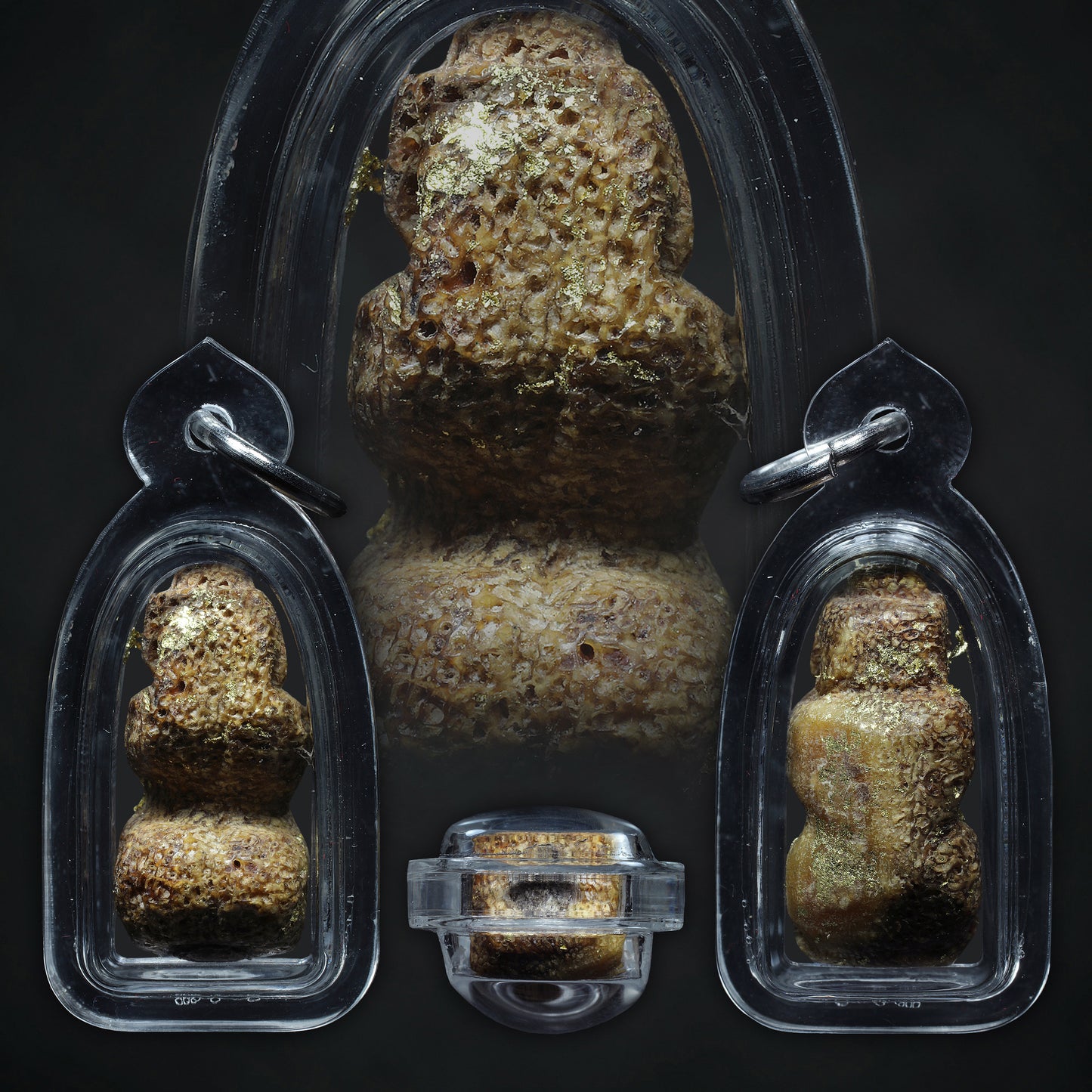
The principal material is a human relic attributed to an accomplished cave ascetic, believed within the lineage account to be part of the hip bone.
Its importance does not arise simply from being an old relic.
The significance comes from whose remains they were believed to be and the circumstances in which they were found.
The holy man had withdrawn into seclusion for meditation, and his remains were left within that environment for years.
Por Sala Tan also retained soil from the cave itself.
This material was placed beneath and around the relic so that the completed Phra Pidta maintained a physical relationship with its original place of practice.
Small traces of gold leaf complete the exterior.
Thus, very little about the piece is decorative.
The relic is the body.
The cave material is the foundation.
And the Pidta form provides the spiritual language through which Por Sala Tan directed the artifact.
Ritual
Por Sala Tan was himself a practitioner of Pidta Wicha, making this form especially suitable for the relic.
The ritual intention centred upon withdrawal from harmful influences.
Rather than meeting every hostile force directly, Pidta Wicha traditionally works through the principle of closing, concealing and removing oneself from the attention of danger.
The relic of the ascetic was therefore prepared within this framework.
Cave soil was incorporated as the grounding element, maintaining the connection with the place where the holy man had practised.
The artifact was then consecrated through Por Sala Tan's meditation and Pidta Wicha.
There is an important symbolic relationship between all three components:
the ascetic withdrew into the cave.
Pidta withdraws the senses from the external world.
Samadhi withdraws the mind from distraction.
The construction therefore follows one consistent spiritual principle.
Blessings and Effects
The principal traditional quality is Klaew Klaad and protection through avoidance — circumstances in which danger, hostility or misfortune is believed to pass without fully reaching the keeper.
Pidta is also associated with concealment from malicious attention, gossip, jealousy and people who may wish to create unnecessary difficulties.
The relic element adds the traditional concept of Baramee. Within this interpretation, the remains of an accomplished practitioner are respected as physical traces of a life spent cultivating discipline and spiritual practice.
For livelihood, Pidta Wicha is also traditionally connected with Choke Lap, Maha Pokasap and the preservation of resources. The emphasis is not merely upon receiving wealth, but upon preventing unnecessary loss and allowing opportunities to develop without interference.
For meditation, the symbolism is particularly direct: quietening distraction, strengthening concentration and remembering the example of someone who chose a life of secluded practice.
Modern Application
At approximately 1 Inch, this Phra Pidta is particularly practical as an everyday personal artifact.
It can be placed discreetly in a pocket or carried in a small protective pouch.
For someone working in a competitive environment, its traditional purpose is not to overpower everyone around them. Instead, Pidta represents remaining outside unnecessary conflict while continuing one's own work.
For business owners, it may be kept close when handling negotiations, contracts or situations involving uncertain intentions.
For travellers, the traditional Klaew Klaad aspect makes it appropriate as a small protective companion.
For practitioners, it may be kept near during meditation as a physical reminder of the unnamed ascetic whose relic forms the piece.
The modern lesson of Pidta remains surprisingly practical:
not every confrontation needs to be entered, and not every distraction deserves our attention.
Physical Details
An exceptionally compact Phra Pidta measuring approximately 1 Inch, individually formed from a relic traditionally identified as part of the hip bone of a deceased cave ascetic. The natural porous structure of the relic remains strongly visible throughout the figure, giving the surface an irregular organic character. Cave soil associated with the original meditation site was incorporated beneath the relic, while surviving gold-leaf application remains visible across portions of the surface. The piece is presently protected within a clear casing and is sufficiently small to be carried discreetly in a pocket.
Recommended Pairing
This Phra Pidta is already strongly centred upon protection, concealment, Baramee and concentration, and can comfortably be carried alone.
For business use, it pairs naturally with Metta Maha Niyom, creating a traditional balance between avoiding hostility and encouraging favourable relationships.
For greater emphasis upon wealth, Maha Pokasap or Choke Lap may complement the Pidta's traditional association with preserving resources and opening opportunities.
For meditation and spiritual practice, a Lersi artifact provides perhaps the most natural pairing. The Lersi represents the teacher and progression of knowledge, while this Pidta represents withdrawal, concentration and inner stillness.
Personal Notes
What makes this Phra Pidta particularly interesting is the contrast between its physical size and the history represented within it.
It measures only around two centimetres.
It can disappear completely inside a pocket.
Yet its story begins with a holy man who withdrew from ordinary society and entered a cave to practise Samadhi.
Years passed.
The body returned towards nature, but part of the physical relic remained.
Por Sala Tan later encountered that material and did not attempt to disguise what it was. The natural porous surface was preserved and transformed into the form of Pidta, with soil from the original cave retained beneath it.
There is something very appropriate about that.
A large and elaborate artifact would almost contradict the story.
This piece is small, quiet and easily concealed.
Just as the ascetic withdrew from the world, Pidta closes itself away from the world.
For me, that is the strongest character of this artifact.
Sometimes protection does not mean becoming stronger than everything around us. Sometimes it means knowing what to close out, what to walk away from, and where to place our attention instead.
-
Free Shipping for Singapore| $15 Worldwide | $60 USA For Items Below $350