
OOBThaiAmulets
Por Sala Tan
Por Sala Tan
Couldn't load pickup availability
PST07
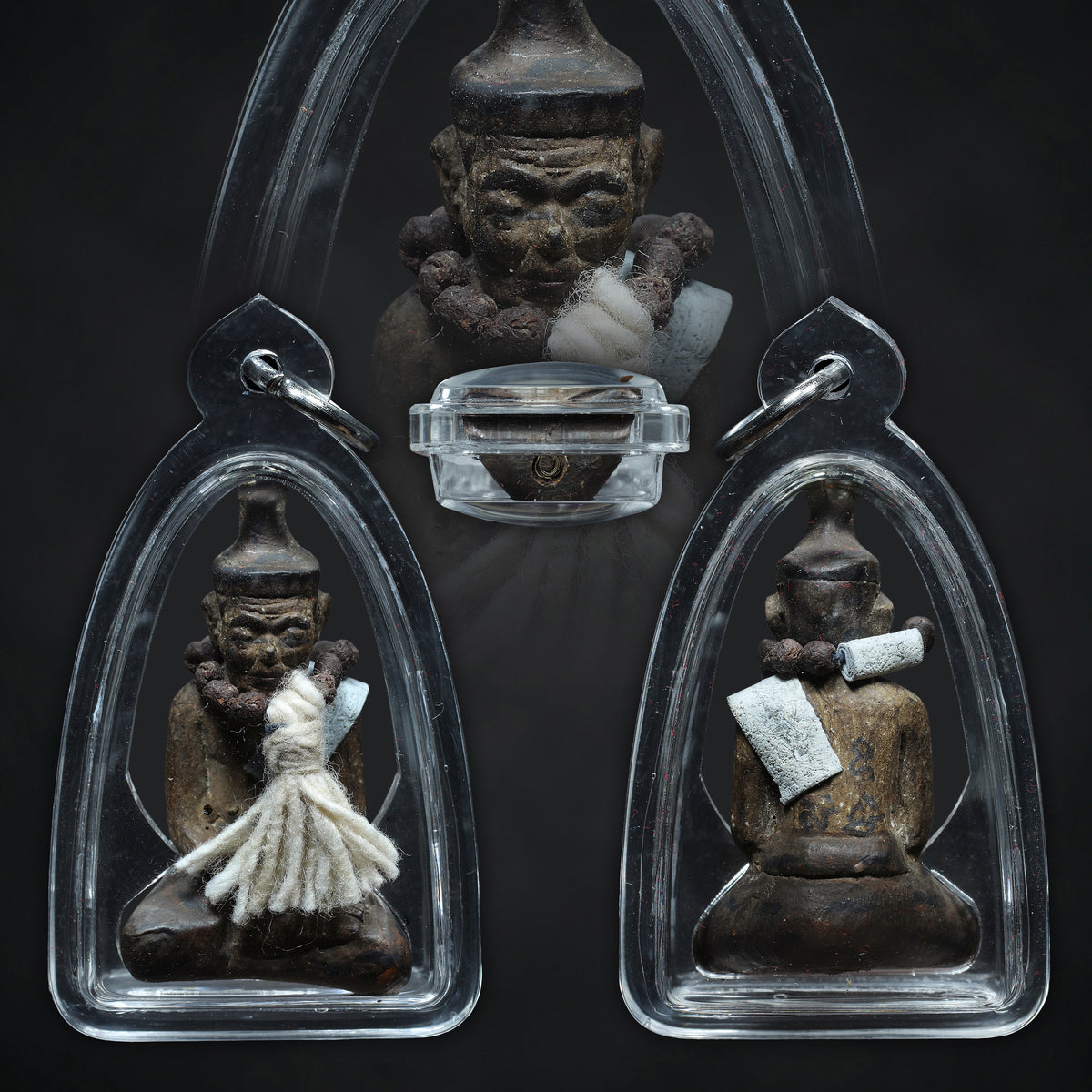
Lersi with Jindamani Mala
Por Sala Tan
1.5 Inches
Mainstream Artifact
Sacred Craftsmanship
Each artifact was individually carved and assembled from natural wood, relic materials and old ritual components. Variations in the grain of the Mai Payoom, carving, relics, mala beads, Sai Sin, yantra and takrut therefore make every surviving example individually distinctive.
Personal Experiences Shared by Luksits
Among luksits who worked with Lersi pieces of this nature, the recurring discussion was often not about sudden wealth or dramatic material results.
It was about direction.
Some practitioners described periods when their understanding of Wicha appeared to stop progressing. They continued studying and practising, yet felt that something was missing.
After keeping a Lersi artifact close during meditation and practice, some spoke of suddenly understanding something they had previously struggled with — a ritual sequence becoming clearer, an old teaching making sense, or an instinctive understanding of how a particular practice should be approached.
Others described a quieter form of guidance.
When facing important decisions, they would sit calmly before the Lersi rather than immediately acting. After meditation, the answer sometimes appeared considerably clearer.
These experiences are why many of Por Sala Tan's luksits regard Lersi artifacts not simply as protective amulets, but as objects connected with teachers, knowledge and the continuation of Wicha.
The Jindamani mala makes this particular example especially meaningful, because it was itself a working ritual object previously handled and used by a Lersi.
Summary
This is one of approximately 50 Lersi figures prepared under Por Sala Tan as part of a prolonged three-year project.
Carved from Mai Payoom, the batch incorporated relic materials connected with eight deceased Lersis and passed through eight separate cave ceremonies.
This example belongs to the much smaller group carrying a Jindamani herbal mala formerly used by a Lersi, with fewer than five pieces said to have received such a mala.
Its traditional emphasis is therefore strongly centred upon Baramee, guidance, protection, meditation, intuitive awareness and progression in Wicha.
Rather than representing one isolated blessing, it brings together the physical traces of earlier practitioners, Por Sala Tan's own ritual preparation and repeated cave consecrations into a single lineage artifact.
Historical Background
The Lersi occupies an unusual position within Thai and wider Southeast Asian sacred traditions.
Derived from the older concept of the Rishi or hermit-sage, the Lersi represents the practitioner who withdraws from ordinary distractions in pursuit of meditation, specialised knowledge and disciplined spiritual practice.
Within Thai traditions, Lersi are particularly associated with teachers.
They appear in traditions concerning herbal knowledge, healing, sacred inscription, meditation, astrology, ritual arts and numerous branches of Wicha. For this reason, respect towards the Lersi is closely connected with Wai Kru — acknowledgement and gratitude towards one's teachers and lineage.
Por Sala Tan's own practices frequently brought him into contact with forest practitioners, Lersi and other holders of regional Wicha.
Consequently, relics and ritual objects connected with such practitioners were not regarded merely as unusual materials.
They represented continuity.
An old mala, a piece of Sai Sin, hair, cremated material or an object formerly used in practice could preserve a tangible connection between teacher, student and subsequent generations.
This understanding forms the foundation of this particular Lersi.
Origins of the Materials
The principal body is Mai Payoom, chosen as the structural foundation of the artifact.
Within the batch were incorporated relics associated with eight deceased Lersis, including cremated remains and hair preserved after their passing.
Rather than concentrating the identity of the artifact upon a single relic source, Por Sala Tan brought these materials together as a representation of a broader Lersi lineage.
The most distinctive material on this particular example is the Jindamani mala.
The beads were prepared from Jindamani herbal material and had previously formed part of a Lersi's own ritual equipment. Having been handled and used during practice, such an object was regarded within the lineage as considerably different from newly prepared material.
It already possessed a history of use.
The figure also carries a handwritten takrut, Sai Sin and visible yantra, providing additional layers to the completed artifact.
Ritual
The consecration of this batch was deliberately prolonged.
Rather than completing the figures through a single ceremony, Por Sala Tan carried them through approximately three years of preparation, involving eight cave ceremonies at different locations.
The use of caves is particularly appropriate to Lersi practice.
Caves naturally provide seclusion from ordinary activity and have long served as places for meditation, retreat and disciplined spiritual practice. Their enclosed environment also carries strong symbolic meaning: withdrawing from the external world before returning with greater understanding.
At each stage, the figures underwent further chanting and ritual preparation.
The process was therefore cumulative.
One ceremony did not replace the previous ceremony. Each became another layer in the object's ritual history.
The takrut and yantra provided direction to the Wicha, while the Lersi relics established the connection with the earlier practitioners represented within the batch.
For the few examples carrying an original Jindamani mala, an additional connection was created through an object that had already participated in the spiritual practice of a Lersi during his lifetime.
Blessings and Effects
The traditional qualities associated with this Lersi concentrate strongly upon Baramee and spiritual development.
It is approached for clearer judgement when circumstances become confusing, greater patience before important decisions and the ability to recognise a more appropriate direction rather than reacting immediately.
For practitioners of Wicha, the Lersi is particularly associated with Kru Baramee — the blessing and authority of the teacher. It may therefore be kept during study, meditation, ritual work or periods when one's practice appears to have reached an obstacle.
The Jindamani mala adds a strong traditional association with protection and preservation of Baramee.
Other qualities traditionally associated with the piece include protection against disruptive influences, greater concentration during meditation, intuitive warnings, clearer dreams and sensitivity towards circumstances that deserve greater caution.
Modern Application
One does not need to be a practising Lersi to understand the principle represented by this artifact.
Modern life frequently rewards immediate reaction. Decisions are made quickly, information arrives continuously and people are often pressured to act before they have properly considered their direction.
The Lersi represents almost the opposite approach.
Become still first. Understand clearly. Then act.
For someone studying Wicha, the artifact can be kept near the place of practice or meditation as an acknowledgement of the teachers who came before.
For business owners and professionals, its relevance is more concerned with judgement, patience and recognising the correct direction before committing resources.
For collectors, the combination of Mai Payoom, eight Lersi relic sources, a three-year ritual period and eight cave ceremonies already distinguishes the batch.
The addition of an original Jindamani mala makes this particular example considerably more specialised within that group.
Physical Details
A seated Lersi individually carved from aged Mai Payoom, retaining the natural grain and irregularities of the wood. The figure carries an old Jindamani herbal mala around the neck together with Sai Sin, while a rolled handwritten takrut is attached across the body. The reverse retains visible handwritten yantra upon the wooden surface. Relic materials associated with eight deceased Lersis were incorporated into the batch. This example belongs to the very small number said to have received an original Lersi-used Jindamani mala and is preserved within a clear protective casing.
Recommended Pairing
This Lersi functions naturally as a principal Kru and Baramee piece and does not require another artifact to complete its traditional purpose.
For practitioners concentrating upon meditation or Wicha, it can be paired with another Lersi artifact connected with a specific branch of practice while allowing this piece to remain the central representation of Kru Baramee and lineage guidance.
For business use, pairing with Metta Maha Niyom can add a softer interpersonal quality, particularly for those dealing regularly with customers, colleagues or negotiations.
For protection, it may be paired with a Suer, Wua Thanu or other protective Kreung Rang, while the Lersi remains focused upon judgement, guidance and awareness.
Personal Notes
What distinguishes this piece for me is not simply the number of materials placed inside it.
It is the amount of time and continuity represented by those materials.
The Mai Payoom was carved into the image of a teacher.
Relics from eight departed Lersis connected the figure with practitioners who came before.
The batch then travelled through eight cave ceremonies over approximately three years.
And on this particular example sits something even more personal — a Jindamani mala that had already accompanied a Lersi during his own practice.
It therefore feels less like an artifact created at one particular moment and more like something that accumulated its history gradually.
Teacher to practitioner.
Practitioner to relic.
Relic to artifact.
Artifact to the next luksit.
That continuity is perhaps one of the most appropriate meanings a Lersi artifact can carry.
Wicha survives because knowledge is passed on. The teacher may eventually leave, but what was taught does not necessarily leave with him.
-
Free Shipping for Singapore| $15 Worldwide | $60 USA For Items Below $350