
OOBThaiAmulets
Por Sala Tan
Por Sala Tan
Couldn't load pickup availability
PST07
Racha Khu Baramee
Por Sala Tan
2 Inches
Barang Artifact
Individual Craftsmanship
Each artifact is individually handmade from prepared sacred materials. Natural differences in the powder, surface, embedded takruts, gold leaf and positioning of the inserts mean that no two examples should be expected to appear exactly alike.
Personal Experiences Shared by Luksits
Pieces of this nature are traditionally valued by those whose daily lives depend heavily upon authority, relationships and the cooperation of others.
Business owners, managers and those involved in negotiation may approach such an artifact not simply for wealth, but for Baramee — the personal presence through which others are more willing to listen, cooperate and show respect.
The paired male and female imagery is also significant. Rather than concentrating upon a single quality, the piece represents a balance between firmness and softness.
In practical terms, luksits may associate this with knowing when to stand one's ground and when to approach another person with Metta.
Summary
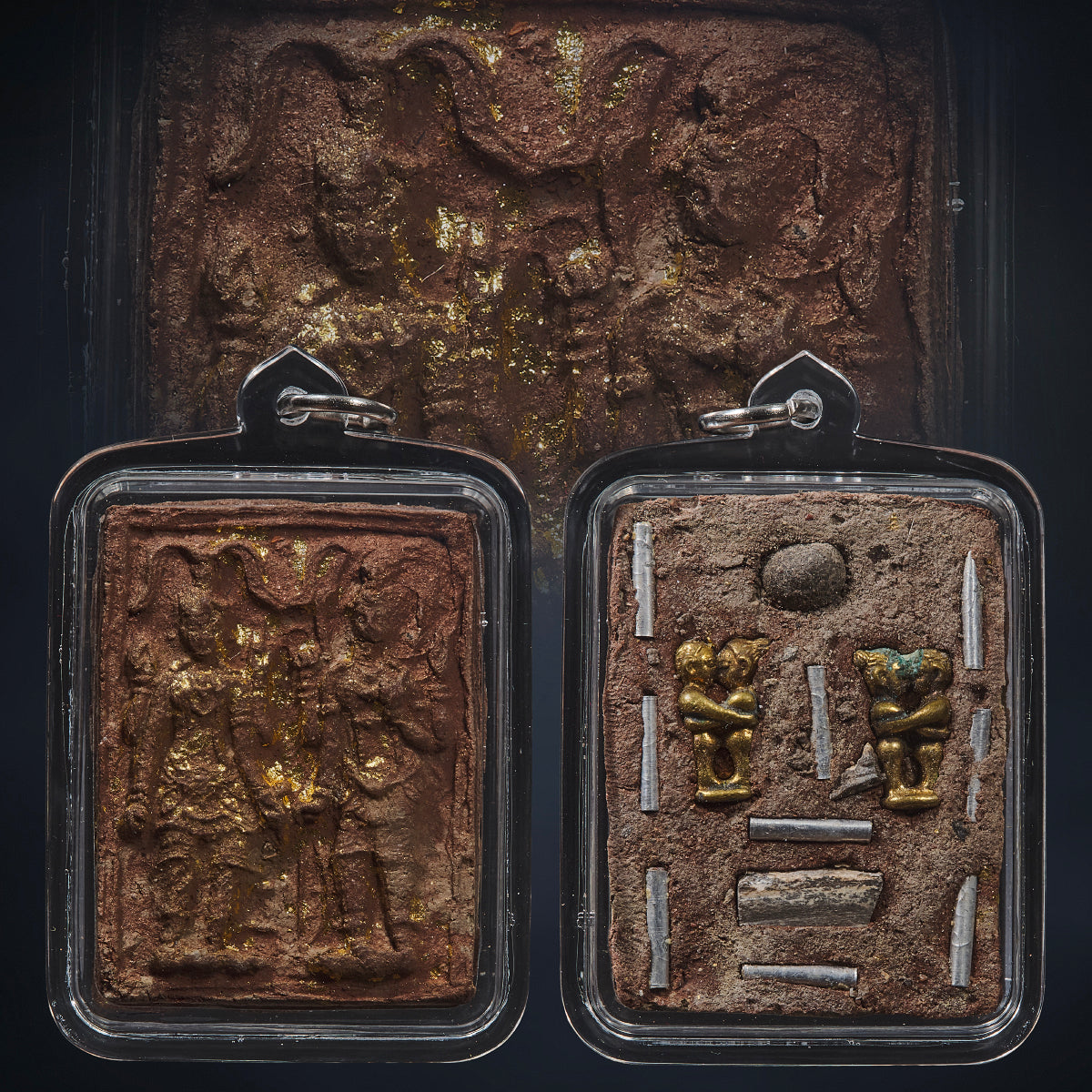
This is a particularly elaborate Burmese royal-couple sacred piece, combining royal symbolism with Barang and traditional occult materials.
The two standing figures on the front evoke the image of a king and queen, representing the union of authority, merit, compassion and harmonious partnership.
The imagery is reminiscent of Burmese traditions surrounding royal couples, including the cultural memory of King Anawrahta of Pagan and his royal consorts. However, unless the original maker specifically identified the figures, they are better understood as royal symbolic figures rather than definitively identified historical portraits.
Its reverse reveals the more esoteric character of the artifact.
Takruts, sacred inserts, twin golden figures and other prepared materials have been assembled together, creating a piece directed towards Baramee, Metta Maha Niyom, protection, benefactors and stability of fortune.
Historical Background
King Anawrahta, who ruled from 1044 to 1077, is remembered as one of the formative rulers of the Pagan Kingdom and an important figure in the development of Burmese kingship.
The Pagan period became closely associated with the expansion of Buddhist institutions, temple construction, merit-making and the relationship between political authority and religious patronage.
Within later popular understanding, the righteous ruler came to represent more than political power alone. Authority was ideally supported by merit, generosity, discipline and responsibility towards others.
Royal-couple imagery therefore carries a broader symbolism.
The king represents command, protection and worldly authority, while the queen introduces qualities of compassion, attraction, harmony and support.
Together, they form an image of power that is stabilised rather than uncontrolled.
Origins of the Materials
The body of the amulet is formed from a reddish-brown sacred powder or clay mixture associated with Burmese-style sacred-object making.
Such mixtures may traditionally incorporate combinations of prepared earth, old sacred powders, temple-related materials and other substances selected by the practitioner.
The reverse contains the most visible collection of ritual components.
Several metal takruts have been inserted around the surface. A round sacred insert appears towards the upper centre, while a larger rectangular relic or sacred material is embedded below.
Two small golden figures stand symmetrically on either side of the centre.
The surface is then extensively covered with gold leaf, visually bringing these separate ritual components together into a single composition.
Ritual
In traditional practice, an artifact combining so many separate materials would not be understood through one ingredient alone.
The front establishes the principal symbolism of the royal pair.
The reverse then reinforces the intended qualities through multiple takruts and sacred inserts. Different takruts may traditionally be prepared for individual purposes such as Metta, authority, protection, attraction, wealth or the support of benefactors.
The paired golden figures further reinforce the concept of two complementary forces operating together.
Within Barang practice, materials of spirit or relic origin may also be incorporated to provide the spiritual connection through which the artifact is worked.
The result is therefore a layered construction: royal symbolism on the front and the working ritual components concealed or embedded behind it.
Blessings and Effects
The principal traditional associations of this piece centre upon Baramee and Metta Maha Niyom.
Baramee concerns presence, merit and authority — particularly the ability to command respect without constantly resorting to force.
Metta Maha Niyom concerns goodwill, popularity and favourable treatment from others.
The paired royal figures additionally represent harmony between different qualities:
- Authority and leadership
- Metta and attraction
- Respect and recognition
- Benefactors and assistance
- Business relationships and negotiation
- Protection against harmful intentions
- Stability of wealth and personal fortune
The emphasis is therefore not merely upon obtaining wealth. It is upon creating favourable conditions around the bearer — respected by others, supported by useful relationships and better positioned when opportunities arise.
These remain traditional spiritual associations rather than guaranteed effects.
Modern Application
This type of piece is particularly relevant to people whose success depends upon leadership and human relationships.
A business owner may traditionally carry it when meeting clients, negotiating agreements or managing staff. Someone seeking advancement may approach it for Baramee, recognition and support from senior figures.
Those working in sales may instead focus upon its Metta qualities — encouraging smoother conversations, repeat customers and stronger professional relationships.
The symbolism of the royal couple also provides a useful reminder for leadership itself.
Authority alone can become harsh, while kindness without firmness can become ineffective. The paired figures represent the meeting of both qualities: the ability to lead while maintaining goodwill.
Physical Details
A rectangular Burmese-style sacred powder amulet depicting two standing royal figures in relief on the front, surrounded by additional symbolic forms within the reddish-brown sacred material. The reverse is extensively covered with gold leaf and contains numerous individually embedded metal takruts, a round sacred insert, a larger central rectangular relic or prepared material and two small golden figures arranged symmetrically on either side. The handmade surface remains deliberately irregular, with the individual inserts clearly visible rather than concealed within the body of the piece. The artifact is currently preserved in a clear protective casing.
Recommended Pairing
Because this piece already combines Baramee, Metta, protection and attraction, it can function as a broad everyday artifact without requiring extensive pairing.
For someone focused upon business, it may be paired with a Choke Lap or Riak Sap piece to place greater emphasis upon opportunities, income and the movement of wealth.
For leadership or career advancement, a Lersi associated with wisdom and Baramee would complement the royal symbolism particularly well.
Where the principal concern is protection, it may instead be paired with a guardian-oriented artifact, allowing the royal couple piece to remain focused upon relationships, authority and favourable human interaction.
Personal Notes
What stands out about this piece is the contrast between its two sides.
The front is comparatively restrained: a king and queen standing together.
Turn the artifact over and its construction becomes considerably more complex. Multiple takruts, golden figures, sacred inserts and gold leaf reveal that the piece was intended as more than a simple representation of Burmese royalty.
Its strongest symbolism lies in the pairing itself.
The king does not stand alone, nor does the queen. Together they represent two different qualities supporting one another — authority with compassion, leadership with attraction, strength with diplomacy, and worldly success with spiritual merit.
For collectors of older Burmese and Barang traditions, this combination gives the piece a character quite different from an artifact devoted solely to wealth, protection or Saneh. Its purpose is broader: to strengthen the position of the bearer among other people while maintaining the relationships upon which lasting success depends.
-
Free Shipping for Singapore| $15 Worldwide | $60 USA For Items Below $350