
OOBThaiAmulets
Por Sala Tan
Por Sala Tan
Couldn't load pickup availability
PST04
Mala Gaduk Chang
Por Sala Tan
Sacred Craftsmanship
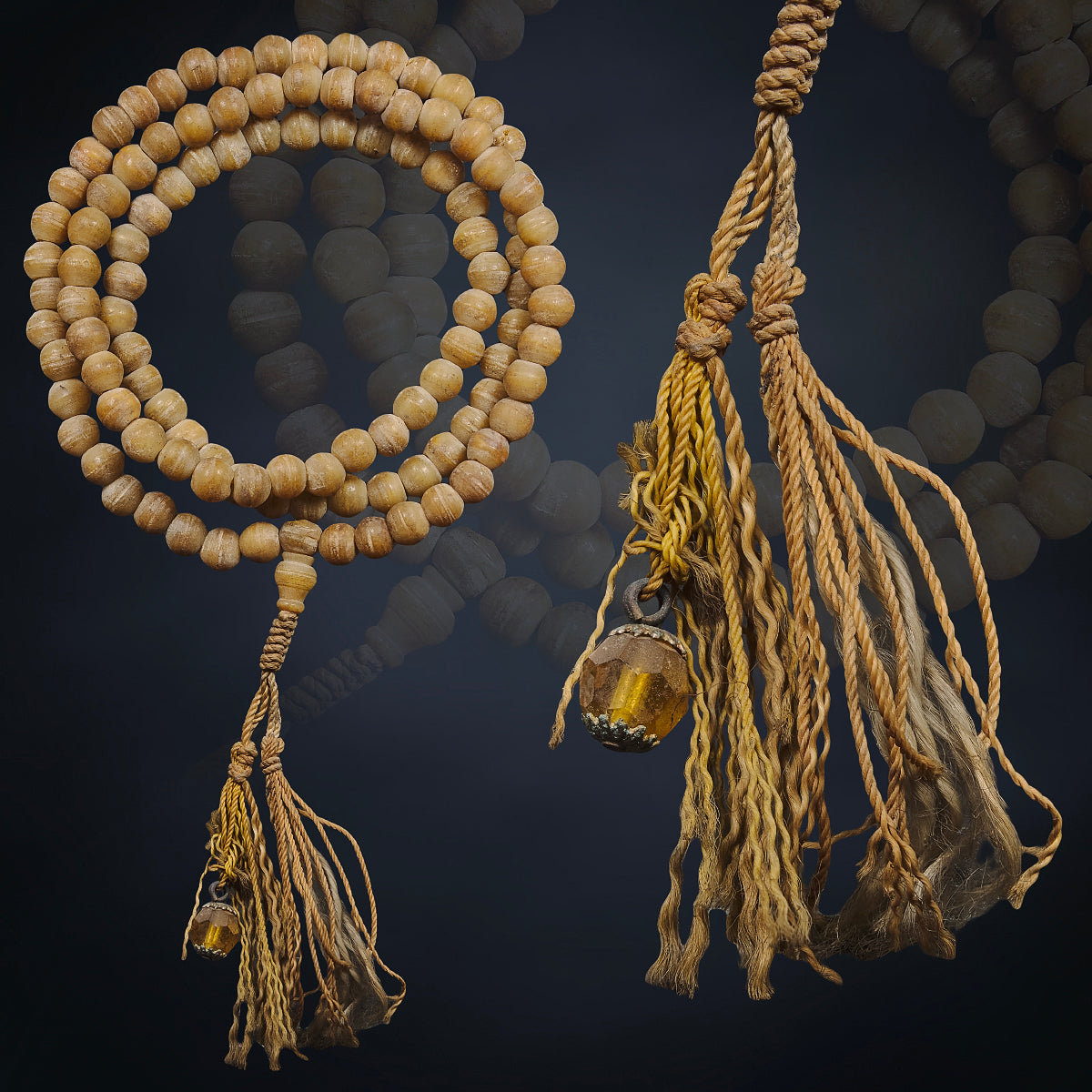
The beads were individually shaped and assembled by hand before being strung into the traditional 108-bead arrangement. Natural differences in colour, grain, shape and ageing remain visible throughout the mala, giving each ritual set its own individual character.
Personal Experiences Shared by Luksits
Among Por Sala Tan's luksits, the Mala Gaduk Chang was regarded less as an amulet to be worn and more as a working instrument of practice.
Such malas accompanied meditation, chanting, wicha practice and consecration ceremonies. With repeated ritual use, practitioners regarded them as gradually accumulating baramee — the spiritual authority and strength generated through disciplined practice, blessings and sacred ceremony.
For ceremonies requiring yang energy, authority, command and strong protective force, the Gaduk Chang mala was preferred.
This distinction is important: the present mala was not prepared as a spirit-bound or Prai object. Its character comes from baramee, ritual use and the wicha repeatedly performed through it.
Summary
The Mala Gaduk Chang is a 108-bead ritual mala personally prepared and used within the wicha tradition of Por Sala Tan.
Made from Gaduk Chang gathered and offered by luksits, it served as a working sacred implement for meditation, mantra recitation, wicha practice and consecration ceremonies.
Its character is distinctly yang: grounded, authoritative and protective.
Of particular importance is its association with ceremonies invoking Lersi Ser Ming Pai, the Tiger-Headed Lersi, whose tradition embodies fierce protection, spiritual command and disciplined authority.
Rather than being made primarily for distribution, this was a ritual tool with lineage and use — an object whose importance developed through the ceremonies in which it participated.
Historical Background
The mala has a long history across Buddhist and esoteric traditions as an instrument for maintaining concentration and counting repeated recitations.
The number 108 carries deep significance throughout Buddhist practice and is commonly reflected in prayer beads, mantra repetitions and contemplative disciplines.
Within Por Sala Tan's practice, however, the material of a mala could also be chosen according to the nature of the wicha being performed.
Gaduk Chang carries the traditional symbolism of strength, stability, dignity, endurance and commanding presence. These qualities made it particularly suited to ceremonies requiring a strong yang foundation rather than the receptive or spirit-oriented character associated with certain yin materials.
Origins of the Materials
The principal material is Gaduk Chang
According to the lineage surrounding these malas, suitable material was sometimes gathered by Por Sala Tan's luksits during journeys into mountainous regions for meditation. The material would then be brought back and entrusted to him.
Por Sala Tan did not simply string whatever material was available. He waited until he considered the material appropriate before creating a complete 108-bead mala.
For practitioners, the significance of Gaduk Chang extends beyond the physical material itself. The elephant traditionally represents immense strength held under control — power combined with patience, stability and authority.
This symbolism closely matches the intended ritual character of the mala.
Ritual
The Mala Gaduk Chang became particularly important during consecration ceremonies requiring deep wicha and sustained chanting.
Por Sala Tan would hold or work with the mala while reciting ancient incantations, maintaining meditative concentration and directing the ritual intention of the ceremony. In this context, each bead provided a physical rhythm through which repeated kata and mantra could be maintained.
Some ceremonies demanded considerable baramee from the practitioner — particularly rites concerned with protection, command, stabilisation and the control of powerful ritual forces.
Por Sala Tan invoked this Lersi current during numerous consecrations. Within the lineage, Lersi Ser Ming Pai represents fierce guardianship, authority, courage, discipline and spiritual command.
The Gaduk Chang mala was repeatedly present during such chanting and consecration work.
For this reason, practitioners regard the mala as having absorbed the baramee of repeated Lersi practice — particularly the commanding, protective quality described as Tiger Baramee.
Importantly, this does not mean that a tiger spirit or another entity is considered attached to the mala. Its significance comes from ritual use, invocation and accumulated baramee rather than spirit binding.
Blessings and Effects
The Mala Gaduk Chang is traditionally associated with Baramee, strengthening personal presence, confidence and spiritual authority.
Its yang character is also connected with Amnaj, or commanding power, together with courage, decisiveness and protection during difficult circumstances.
Through its association with Lersi Ser Ming Pai, practitioners further connect it with Tiger Baramee — a symbolism of disciplined strength, fierce guardianship and the ability to remain firm when confronting obstacles.
For meditation and wicha practitioners, its most direct purpose remains concentration and mantra recitation. The physical movement through 108 beads establishes rhythm while helping the practitioner maintain focus through extended chanting.
Modern Application
The Mala Gaduk Chang may continue to be used traditionally for chanting, meditation and wicha practice, but it also has an important place as an altar object.
Within the lineage, a mala repeatedly employed in consecration is regarded as a conductor of baramee. It may therefore be placed near other sacred objects on an altar as a supporting ritual implement.
This is particularly interesting because its yang character allows it to sit alongside different traditions. It may accompany mainstream Buddhist amulets, Lersi pieces or more yin-oriented sacred objects without itself being regarded as Prai-based.
Its purpose is not to introduce another spirit to the altar, but to provide a stable ritual foundation of accumulated practice and baramee.
Physical Details
This is a complete 108-bead Mala Gaduk Chang, individually prepared naturally and joined into a traditional long-form chanting strand. The beads display variations in cream, ochre and deeper aged tones, together with irregularities characteristic of individually worked natural material. A shaped terminal bead leads into the original-style corded tassel, completing a functional ritual mala intended for handling during chanting and meditation rather than merely decorative display.
Recommended Pairing
The Mala Gaduk Chang is best regarded as an altar and practice companion rather than an ordinary necklace.
It pairs naturally with Lersi amulets, particularly pieces connected with authority, protection and disciplined wicha practice. It may also be placed alongside mainstream Buddhist amulets where the intention is to establish a stronger atmosphere of chanting, concentration and baramee around the altar.
For practitioners owning both yin and yang sacred objects, the mala may serve as a strong yang-oriented ritual anchor within the collection.
Personal Notes
This is not a commercial mala made simply for sale or general distribution.
Its significance lies in the sequence behind it: Gaduk Chang was gathered and entrusted by luksits, selected and prepared by Por Sala Tan, formed into the traditional 108-bead arrangement, and subsequently used as a working instrument during chanting and consecration.
Over time, the mala became more than the sum of its physical materials.
Within Por Sala Tan's tradition, it represents a living conductor of baramee — an old working implement carrying the imprint of meditation, ancient kata, Lersi invocation and repeated sacred ceremony.
For this reason, it should be understood first as a piece of Por Sala Tan's ritual lineage and legacy, and only secondly as a collectible sacred object.
-
Free Shipping for Singapore| $15 Worldwide | $60 USA For Items Below $350