
OOBThaiAmulets
Por Sala Tan
Por Sala Tan
Couldn't load pickup availability
PST02
Rian Pak Pii
Por Sala Tan
B.E. 252x
2cm
Barang Artifact
Sacred Craftsmanship
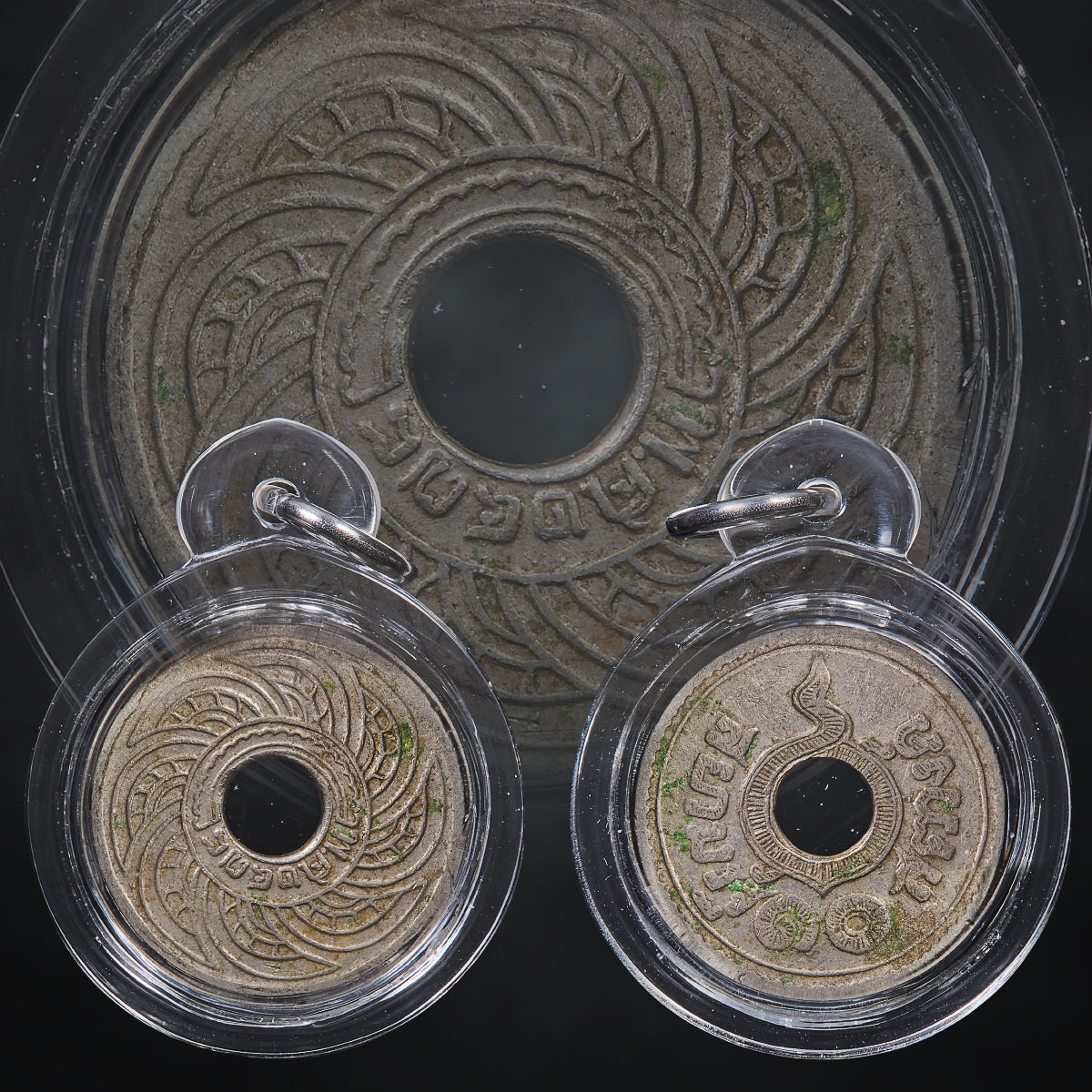
The Rian Pak Pii is one of Por Sala Tan's more unusual Yin-based ritual objects, it is an old Ngern Pak Pii — a funerary coin traditionally placed in the mouth of the deceased.
Each Rian Pak Pii originates from an actual older coin and its individual ritual history. Natural differences in wear, oxidation, surface deposits, markings and condition are inherent to these pieces and form part of their character.
Personal Experiences Shared by Luksits
Among Por Sala Tan's luksits, the Rian Pak Pii was often regarded as a useful supporting artifact rather than something that always needed to be worn alone.
Some followers tied one together with an existing Prai or Barang amulet when they felt that the original piece required a stronger Yin foundation. In this role, the coin was regarded almost as an amplifier — adding the funerary Yin quality of the Ngern Pak Pii without changing the identity of the principal artifact.In this form, experiences were more commonly associated with Metta, Saneh and luck, particularly in situations involving money, customers and opportunities.
Older practitioners also associated Ngern Pak Pii with moments of transition. When beginning a new business, recovering after financial difficulty or entering an uncertain period of life, the symbolism of money that had “crossed the boundary and returned” carried particular significance.
Summary
The Rian Pak Pii is an old funerary coin selected and consecrated by Por Sala Tan for its strong Yin character.
Traditionally known as Ngern Pak Pii, such coins were placed in the mouth of a deceased person as part of funeral practice. Their later use within occult traditions developed from their intimate association with death, passage and the boundary separating the living from the spirit world.
Por Sala Tan used these coins both as independent charms for Metta, Saneh, luck and financial movement, and as supplementary pieces tied to other amulets to strengthen Yin energy.
The Chakra imagery gives this particular example an additional association with protection, removal of obstacles and turning away harmful influences.
Historical Background
The name Ngern Pak Pii may be understood literally as “money of the ghost's mouth”, while Rian Pak Pii refers to the coin itself.
In northern Thai and wider regional funerary traditions, money could be placed with the deceased as part of the final rites. One practice involved placing a coin within the mouth before cremation or burial.
Several explanations have traditionally surrounded this custom.
The money could represent provisions for the deceased's onward journey, a symbolic payment for passage, or a final worldly offering before separation from the living household.
Whatever the precise local interpretation, the central symbolism is transition.
The deceased has completed one condition of existence and is preparing to enter another.
This boundary-crossing symbolism later made such coins significant to practitioners of occult wicha. A coin normally belongs to the everyday world of exchange and circulation, yet the Ngern Pak Pii has entered the realm of death and subsequently returned to the hands of the living.
It is this unusual history that gives the material its reputation.
Origins of the Materials
Unlike an ordinary coin subsequently blessed for good fortune, the important characteristic of a genuine Rian Pak Pii is its previous funerary use.
The coin had already accompanied the deceased through part of the final rites before eventually being recovered.
Traditional practitioners believed this prolonged contact gave the metal a pronounced Yin association and made it useful as a ritual bridge between ordinary material symbolism — money, exchange and circulation — and the unseen world.
This particular example also bears a Chakra design.
The Chakra is closely associated with the Sudarshana Chakra, the sacred discus of Vishnu, known in Thailand as Phra Narai. In Hindu iconography it represents divine power capable of overcoming destructive forces and restoring order.
The combination was especially appropriate for Por Sala Tan's purpose: funerary Yin material carrying a symbol traditionally associated with cutting through obstacles and harmful influences.
Ritual
Por Sala Tan did not treat the old corpse coin simply as an object that had acquired power automatically through contact with death.
It was ritually prepared and chanted so that its existing Yin association could be directed towards specific purposes.
One application was as an enhancer for other Barang artifacts.
The Rian Pak Pii could be tied together with an amulet, keychain or sacred object, allowing its Yin character to supplement Prai-based or spirit-related wicha already present within the principal piece.
It could also be consecrated for independent carrying.
Here, the emphasis shifted towards Metta, Saneh, Maha Lap, protection and the movement of stagnant fortune.
The Chakra symbolism complemented this purpose by representing the clearing of obstructions before opportunity could move forward.
Por Sala Tan's approach therefore transformed the coin from a funerary object into a deliberately directed ritual tool.
Blessings and Effects
The Rian Pak Pii has several overlapping traditional applications.
Its most distinctive role within Por Sala Tan's practice is Yin enhancement. When combined with another Barang or Prai artifact, it is intended to deepen the Yin aspect of that piece and strengthen its connection with spirit-oriented wicha.
When carried independently, it is traditionally associated with Metta and Saneh, encouraging favourable attention, social receptiveness and smoother dealings with others.
The monetary identity of the object also gives it a strong association with Maha Lap and financial circulation. Practitioners may carry it when seeking new income, improved business turnover, repayment of money owed or movement after a period of financial stagnation.
Its connection with passage gives rise to another important quality: crossing obstacles.
Traditional interpretations therefore extend to overcoming difficult periods, beginning again after failure, passing safely through uncertain circumstances and turning an unfavourable situation towards a new direction.
Finally, the Chakra and funerary associations give the piece a protective dimension — particularly against negative spiritual influences, bad omens and unseen disturbances.
Modern Application
For a modern collector, the Rian Pak Pii can be understood in two principal ways.
The first is as a supporting artifact.
It may be kept alongside a Por Sala Tan Prai, Mae Prai, Khun Paen or other Barang piece where the intention is to reinforce its Yin character without replacing the principal amulet.
The second is as a small standalone charm.
At approximately 2 cm, it is discreet enough for everyday carrying and may traditionally be approached for business, customer relations, Saneh, financial movement or protection during periods of significant change.
Its symbolism is particularly appropriate when a person is closing one chapter and entering another — beginning a business, rebuilding after hardship, changing career direction or attempting to break a prolonged period of stagnation.
In this context, the meaning of the Rian Pak Pii is especially striking: something that accompanied the end of one journey becomes a symbolic aid for the beginning of another.
Physical Details
The Rian Pak Pii measures approximately 2 cm and is an original older metal coin now preserved within a fitted clear protective casing. One face carries an elaborate rotating Chakra motif surrounding the central aperture, while the opposite face contains further sacred and decorative markings arranged around the same opening. Age-related wear, oxidation, deposits, softened details and variations in surface colour are natural characteristics of an older funerary coin and should be expected from piece to piece.
Recommended Pairing
The Rian Pak Pii is particularly suited to pairing with Prai and Barang artifacts, where its principal role is to contribute additional Yin energy to the existing wicha.
For Saneh work, it may accompany Yin Tong, Khun Paen or Mae Prai, combining its Yin foundation with more specialised attraction qualities.
For business and financial purposes, pairing it with Phra Sivali creates a contrasting combination: the Rian Pak Pii traditionally representing movement, opportunity and the breaking of stagnation, while Phra Sivali represents livelihood and abundance.
A Buddha image or Phra Somdej may also be carried alongside it where the owner prefers to balance the strong Yin symbolism of the funerary coin with Baramee and merit-based Buddhist practice.
-
Free Shipping for Singapore| $15 Worldwide | $60 USA For Items Below $350