
OOBThaiAmulets
Por Sala Tan
Por Sala Tan
Couldn't load pickup availability
PST02
Mae Prai Karen Relic
Por Sala Tan
2 Inches
Barang Artifact
Sacred Craftsmanship
This Mae Prai Karen Relic is a deeply personal spirit-based artifact by Por Sala Tan, connected with a young woman from the Karen Highlands and the possessions to which she remained strongly attached after death.
Each aspect of this artifact was individually assembled from original relic and ritual materials. Natural variations in the relic surface, handwritten Yant, cord, sacred material and ageing are intrinsic to the piece and form part of its individual history.
Personal Experiences Shared by Luksits
The most important experiences surrounding this Mae Prai were not initially reports of Seneh, but the difficulty Por Sala Tan encountered in helping the young woman's spirit release its attachment.
Several ritual attempts had already been made, yet something remained unresolved.
According to the account passed down by Ajarn Lek, the problem became clearer when the woman's attachment to her traditional family beads was understood.
Por Sala Tan did not respond by attempting to overpower the spirit.
Instead, he made the unusually personal decision to offer one bead from his own long-used meditation beads.
After this exchange and the accompanying merit transfer, those close to the work regarded the Mae Prai as noticeably calmer and more harmonious.
Ajarn Lek later related that the connection did not disappear completely. He continued at times to experience the young woman during meditation, dreams and brief visual impressions.
These appearances were not described as threatening.
Within the lineage account, they were interpreted as signs that although the suffering and attachment surrounding the spirit had been pacified, a connection with the people involved in helping her remained.
This history is important to understanding the artifact. Its Seneh character was not established through a story of domination, but through offering, reconciliation and cooperation.
Summary
The Mae Prai Karen Relic is an unusual Seneh artifact whose history centres upon the attempted liberation of a young Karen woman who remained attached to a treasured family possession.
Her attachment could not initially be resolved through ritual alone.
Por Sala Tan eventually offered her one bead from his own personal meditation-bead string, creating a symbolic exchange for the beads she had remained unwilling to leave behind.
According to Ajarn Lek, this act finally brought the Mae Prai into a calmer and more cooperative state.
The relic was subsequently prepared with handwritten Yant, Takrut, sacred material and fibre binding, while Por Sala Tan's personal bead became an important part of its history.
Its traditional qualities centre upon Seneh, Metta, meaningful human connection, attraction and harmonious relationships.
Historical Background
The Karen peoples comprise several related ethnic communities found across areas of present-day Myanmar and Thailand, including mountainous and border regions where distinctive languages, dress, craft traditions and local customs have been maintained across generations.
Within the history preserved for this particular artifact, the young woman's beaded necklace was especially important.
It was not remembered simply as jewellery.
The beads represented family continuity, personal identity and a connection with the cultural world to which she had belonged. Her unwillingness to separate from them therefore became central to the understanding of why her spirit remained attached.
This gives the piece a rather different character from conventional Mae Prai artifacts created principally around attraction wicha.
The starting point was unresolved attachment.
Por Sala Tan's task was first to address that attachment and establish peace. Only after this relationship had been resolved could the relic become part of a properly prepared sacred object.
Origins of the Materials
The principal relic is associated with the young Karen woman whose story forms the foundation of the piece.
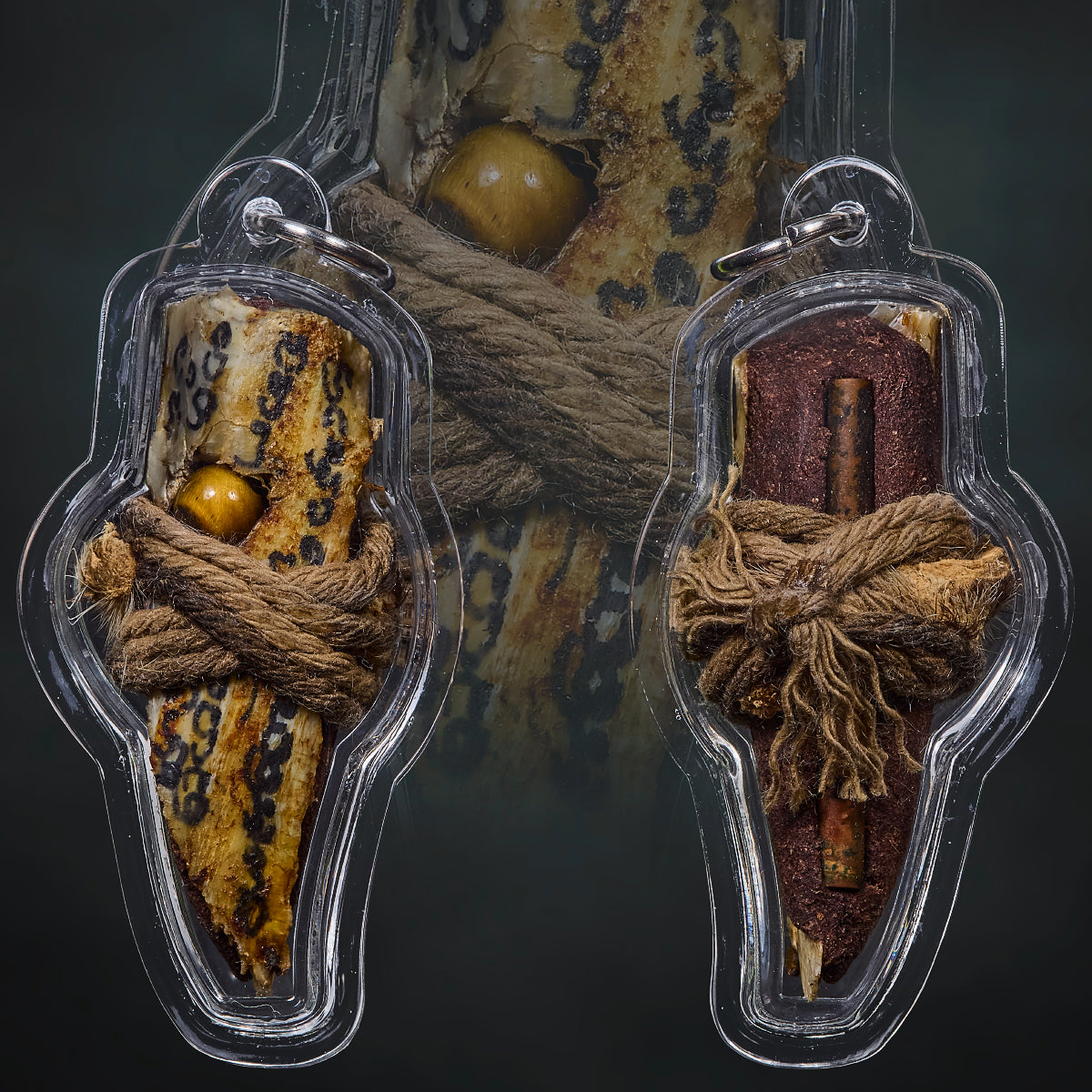
Por Sala Tan retained the natural character of the material and applied sacred inscriptions directly across its surface.
A Takrut was prepared for the reverse, together with sacred substances intended to stabilise and anchor the completed construction.
Old fibre cord was used extensively around the relic.
The most personally significant material, however, came directly from Por Sala Tan himself.
When it became apparent that the woman's attachment to her inherited beads remained an obstacle, Por Sala Tan took a bead from the meditation string he had personally carried for decades.
Within the ritual understanding of the event, the importance was not the monetary value of the bead.
Its significance came from use and personal association.
It had accompanied Por Sala Tan through years of practice and therefore represented something belonging genuinely to him. By giving it away, the gesture became an offering rather than the simple addition of another ritual ingredient.
Ritual
Por Sala Tan initially approached the Mae Prai through rites intended to pacify the spirit, transfer merit and allow her to move beyond the circumstances surrounding her death.
The process was not immediately successful.
Despite repeated consecration, the attachment persisted.
Once the connection with her traditional beads was recognised, Por Sala Tan changed his approach. Rather than relying upon stronger ritual command, he introduced a personal exchange.
One bead from his own meditation string was offered to the Mae Prai.
The gesture acknowledged the importance of what she had lost while simultaneously providing something connected with the person attempting to help her.
Merit was transferred and the ritual relationship was re-established upon this basis.
The relic was then completed with sacred Yant, Takrut, prepared ritual material and fibre binding. The spirit relationship was understood as one of agreement and cooperation rather than coercive restraint.
This distinction became central to the character of the finished artifact.
Blessings and Effects
The principal traditional quality of the Mae Prai Karen Relic is Seneh, but its character is more closely associated with emotional connection than purely physical attraction.
It is traditionally approached for personal charm, approachability and the ability to establish warmer relationships with others.
Metta qualities complement this function by encouraging goodwill, sympathy and a softer response from people encountered by the bearer.
In relationships, the emphasis is upon connection, understanding and emotional closeness.
For those working with customers or members of the public, the same qualities may be applied towards rapport and favourable interpersonal dealings.
The story of the Mae Prai also gives the artifact an association with reconciliation — finding a point of understanding where attachment or emotional difficulty has prevented a relationship from moving forward.
Within Por Sala Tan's tradition, these qualities are understood as spiritual assistance rather than control over another person's will.
Modern Application
This piece may appeal particularly to someone seeking Seneh with a gentler interpersonal character.
Rather than focusing solely upon romantic attraction, it may be carried where empathy, communication and the ability to connect meaningfully with others are important.
This makes it relevant to relationships as well as occupations involving clients, negotiation, hospitality or regular personal interaction.
For practitioners, the history also carries a broader lesson.
Por Sala Tan's eventual solution was not to apply greater force when his earlier attempts failed. He recognised the source of the attachment and responded with an offering carrying genuine personal significance.
The artifact consequently preserves an important aspect of his approach to spirit work: understanding the history behind an attachment could sometimes be more important than attempting to overpower it.
Physical Details
This Mae Prai artifact retains the irregular natural form of its original relic material, with handwritten sacred Yantvisible across the surface. A small bead associated with Por Sala Tan's personal offering is incorporated into the construction. The reverse contains a prepared sacred base with a Takrut positioned centrally, while old fibre cord is wrapped and knotted firmly around the body. Natural ageing, staining, irregularities in the relic, handwritten inscriptions and wear to the cord are inherent to the original construction. The artifact is presently preserved within a fitted clear protective casing.
Recommended Pairing
Because this Mae Prai is principally associated with Seneh, Metta and emotional connection, it pairs naturally with a Buddha image for Baramee, merit and spiritual balance.
A Phra Somdej can provide this broader Buddhist foundation while leaving the Mae Prai focused upon its specialised attraction and relationship qualities.
For business or client-facing use, Phra Sivali may complement the piece through traditional associations with livelihood, abundance and favourable opportunities.
A Lersi image is another meaningful pairing for those following Por Sala Tan's tradition. The Mae Prai represents Seneh through reconciliation and cooperation, while the Lersi provides the complementary qualities of wisdom, guidance and disciplined wicha.
-
Free Shipping for Singapore| $15 Worldwide | $60 USA For Items Below $350