
OOBThaiAmulets
Por Sala Tan
Por Sala Tan
Couldn't load pickup availability
PST02
Yoni
Por Sala Tan
2.5 Inches
Barang Artifact
Sacred Craftsmanship
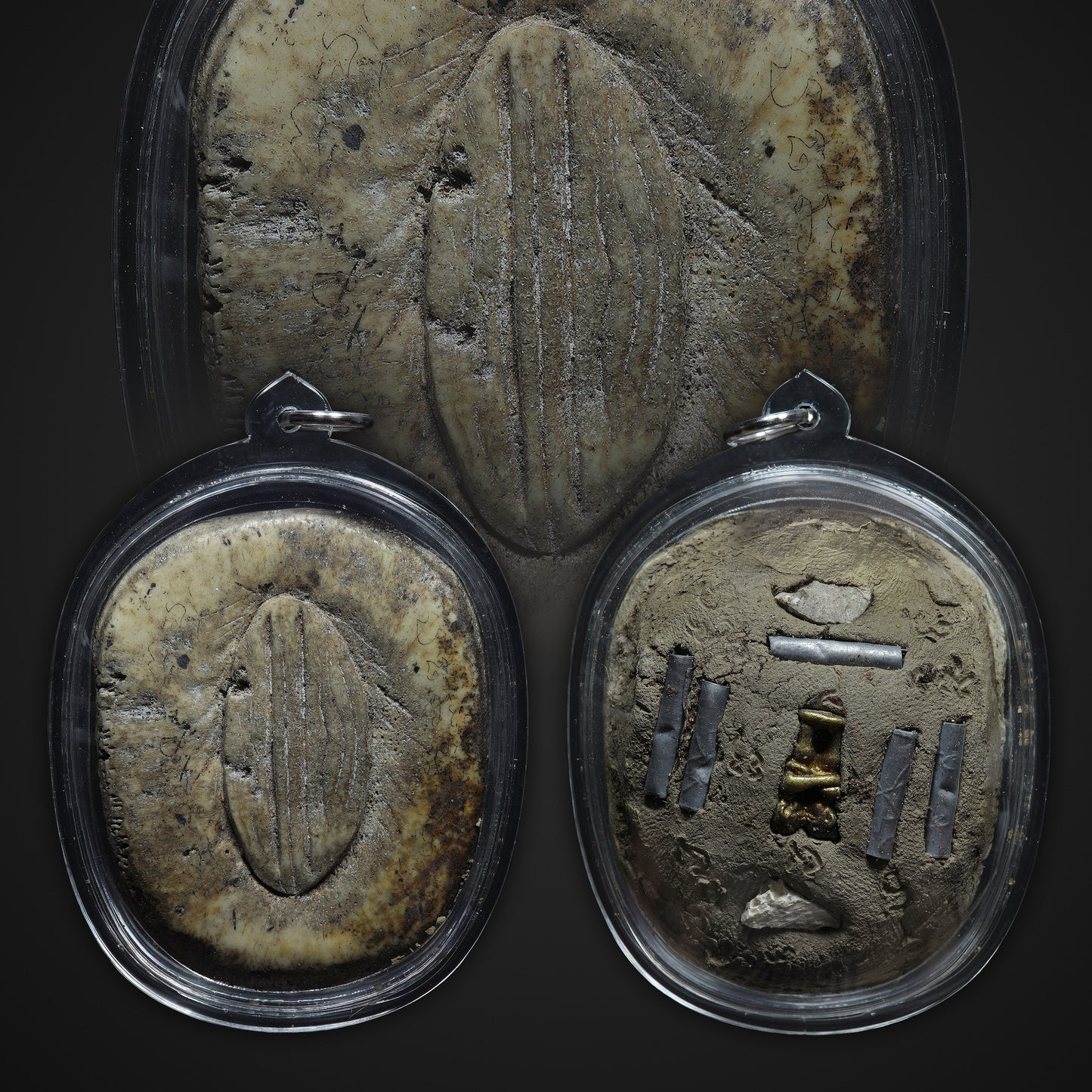
This Yoni is one of the more unusual relic-based sacred objects associated with Por Sala Tan. Its principal body was carved from what was described within the lineage as a relic-grade Yoni bone more than a century old, originally excavated from the Isan region of northeastern Thailand.
Each element was positioned by hand according to Por Sala Tan's intended arrangement. Natural ageing, mineral staining, burial marks, relic texture, ritual powders and variations in the embedded materials form part of the character of the original piece.
Personal Experiences Shared by Luksits
The most important experience associated with this Yoni comes from the luksit who originally possessed the relic.
Before bringing it to Por Sala Tan, he had spent more than a year attempting to awaken its Saneh qualities through his own ritual methods. Despite repeated efforts, he felt virtually no response from the material.
This was particularly puzzling because he believed the relic itself was far from ordinary.
The situation changed when Por Sala Tan worked on it.
After examining the relic and installing the new ritual components, Por Sala Tan began chanting. According to the account preserved with the piece, within approximately five minutes the character of the object appeared to change noticeably.
The luksit described experiencing a sensation resembling a buzzing heat, while others present described a much stronger sense of presence or pull surrounding the relic.
For the luksit, the significance was immediate. Something he had attempted unsuccessfully for more than a year had apparently responded within minutes under Por Sala Tan's ritual intervention.
He subsequently carried and used the Yoni for a period of time.
Its history then took another unexpected turn.
During one of Por Sala Tan's Wai Kru ceremonies, the luksit placed the Yoni into the communal blessing basket so that it could participate in the ceremony with other sacred objects.
Afterwards, he forgot to retrieve it.
Por Sala Tan recognised the piece and, rather than allowing it to become misplaced, transferred it to his own altar. There it remained for more than fifteen years, repeatedly exposed to Por Sala Tan's chanting, ceremonies and altar practice until the master's passing.
Summary
This Yoni brings together three distinct stages of sacred history.
The first is its origin as an old relic excavated in Isan and believed to be more than a century old.
The second is its reactivation by Por Sala Tan, who recognised that the material was not spiritually empty but dormant after its prolonged burial. He prepared the reverse with Paneang relics, Yin Tong, copper and lead Takrut, sacred powders and ritual waxes, then performed the chanting associated with its awakening.
The third is its extraordinary period of altar residence.
After being accidentally left behind during a Wai Kru ceremony, the Yoni remained upon Por Sala Tan's own altar for more than fifteen years, receiving repeated exposure to ceremonies and chanting until his passing.
Its principal traditional direction is Saneh — attraction, magnetism, personal presence and favourable interpersonal response.
Historical Background
Yoni imagery belongs to a much older symbolic tradition than the modern Thai amulet market.
Across South and Southeast Asian traditions, the Yoni has represented feminine generative power, fertility, creation and the receptive principle. Within later folk and esoteric practices, this symbolism could also become closely connected with attraction, sexuality and Saneh.
Por Sala Tan's treatment of this particular artifact, however, was determined as much by the history of its material as by its physical form.
The relic had reportedly remained underground for more than a century before being excavated in Isan.
Its subsequent owner recognised unusual potential in the object but was unable to obtain the response he expected despite prolonged ritual work.
Por Sala Tan interpreted this not as evidence that the material lacked spiritual significance, but as a consequence of long dormancy.
In his understanding, a sacred relic could retain its underlying character while becoming inactive after prolonged isolation. Such an object required the appropriate wicha to reopen, stabilise and redirect what remained within it.
This became the foundation of his work upon the Yoni.
Origins of the Materials
The principal body is an old Yoni relic excavated from the Isan region, with its age traditionally given as more than one hundred years.
Its prolonged burial is important to the history of the piece. The surface retains the irregular colouration, ageing and weathering expected of material that had spent a considerable period underground.
Por Sala Tan supplemented this original relic with several materials.
Most significant were the new Paneang relics introduced into the rear chamber. These were intended to provide the necessary ignition and connection for the dormant original material.
A small brass Yin Tong was added at the centre. The paired male-and-female symbolism of Yin Tong naturally complemented the Yoni's Saneh orientation.
Several lead and copper Takrut were positioned around the central figure, while sacred powders and ritual waxes filled and stabilised the remaining chamber.
The completed artifact therefore retains its century-old relic as its foundation while incorporating later ritual materials selected personally by Por Sala Tan.
Ritual
Por Sala Tan's intervention was deliberately direct.
He first identified the original problem as dormancy caused by prolonged burial, rather than absence of spiritual potential.
The reverse was then prepared to receive the new ritual components.
Paneang relics were introduced to awaken and reconnect the older material. The brass Yin Tong strengthened the Saneh direction, while the copper and lead Takrut provided individually prepared wicha around the central chamber.
Sacred powders and waxes were then used to anchor the entire arrangement.
Once the physical preparation was complete, Por Sala Tan began chanting.
According to the owner, the response came in approximately five minutes — exceptionally quickly when compared with his own unsuccessful efforts during the preceding year.
The later history of the artifact effectively extended this ritual process far beyond its initial activation.
After being left in the Wai Kru blessing basket, the Yoni was placed upon Por Sala Tan's personal altar, where it remained for more than fifteen years. During this period it was present through repeated chanting, offerings, Wai Kru observances and other ceremonies conducted around the altar.
Blessings and Effects
The principal traditional quality of this Yoni is Saneh.
Its purpose is centred upon personal attraction and the ability to create a stronger impression upon people encountered by the bearer.
The Yoni and Yin Tong combination particularly emphasises interpersonal magnetism, including romantic attraction, warmth between people and increased noticeability in social circumstances.
Its application can also extend into business.
For those whose livelihood depends upon customers, negotiation or personal relationships, Saneh may be understood as supporting rapport, favourable attention and the ability to establish connections more easily.
The Paneang relics and other ritual materials strengthen the attraction-oriented direction established by Por Sala Tan, while the Takrut provide the wicha through which the different components were ritually organised.
The artifact is therefore best understood as a specialised Saneh piece, rather than a general-purpose protective amulet.
Modern Application
The Yoni is particularly relevant to individuals whose circumstances depend heavily upon personal interaction and presence.
It may traditionally be carried for romance and attraction, but its application is not limited to intimate relationships.
Those involved in sales, hospitality, entertainment, negotiation or other client-facing occupations may approach the piece through its broader Saneh qualities — becoming more noticeable, encouraging warmer responses and improving interpersonal rapport.
Its long altar history also gives it significance beyond practical use.
For collectors of Por Sala Tan's work, this is an artifact whose provenance records a direct sequence from ancient buried relic, to a luksit's unsuccessful attempts at activation, to Por Sala Tan's personal intervention, and finally to more than fifteen years upon his own altar.
That history makes the object as much a piece connected with Por Sala Tan himself as it is a traditional Yoni talisman.
Physical Details
This is a substantial oval Yoni relic, traditionally dated to more than a century old and originating from an excavation in Isan. The front retains the raised Yoni form surrounded by the naturally aged relic surface. The reverse contains Por Sala Tan's prepared ritual chamber, incorporating a small brass Yin Tong, multiple lead and copper Takrut, Paneang relic material and sacred powders and waxes. Ageing, staining, surface irregularities and burial-related marks remain visible throughout the original material. The artifact is presently preserved within a fitted clear protective casing.
Recommended Pairing
Because this Yoni is strongly directed towards Saneh, it can be paired with a Buddha image to provide a complementary foundation of Baramee and merit.
A Phra Somdej is particularly suitable when the owner wishes to balance the attraction-oriented character of the Yoni with a more traditional Buddhist sacred object.
For business use, Phra Sivali offers another complementary pairing. The Yoni supports personal magnetism and favourable interaction, while Phra Sivali is traditionally associated with livelihood, abundance and favourable opportunities.
For collectors following Por Sala Tan's own Barang tradition, the Yoni may also be kept as a specialised standalone piece. Its combination of an old Isan relic, Por Sala Tan's direct reactivation and its more than fifteen years of residence upon his altar already gives it a particularly complete ritual history.
-
Free Shipping for Singapore| $15 Worldwide | $60 USA For Items Below $350