
OOBThaiAmulets
Por Sala Tan
Por Sala Tan
Couldn't load pickup availability
PST02
Naga Takrut
Por Sala Tan
4 Inches
Mainstream Artifact
Sacred Craftsmanship
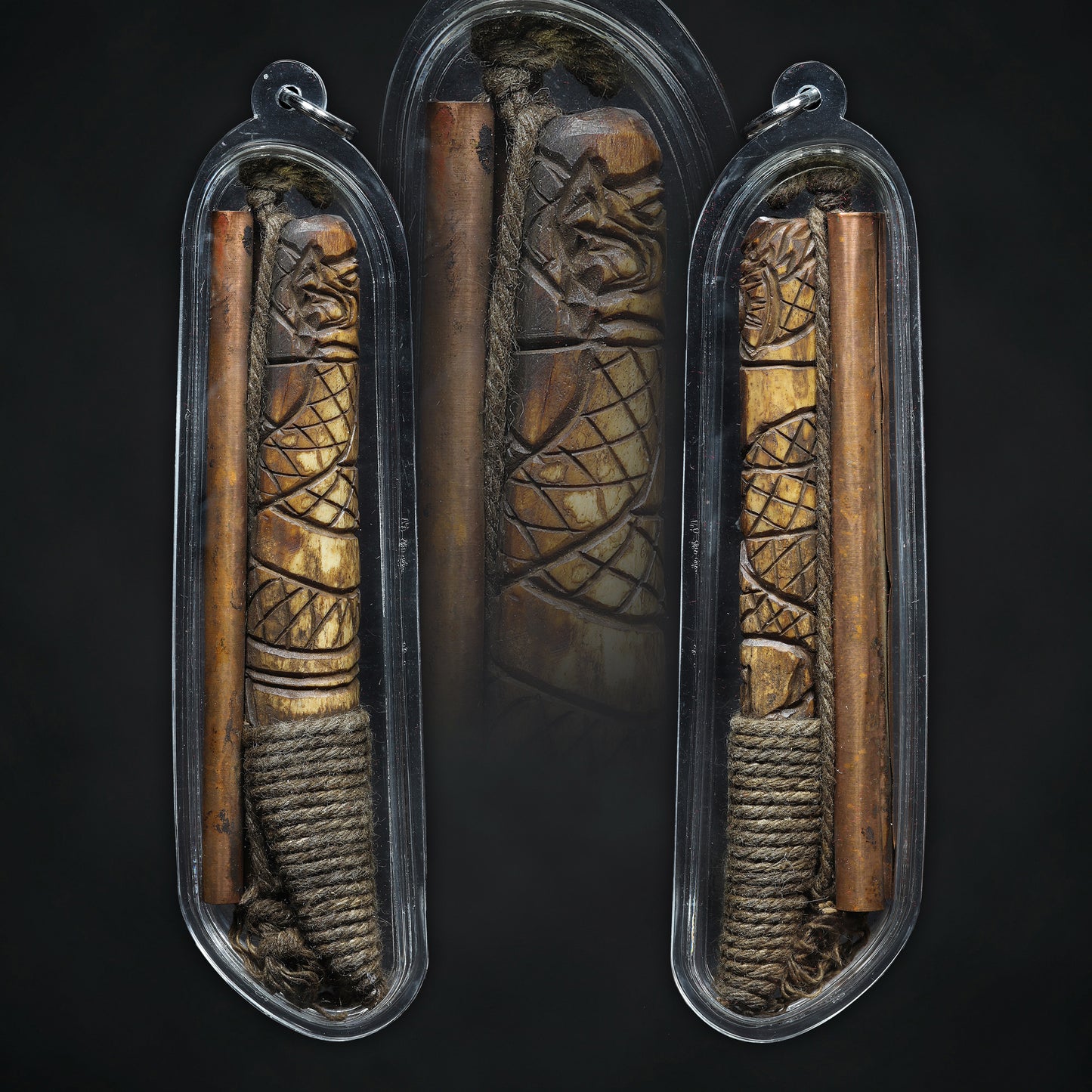
This Naga Takrut was created by Por Sala Tan during one of his visits to Laos, using old relic material collected from the environment surrounding the Mekong River.
Each Naga was individually carved and assembled from naturally aged relic material. Differences in colour, grain, weathering, carving, cord wrapping and Takrut placement are consequently inherent to the workmanship and make every surviving piece individually distinct.
Personal Experiences Shared by Luksits
Among Por Sala Tan's luksits, the Naga Takrut became particularly associated with people involved in business, sales and negotiation.
Owners commonly approached it as a piece for circumstances where both opportunity and protection were required. The Metta Maha Niyom side was carried to encourage smoother dealings with customers, employers and business contacts, while the protective side was relied upon when travelling or entering uncertain situations.
The Naga Takrut also acquired a reputation among some followers facing legal disputes or difficulties involving authority.
Por Sala Tan, however, was clear about how this aspect should be understood.
He taught that such a sacred object was intended to help a person through difficulties and improve the direction of his or her life. A person who had made a mistake might receive an opportunity to avoid a worse outcome, correct the situation or begin again.
But he did not present the Takrut as permission to repeatedly break the law.
His warning was straightforward: an amulet might appear to help someone escape trouble once or twice, but a person who deliberately continues wrongdoing will eventually encounter the consequences of both law and karma.
For his luksits, this caution became an important part of the Naga Takrut's history. Protection was meant to provide another opportunity to live correctly, not encouragement to misuse spiritual practice.
Summary
The Naga Takrut is one of Por Sala Tan's combined attraction-and-protection pieces, created around an old relic collected from the Mekong River environment during his travels in Laos.
Its construction brings together a hand-carved Naga, sacred cord, a larger copper Takrut and a specially prepared duo Takrut.
The two smaller Takruts establish the principal balance of the piece: Metta Maha Niyom for mercy, charm, wealth and favourable dealings; Kong Grapan Chadtri and Klaew Klaad for protection, avoidance of danger and defence against harmful influences.
Together with the traditional symbolism of the Naga, these elements give the piece a broad character centred upon business opportunity, prosperity, protection, safe passage and overcoming difficult circumstances.
Historical Background
The Mekong River has long occupied an important place in the religious and folkloric imagination of communities throughout mainland Southeast Asia.
For populations living along the river, the Mekong is not merely a geographical feature. It is a source of livelihood, movement, fertility and life, while traditional stories also connect its waters with the realm of the Naga.
Nagas appear throughout Buddhist and older regional traditions as powerful serpent beings associated with water, subterranean realms, fertility, treasures and guardianship.
One of the best-known Buddhist narratives concerns Mucalinda, the Naga King who sheltered the Buddha during a period of severe rain following his enlightenment.
Along the Mekong, Naga beliefs developed their own strong regional character. The river itself became inseparable from stories of unseen Naga realms beneath the water.
Por Sala Tan's decision to carve a Naga from material recovered from the Mekong environment therefore carried a natural symbolic connection: a river relic transformed into the image of the spiritual guardian traditionally associated with that river.
Origins of the Materials
According to the history preserved with these pieces, Por Sala Tan obtained the principal relic material while travelling in Laos along the Mekong River.
During the monsoon season, the river can become powerful and unpredictable. Large animals, including buffalo, may occasionally be lost to the water. When water levels later fall during the dry season, old remains can become exposed or accessible along sections of the river environment.
Such naturally recovered relic materials were sometimes collected by practitioners and masters for traditional sacred work.
Por Sala Tan selected suitable material for carving into the Naga form rather than using it in an unworked state.
Copper was used for the accompanying Takrut, while prepared sacred cord provided the binding that physically and ritually united the different components.
The result combines river-recovered relic material, carved sacred imagery, Takrut and consecrated cord within a single construction.
Ritual
After preparing and carving the relic into the Naga form, Por Sala Tan added the Takrut components that determined the principal functions of the completed piece.
The duo Takrut was particularly important.
The first was inscribed and prepared according to Metta Maha Niyom wicha, directing the piece towards mercy, popularity, favourable human relationships, business dealings and the attraction of opportunities.
The second was prepared according to Kong Grapan Chadtri and Klaew Klaad wicha, establishing its defensive qualities.
These two traditions were deliberately combined rather than treated separately.
One side draws favourable circumstances towards the bearer; the other is intended to keep danger and harmful influences away.
The Takruts and carved Naga were then joined with sacred cord and subjected to Por Sala Tan's chanting and consecration, establishing them as one completed talisman rather than a collection of separate components.
Blessings and Effects
The Naga Takrut is traditionally associated with wealth, business opportunity and prosperity.
Its Metta Maha Niyom component is intended to support personal charm and favourable interactions, particularly when dealing with customers, employers, business partners or other people whose goodwill can influence an outcome.
For those involved in sales, this translates into the traditional qualities of approachability, persuasive speech, customer goodwill and opportunity.
The second major function is protection.
Klaew Klaad is associated with avoiding accidents and passing safely through dangerous circumstances, while Kong Grapan Chadtri represents stronger physical protection and resilience.
The Takrut is additionally associated within Por Sala Tan's tradition with guarding against harmful spiritual influences and black magic.
Another traditional application concerns difficult encounters with authority or legal problems. This should be understood as seeking mercy, favourable consideration and an opportunity to resolve difficulties rather than immunity from legal responsibility.
Por Sala Tan specifically warned against using this belief to justify repeated wrongdoing. Protection, in his teaching, was meaningful only when it gave the individual an opportunity to improve his or her conduct.
Modern Application
The Naga Takrut is particularly suited to people whose daily lives combine commercial interaction with frequent movement or uncertainty.
Business owners, salespeople and those working directly with clients may appreciate the combination of Metta Maha Niyom and prosperity-oriented qualities.
Those who travel regularly may place greater emphasis upon its Klaew Klaad and protective aspects.
It can also be carried when negotiating contracts, meeting senior figures, resolving disputes or approaching situations where calm communication and favourable consideration are particularly important.
Its underlying balance remains relevant: attract what is beneficial, avoid what is harmful and use favourable circumstances responsibly.
Physical Details
This is an elongated Naga talisman hand-carved from old relic material collected from the Mekong River environment during Por Sala Tan's travels in Laos. The Naga displays deeply incised scale patterns along its body and a strongly defined carved head. A large copper Takrut runs alongside the carving, while sacred cord is wrapped tightly around the lower portion and extends along the body. A specially prepared duo Takrut forms part of the consecrated construction, with one dedicated to Metta Maha Niyom and the other to Kong Grapan Chadtri and Klaew Klaad. Natural variations in relic colour, grain, ageing, carving and cord condition are expected. The piece is presently preserved within a clear protective casing.
Recommended Pairing
The Naga Takrut is already relatively broad in function because it combines Metta, prosperity and protection within a single piece.
For those wishing to strengthen its business aspect, a Phra Sivali can provide a complementary Buddhist association with livelihood, abundance and favourable circumstances.
A Phra Somdej or another Buddha image may instead be paired with it for Baramee, merit and spiritual stability.
This latter combination is particularly appropriate to Por Sala Tan's warning surrounding the Naga Takrut. Its protective qualities should not be understood as freedom from consequences, but as support for navigating difficulties correctly and making better use of opportunities when they arise.
-
Free Shipping for Singapore| $15 Worldwide | $60 USA For Items Below $350