
OOBThaiAmulets
Por Sala Tan
Por Sala Tan
Couldn't load pickup availability
PST02
Salika Lin Thong
Por Sala Tan
2.5 Inches
Mainstream Artifact
Sacred Craftsmanship
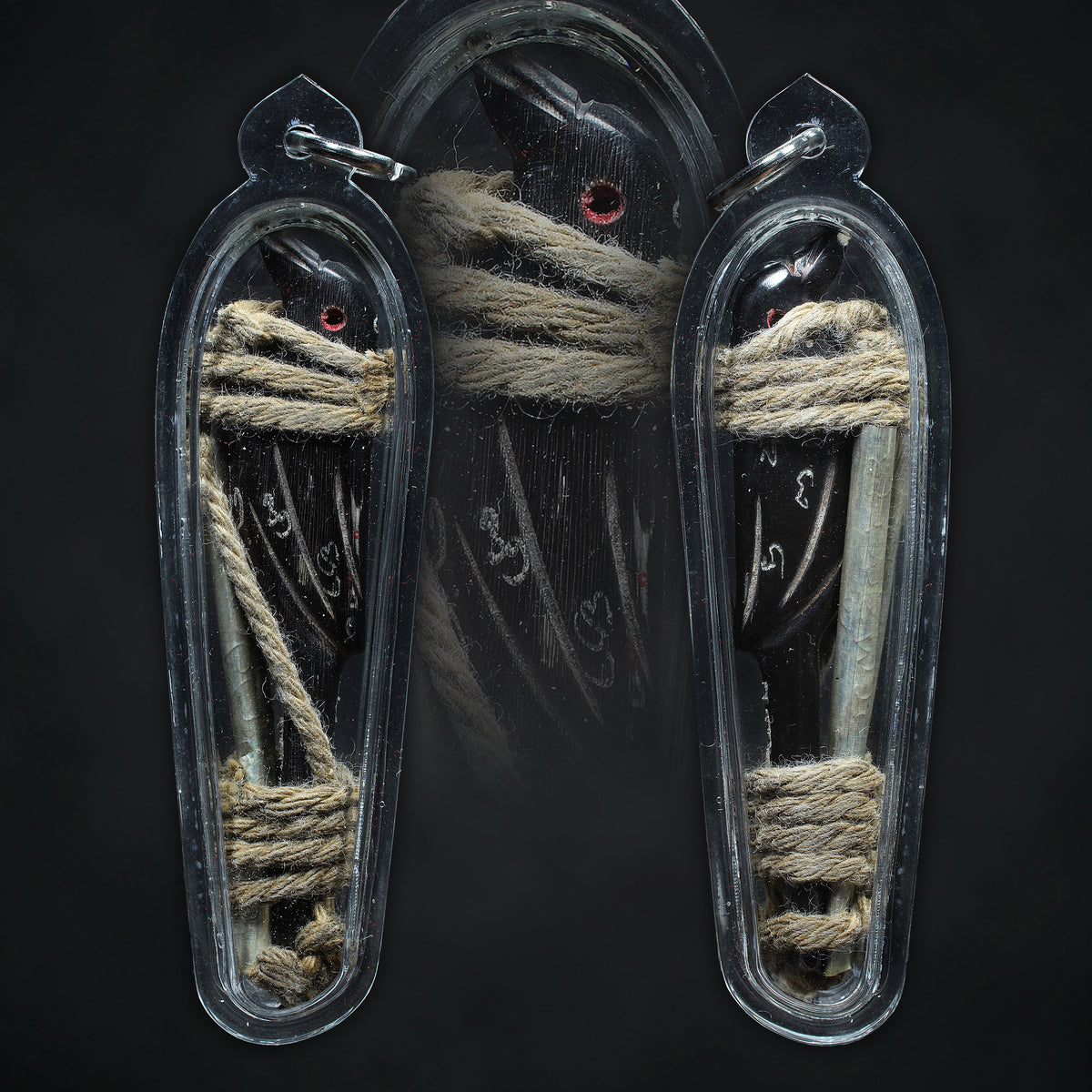
This Salika by Por Sala Tan was individually carved from Kao Kwai, the horn of an old male water buffalo that belonged to a fellow villager from the same village where Por Sala Tan lived.
Each Salika was individually carved from natural Kao Kwai and assembled by hand. Differences in horn grain, colour, carving, cord placement and surface character are therefore natural, making every surviving piece individually distinctive.
Personal Experiences Shared by Luksits
Feedback from owners has centred overwhelmingly upon communication.
Luksits who carried these Salika described conversations as becoming easier, particularly in situations where the other person was initially resistant, unhappy or difficult to manage.
Those working in sales found this especially useful.
Some owners reported that they were better able to explain proposals, manage customer expectations and close sales deals. The effect they described was not that another person suddenly became submissive, but rather that communication seemed to encounter less resistance.
Difficult customers were another recurring theme.
When confronted by an unhappy client or an unwelcome situation, owners described finding the right words more readily and being able to appease the customer before the disagreement became more serious.
Others associated the Salika with people being more willing to listen until they had finished speaking.
For people whose livelihood depended upon conversation, negotiation and maintaining relationships, this made the artifact particularly practical. Rather than being carried only for abstract ideas of charm, it became a working piece for speech, persuasion and interpersonal goodwill.
Summary
This Salika combines a simple village provenance with one of the most recognisable forms of Thai speech-related wicha.
Its body was carved from Kao Kwai belonging to an old male water buffalo from Por Sala Tan's own village. The animal had been known as strong yet friendly towards people and died naturally from old age.
Por Sala Tan subsequently used portions of its horn and remains to create sacred objects for villagers.
The Salika was carved from the horn, accompanied by a Metta Maha Niyom Takrut and bound with sacred ceremonial cord to concentrate and retain the consecrated power.
Its traditional character centres upon eloquence, persuasive communication, Metta Maha Niyom, Maha Saneh, customer relations, negotiation and commercial success.
The story of birds gathering and chirping above the roof while Por Sala Tan was preparing the Salika adds an especially fitting piece of village oral history to an artifact whose symbolism is itself centred upon the captivating voice of a bird.
Historical Background
Salika Lin Thong
Salika, sometimes rendered Sarika, occupies an important position within Thai sacred traditions concerning speech and personal attraction.
One of the best-known concepts is Salika Lin Thong — the “golden-tongued Salika”.
The symbolism is straightforward but powerful: just as a beautiful bird can make people stop and listen to its call, the practitioner seeks speech that is pleasant, convincing and difficult to ignore.
For this reason, Salika wicha became closely associated with people whose success depended upon words.
Merchants wanted customers to listen.
Negotiators wanted opposing parties to remain receptive.
Teachers and leaders wanted their words to carry weight.
Those seeking romance wanted conversation to feel natural rather than forced.
The Salika tradition therefore overlaps with both Metta Maha Niyom and Maha Saneh, but its distinctive emphasis is communication. It is not merely about being noticed; it is about what happens after one begins to speak.
Por Sala Tan's Kao Kwai Salika follows this traditional principle closely.
Origins of the Materials
The provenance of the Kao Kwai is particularly personal because it did not originate from a distant ritual supplier.
The buffalo lived within Por Sala Tan's own village.
It belonged to another villager and was familiar to the local community. During its life it was remembered as a powerful male animal, yet one that remained friendly and accustomed to people.
Eventually, age overtook its physical strength and the buffalo died naturally.
Por Sala Tan subsequently used parts of its horn and remaining material for sacred artifacts intended for villagers.
Within traditional material symbolism, Kao Kwai carries associations with strength, endurance, agricultural livelihood and the close relationship between village life and the water buffalo.
In this particular case, another quality was remembered: temperament.
The animal was strong without being aggressive and approachable despite its physical power. This makes its history particularly suitable for a Salika concerned with influence through goodwill rather than intimidation.
The accompanying Takrut was prepared for Metta Maha Niyom, directing the artifact further towards favourable interaction, popularity and receptiveness from others.
The old sacred cord provides the final visible component, physically binding the Salika and its accompanying ritual element together.
Ritual
After the Kao Kwai had been selected and prepared, Por Sala Tan carved the horn into the Salika form.
The carving was then combined with the Metta Maha Niyom Takrut.
Sacred cord was wound around the construction. In the traditional understanding of the piece, this was not merely a convenient way of attaching the Takrut. The binding formed part of the ritual arrangement, intended to hold and concentrate the wicha within the artifact.
Por Sala Tan then carried out the necessary chanting and consecration.
It was during this period that villagers recalled the unusual behaviour of birds around the building.
According to their account, numerous birds flew above the roof and chirped loudly while the Salika pieces were being prepared.
For villagers familiar with the symbolism of Salika, the occurrence was memorable. The artifact being consecrated below concerned the power of the bird's voice; above, birds had unexpectedly gathered and filled the surroundings with their calls.
The event subsequently became inseparable from the history told about the batch.
Blessings and Effects
The principal quality is Salika Lin Thong — persuasive and pleasant speech. Traditionally, the owner seeks to communicate in a manner that encourages people to listen rather than immediately resist.
Metta Maha Niyom supports goodwill and favourable treatment. This is particularly useful where communication depends upon establishing trust or reducing tension.
Maha Saneh adds personal charm and attraction. In this context, Saneh need not be limited to romance; it may also describe the ability to leave a favourable personal impression.
For commerce, the Salika is traditionally associated with Kha Khai Dee, helping conversation progress towards successful buying, selling and agreement.
It is also particularly suited to negotiation and conflict management. Rather than confronting an angry customer with greater aggression, the traditional ideal is to find words capable of calming the situation and bringing the discussion back towards agreement.
Its principal traditional qualities therefore centre upon eloquence, persuasive speech, customer relations, negotiation, popularity, Metta, Saneh and commercial opportunity.
Modern Application
This is a particularly practical artifact for anyone whose work depends heavily upon speaking.
Salespeople may carry it when presenting products, explaining value or closing agreements.
Business owners may approach it for better communication with customers, employees and suppliers.
Those involved in negotiation, management or client servicing may find its traditional character especially relevant when expectations need to be managed carefully.
It is also appropriate for people working in environments where complaints are unavoidable. The experiences reported by owners repeatedly concern the ability to soften difficult conversations and appease unhappy customers before matters escalate.
Outside business, the same symbolism applies to everyday relationships.
Clearer communication between friends, family members or partners may sometimes be more valuable than simple attraction. In this respect, Salika represents a form of Saneh expressed primarily through speech, understanding and interpersonal warmth.
Physical Details
The artifact is a slender Salika carving fashioned from dark Kao Kwai, retaining the natural character and tonal variation of aged horn.
Fine incised markings and sacred characters can be seen along the dark surface. A small red-filled opening is also visible towards the upper portion.
A long Metta Maha Niyom Takrut runs alongside the carved horn.
Both components are held together by multiple turns of aged sacred cord, with substantial binding at the upper and lower sections. The natural ageing and irregularity of the fibres remain clearly visible.
The piece is presently housed within a fitted clear protective casing, preserving the original horn, Takrut and sacred bindings as a single assembly.
Recommended Pairing
For someone working primarily in sales or commerce, Nang Kwak is an especially natural pairing. Nang Kwak traditionally calls customers and opportunities, while Salika supports the conversation once the customer arrives.
Phra Sivali complements the piece where the broader objective is livelihood, abundance and favourable support from others.
For leadership and negotiation, a Lersi can provide a useful balance of wisdom, judgement and authority alongside Salika's persuasive character.
A Phra Somdej may also be worn with it for Buddhist Baramee and composure, particularly for owners who regularly deal with emotionally difficult or high-pressure situations.
Personal Notes
There is something particularly appropriate about the history of this Salika.
Its material did not come from an anonymous source.
The Kao Kwai belonged to an animal the villagers themselves had known — a strong male water buffalo remembered for being friendly towards people throughout its life.
It eventually died naturally from old age, after which Por Sala Tan transformed part of its horn into an artifact concerned not with force, but with the ability to influence others through communication and goodwill.
Then came the story remembered by the villagers.
While Por Sala Tan was creating and consecrating the Salika, birds gathered above the roof and chirped loudly.
For an artifact based upon the ancient symbolism of a bird whose voice causes others to stop and listen, it was an unusually fitting occurrence.
Perhaps most importantly, later feedback from owners followed the same theme.
They did not simply speak about abstract charm. They spoke about customers becoming easier to communicate with, expectations becoming easier to manage, difficult situations being calmed and sales becoming easier to close.
That is the character of this particular Salika: strength inherited from Kao Kwai, goodwill through Metta Maha Niyom, and influence expressed through the spoken word.
-
Free Shipping for Singapore| $15 Worldwide | $60 USA For Items Below $350