
OOBThaiAmulets
Por Sala Tan
Por Sala Tan
Couldn't load pickup availability
PST02
Nang Kwak
Por Sala Tan
2 inches
Mainstream Artifact
Sacred Craftsmanship
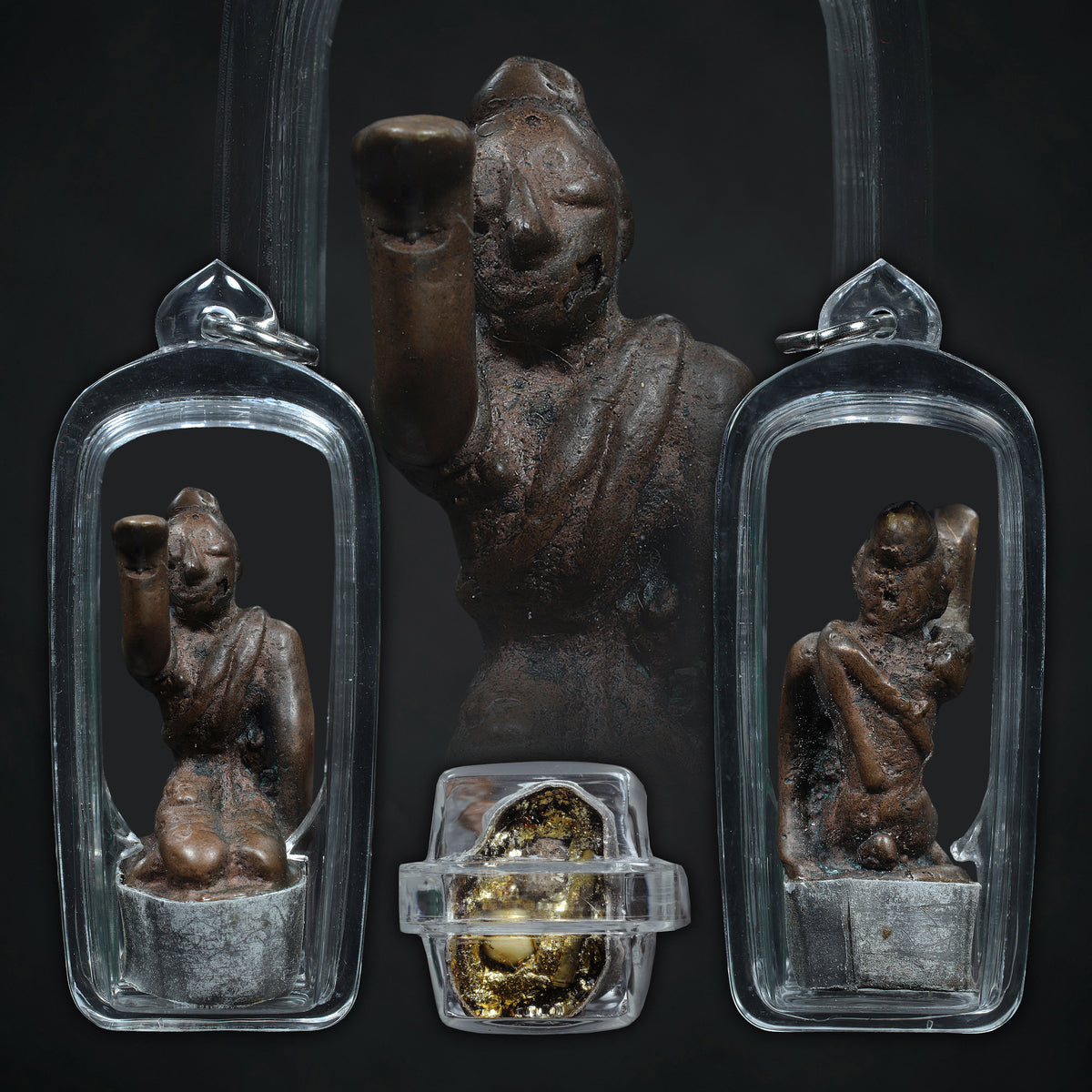
This Nang Kwak Roop Lor is an unusual cross-border work created under the guidance of Por Sala Tan in Tachileik, Burma, during a period when a group of Burmese monks wished to begin producing sacred objects for their own devotees.
Each artifact was individually cast and prepared from old sacred materials. Natural differences in alloy tone, patina, casting texture, surface wear and finishing therefore make every surviving example distinct.
Personal Experiences Shared by Luksits
Only a relatively small number of these Nang Kwak were produced during the Tachileik work, and examples subsequently passing into the hands of Por Sala Tan's luksits were generally kept for long periods.
Among owners, the most frequently discussed quality was not sudden wealth but a gradual improvement in livelihood and opportunity.
Business owners associated the Nang Kwak with better customer flow, smoother dealings and opportunities appearing at useful moments. Some described their businesses as gradually becoming more established after keeping the piece.
The character reported by these owners fits particularly well with the construction of the artifact. Nang Kwak provides the traditional calling and commercial symbolism, while the Payanak materials introduce the ideas of movement, flow and protection. The Takrut and herbal preparation further direct the piece towards opportunity and favourable circumstances.
For many early keepers, it consequently became a working livelihood piece rather than an amulet frequently bought and sold.
Summary
This Nang Kwak is particularly significant because it records a period of Thai–Burmese exchange in sacred craftsmanship.
Burmese monks in Tachileik wished to learn amulet making but lacked the established moulds and accumulated sacred-metal stocks familiar within many Thai amulet traditions.
Por Sala Tan taught them to begin instead with their own temple heritage.
Old and damaged Buddha images — some traditionally regarded as more than two centuries old — were melted and recast through traditional plaster moulds into the form of Nang Kwak.
The base was then prepared with Payanak relics collected by Kruba Pantita, a Takrut made by Kruba Pantita and Yaa Lek, before being sealed.
Its traditional qualities centre upon Kha Khai Dee, Metta Maha Niyom, Chok Lap, customer attraction, commercial prosperity, protection and the favourable movement of livelihood.
Historical Background
Nang Kwak occupies a distinctive place in Thai popular religious culture.
Usually represented as a seated woman with one hand raised towards herself, her gesture is interpreted as calling prosperity and customers towards the owner.
For generations, images of Nang Kwak have consequently been kept in shops, market stalls, restaurants and other places where livelihood depends upon customers and the movement of trade.
The Tachileik pieces, however, arose under unusual circumstances.
During Por Sala Tan's travels and exchanges with practitioners across the Thai–Burmese border, he encountered monks who wished to learn the practical craft of producing sacred objects.
Their difficulty was the absence of an established amulet-making tradition with ready moulds and accumulated sacred materials.
Por Sala Tan's solution was practical.
Rather than attempting to reproduce everything exactly as it might have been done at an established Thai temple, he encouraged the monks to use old sacred metals already belonging to their own religious environment.
Damaged Buddha images could therefore continue their devotional history in another form rather than simply being discarded.
Nang Kwak was particularly appropriate for Tachileik, a border environment historically shaped by trade and movement between communities.
Origins of the Materials
The principal alloy originated from aged brass Buddha images and other available old sacred metals gathered for the casting.
Their importance did not depend solely upon age. These materials had previously existed as religious objects and had spent years within temple environments before being incorporated into the new work.
The base materials introduced another lineage.
The Payanak relics were collected by Kruba Pantita. Within the traditional understanding of the piece, Payanak or Naga-associated substances are connected with protection, spiritual authority, fortune and the favourable flow of circumstances.
This symbolism is particularly compatible with Nang Kwak. Prosperity depends not only upon possession of wealth, but upon movement — customers arriving, money circulating and opportunities continuing to appear.
A Takrut by Kruba Pantita was also incorporated into the base. Its role was associated with personal elevation, favourable business circumstances and the extension of influence beyond one's immediate surroundings.
The third important substance was Yaa Lek (ยาลัก).
Within the tradition accompanying this artifact, Yaa Lek is valued as an herbal preparation associated with luck, attraction and favourable attention. It also forms an important component connected with preparations used alongside Som Poi in traditional ritual bathing and cleansing practices.
Together, these materials gave the underside of the Nang Kwak a ritual construction quite separate from the visible metal figure above it.
Ritual
The ritual began with the preparation of the old sacred metal.
Damaged Buddha images were gathered, cleaned and prepared before being melted together. Traditional plaster moulds were produced under Por Sala Tan's direction, allowing the Burmese monks to learn the practical stages of small-batch sacred casting.
The work took place within the temple environment with Por Sala Tan and senior Burmese monks overseeing the process.
Once the Nang Kwak figures had cooled and been removed from their moulds, attention turned to their bases.
The Payanak relics and Kruba Pantita's Takrut were carefully installed, followed by the prepared Yaa Lek.
The base was subsequently sealed and capped, keeping these materials permanently within the finished artifact.
The completed pieces then underwent chanting and blessing as part of the broader consecration process.
The finished Nang Kwak therefore brought together several distinct elements: old Burmese Buddhist metal, Por Sala Tan's knowledge of amulet casting, Burmese monastic participation, and sacred materials associated with Kruba Pantita.
Blessings and Effects
The central purpose of the piece is Kha Khai Dee — favourable buying and selling, smoother commercial activity and the movement of trade.
Its traditional Nang Kwak character is strongly associated with calling customers, making it particularly relevant to shops and businesses dependent upon regular customer traffic.
Metta Maha Niyom concerns goodwill and favourable treatment, helping to create better interactions between the owner and those encountered through work.
Chok Lap represents fortunate openings and opportunities — useful introductions, unexpected business possibilities and circumstances that appear at the appropriate time.
The Payanak materials add the traditional symbolism of protection, authority and flow, while the Yaa Lek contributes the qualities of attraction, luck and favourable attention.
The Takrut provides another concentrated ritual element directed towards advancement and opportunity.
Taken together, the piece is traditionally approached for customer attraction, business prosperity, Metta Maha Niyom, Chok Lap, livelihood, protection and steady financial movement.
Modern Application
This Nang Kwak is particularly appropriate for business owners, shopkeepers, entrepreneurs, sales professionals and those whose income depends upon customers.
It may be carried personally or respectfully kept at a workplace or business shrine.
For retail owners, the traditional emphasis may be placed upon calling customers and encouraging repeat business.
For sales professionals and agents, its Metta qualities may instead be directed towards smoother communication, favourable reception and productive relationships.
Entrepreneurs may appreciate the broader symbolism created by the Payanak materials: keeping opportunities and resources moving rather than becoming stagnant.
Its cross-border origin also makes it an especially meaningful piece for those involved in international trade, logistics or businesses operating between different communities.
Physical Details
The Nang Kwak measures approximately 2 inches and was produced as a traditional metal Roop Lor.
The figure is shown seated with one arm raised in the characteristic beckoning gesture. Its surface retains a deep aged brown-bronze patina with visible oxidation, casting texture and irregularities arising from the old mixed-metal alloy and small-batch casting process.
The base is noticeably substantial because it contains the additional sacred materials. Within the sealed lower chamber are the Payanak relic material, Kruba Pantita Takrut and Yaa Lek preparation.
Recommended Pairing
For those using the Nang Kwak principally for business, Phra Sivali is a natural pairing. Nang Kwak symbolically calls customers and opportunities, while Phra Sivali broadens the emphasis towards abundance, provisions and sustained livelihood.
Salika may complement it particularly well for salespeople, agents and negotiators whose success depends upon speech and persuasion.
A Lersi provides a different balance, adding guidance, judgement and wisdom in recognising which opportunities should actually be pursued.
For those seeking a stronger Buddhist foundation, Phra Somdej can be paired with the Nang Kwak for Baramee, stability and calm authority.
Personal Notes
What makes this Nang Kwak particularly interesting is that the artifact records more than a single consecration.
It records the transfer of knowledge.
The Burmese monks did not begin with a complete amulet-making system. They lacked the established moulds and stores of sacred alloy available to older amulet-producing lineages.
Por Sala Tan showed them that this did not prevent meaningful sacred craftsmanship.
The materials were already around them.
Old Buddha images that could no longer serve in their original form became the metal for a new generation of sacred objects. Por Sala Tan supplied the practical knowledge required to transform them, while the monks contributed their own temple environment and participation.
The addition of Kruba Pantita's Payanak relics and Takrut, together with Yaa Lek, gave the completed pieces another layer of lineage and purpose.
The result is therefore not simply an old-metal Nang Kwak for wealth.
It is a surviving record of Por Sala Tan teaching sacred craftsmanship in Tachileik — combining old Burmese Buddhist materials, Thai amulet-making knowledge and sacred components from another respected northern lineage into one small Roop Lor devoted to livelihood and prosperity.
-
Free Shipping for Singapore| $15 Worldwide | $60 USA For Items Below $350