
OOBThaiAmulets
Por Sala Tan
Por Sala Tan
Couldn't load pickup availability
PST02
Suer Yan
Por Sala Tan
4 Inches
Barang Artifact
Sacred Craftsmanship
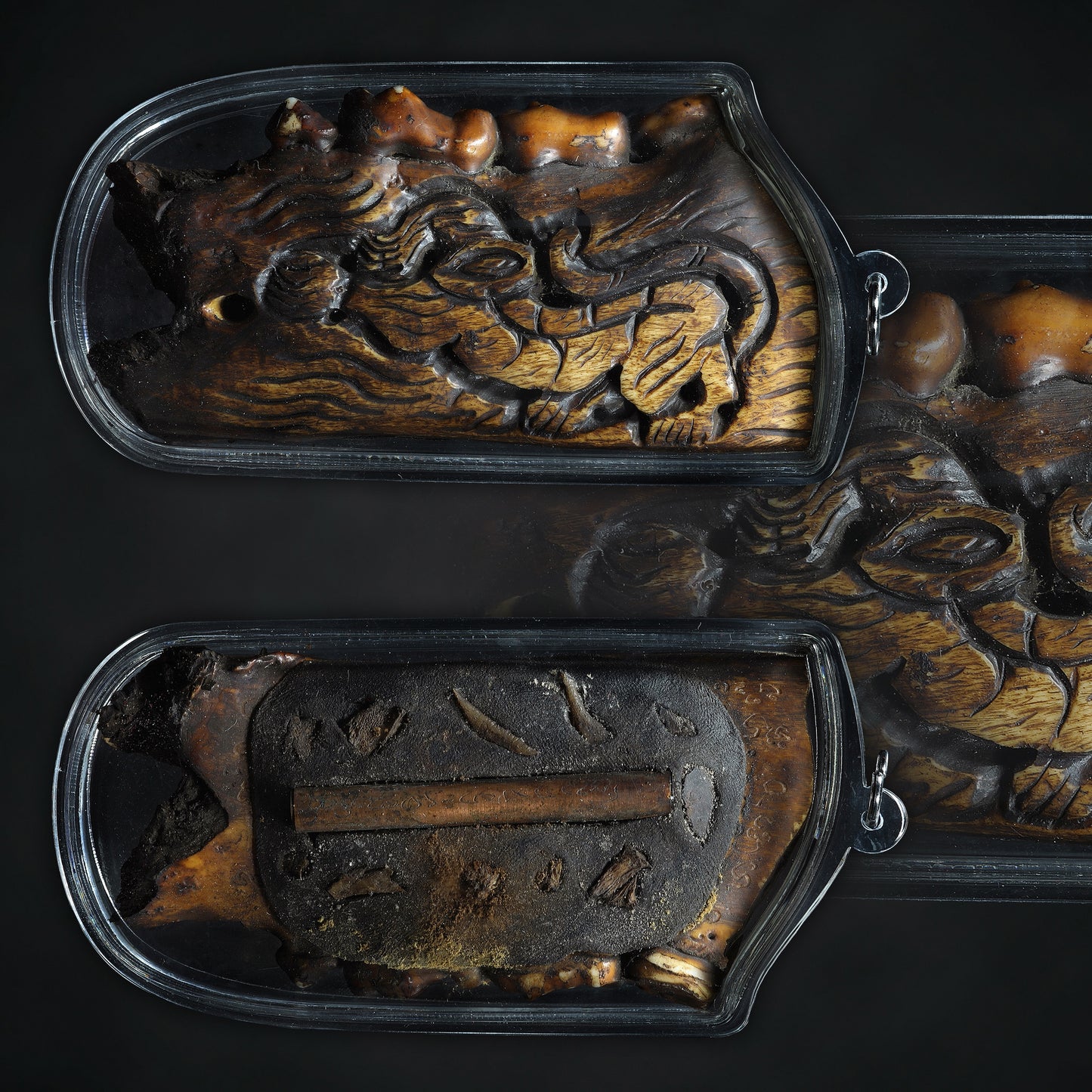
This Suer Yan is a substantial early-period work by Por Sala Tan, carved from an unusual sacred material known within his lineage as Graduk Pak Suer.
Each artifact was individually carved and ritually prepared by hand from naturally irregular sacred materials. Differences in colour, surviving cremation marks, texture, carving, relic placement and ritual deposits are therefore intrinsic to each piece and make every example unique.
Personal Experiences Shared by Luksits
Among Por Sala Tan's luksits, Suer pieces are particularly valued by those who must deal with competition, difficult personalities and situations where authority needs to be maintained without constant confrontation.
Owners often describe the character of Suer Wicha as firm rather than soft. Unlike a dedicated Metta piece intended primarily to make people feel affection towards the bearer, Suer is traditionally approached when the wearer needs confidence, presence and the ability to stand his ground.
This particular piece carries an additional association with hidden enemies and backstabbers.
Luksits working in business or competitive environments have traditionally carried Suer objects when they are concerned about people acting favourably in front of them while working against them privately. The purpose is understood as strengthening one's position and reducing the ability of concealed hostility to cause damage.
The presence of Lersi relics gives this particular Suer Yan another dimension. Followers of Por Sala Tan regard Lersi materials as carrying Baramee derived from practice and wicha, making the piece relevant not only to defence but also to authority, advancement and maintaining respect.
Summary
This Suer Yan is a large and serious example of Por Sala Tan's early craftsmanship, measuring approximately 4 inches and carved from Graduk Pak Suer associated with the cremation of a Lersi.
Its importance lies in the combination of several traditions within one object.
The deeply carved Suer represents courage, protection and commanding presence. Suer Wicha establishes its defensive character, while the surviving Lersi relics connect the piece with meditation, accumulated wicha and Baramee.
At the reverse, cave soil, Lersi relics and a single Takrut complete the ritual construction.
The resulting character is centred upon protection, wealth, Baramee, authority and defence against concealed hostility or betrayal.
Historical Background
The Suer, or tiger, occupies an important position within Thai and wider Southeast Asian sacred traditions.
Its significance extends beyond physical strength. The tiger represents confidence, territorial authority, fearlessness and the ability to command respect without retreating from opposition.
For this reason, tiger-related wicha historically became associated with warriors, travellers, officials, traders and others whose circumstances required courage and authority.
Por Sala Tan's Suer Yan draws upon this tradition but combines it with another important strand of his practice: Lersi wicha.
Lersi are ascetic figures deeply embedded within Thai and regional sacred traditions. They are associated with meditation, teachers of knowledge, healing practices, magical disciplines and the preservation and transmission of wicha.
The relationship between teacher and student is particularly important within Lersi traditions. Sacred knowledge is not regarded simply as a collection of techniques; it belongs to a lineage and carries obligations towards the teachers who preserved it.
This helps explain why relics remaining from a respected Lersi's cremation could acquire such significance.
For Por Sala Tan, these materials represented more than remnants of a cremation. They maintained a tangible connection with the practitioner's life, meditation and accumulated spiritual practice.
Origins of the Materials
The principal body of this Suer Yan is made from Graduk Pak Suer, which had been placed together with a Lersi during cremation.
Fire played an important role in determining what remained.
While much of the material exposed during cremation was consumed or altered, certain portions survived. These surviving pieces, together with relics associated with the Lersi, were subsequently collected by Por Sala Tan.
He did not immediately use everything.
Some materials were preserved for later ritual purposes, while selected portions were gradually transformed into individual sacred artifacts such as this Suer Yan.
The reverse contains additional Lersi relic fragments together with soil obtained from a cave. Cave environments have particular significance within Lersi traditions because secluded natural locations have long been associated with meditation, retreat and ascetic practice.
A single Takrut was then incorporated to bind and direct the different components towards the intended function of the completed artifact.
Ritual
The carving itself formed only one stage of the preparation.
After shaping the Graduk Pak Suer into the guardian figure, Por Sala Tan worked the piece according to Suer Wicha.
The deep carving established the outward form, while chanting and ritual practice established its intended spiritual direction.
The rear was then prepared as the principal chamber for the supporting materials.
Cave soil and surviving Lersi relics were placed into the reverse before the single Takrut was installed. The Takrut served as a ritual anchor, bringing the different elements together rather than leaving the Suer, Lersi and cave materials as unrelated components.
The completed piece therefore combines two complementary spiritual currents.
Suer Wicha provides the outward force — courage, protection, defensive strength and authority.
The Lersi materials provide the inward foundation — Baramee, accumulated practice, knowledge and connection with an established spiritual tradition.
Together they form the particular character of this Suer Yan.
Blessings and Effects
The principal traditional quality of the Suer Yan is protection through strength and authority.
It is associated with courage when confronting difficult situations and with maintaining one's position when facing opposition.
A particularly important quality is protection against hidden enemies, betrayal and backstabbing. Rather than being directed towards retaliation, the piece is traditionally understood as helping prevent concealed hostility from successfully undermining the bearer.
Baramee and authority form another major aspect.
The combination of Suer imagery and Lersi relics makes the piece particularly relevant to those who must lead others, manage businesses or maintain credibility within competitive environments.
Wealth is also traditionally associated with this Suer Yan, particularly through the idea of protecting and strengthening an established livelihood rather than simply producing sudden fortune.
The Suer guards territory; symbolically, this can extend to one's business, career, reputation and accumulated resources.
Modern Application
The Suer Yan is particularly appropriate for people whose circumstances require authority, resilience and protection from competition.
Business owners, managers and those occupying leadership positions may appreciate its traditional association with maintaining respect and protecting one's established position.
It may also appeal to those working in highly competitive environments where office politics, rivalry or concealed opposition are common concerns.
For collectors and practitioners of Lersi wicha, however, this particular piece has another significance.
The surviving Lersi relics and cave materials preserve a physical connection with the older ritual traditions from which Por Sala Tan drew much of his knowledge. In this respect, the Suer Yan is not merely a tiger talisman but also an object connected with teacher lineage and the preservation of wicha.
Physical Details
This is a large Suer Yan measuring approximately 4 inches, deeply hand-carved by Por Sala Tan from Graduk Pak Suer associated with the cremation of a Lersi. The front depicts a powerful Suer guardian figure in Por Sala Tan's characteristic early carving style. The reverse contains a prepared ritual chamber incorporating cave soil, surviving Lersi relic fragments and a single Takrut. Natural irregularities, colour changes, fire exposure, ageing, surface texture and carving marks are inherent to the original material. The piece is presently protected within a fitted clear casing.
Recommended Pairing
Because this Suer Yan already combines protection, authority and Baramee, it can function as a substantial standalone sacred object.
For those seeking a stronger Buddhist foundation, it may be paired with a Phra Somdej or another Buddha image, adding an emphasis upon merit, mindfulness and spiritual stability.
For business use, Phra Sivali provides a complementary association with prosperity, sustenance and favourable opportunities.
A Lersi image may also form a meaningful pairing, particularly for practitioners concerned with Wai Kru, learning and the continuation of wicha. In this arrangement, the Lersi represents the teacher and accumulated knowledge, while the Suer Yan represents the strength and authority required to carry that knowledge into the world.
-
Free Shipping for Singapore| $15 Worldwide | $60 USA For Items Below $350