
OOBThaiAmulets
Por Sala Tan
Por Sala Tan
Couldn't load pickup availability
PST02
Mae Per
Por Sala Tan
2.5 Inches
Barang Artifact
Sacred Craftsmanship
This Mae Per represents an unusual example of Por Sala Tan taking an older sacred object whose original spiritual activity was considered dormant and reactivating it through additional ritual construction.
Each such piece is individually worked from old natural material. Variations in colour, grain, age marks, carving, surface wear and the arrangement of the ritual components are intrinsic to the object and form part of its individual character.
Personal Experiences Shared by Luksits
The history of this Mae Per is closely connected with the luksit who originally sourced it.
According to his account, he had already spent several months attempting to work with the old carving, yet experienced no response. Despite believing the Gaduk Chang Boran itself possessed considerable Baramee, he regarded the piece as spiritually dormant.
Eventually, he brought it to Por Sala Tan.
Por Sala Tan examined the carving and interpreted its condition differently. In his view, whatever presence remained within the old material had not disappeared. It had become deeply dormant after the long period of isolation and exposure to the natural conditions of the cave.
After adding the takruts, embracing couple, sacred materials and prepared powders, Por Sala Tan performed a comparatively short chanting session intended to awaken and redirect the piece.
The luksit's subsequent account became one of the more unusual stories associated with this Mae Per.
Over the following months, he reported the unexpected arrival of three new romantic partners in his life. He felt that these relationships developed with remarkably little pursuit on his part and described the change as though people were being naturally drawn towards him.
Whether interpreted spiritually or personally, this experience was significant enough that he associated the sudden change directly with the period following Por Sala Tan's reactivation of the Mae Per.
The piece later returned to Por Sala Tan during a Wai Kru mass blessing, where it was placed among other sacred objects for consecration. The owner did not subsequently retrieve it. Because of geographical distance and his own obligations, the Mae Per remained with Por Sala Tan for years.
It consequently spent a prolonged period upon or around Por Sala Tan's personal altar, repeatedly exposed to subsequent prayers, ceremonies and ritual activity until the master's passing.
Summary
This Mae Per is distinguished by two separate stages in its history.
The first is the considerably older Gaduk Chang Boran carving itself, reportedly recovered after a prolonged period in a remote cave environment.
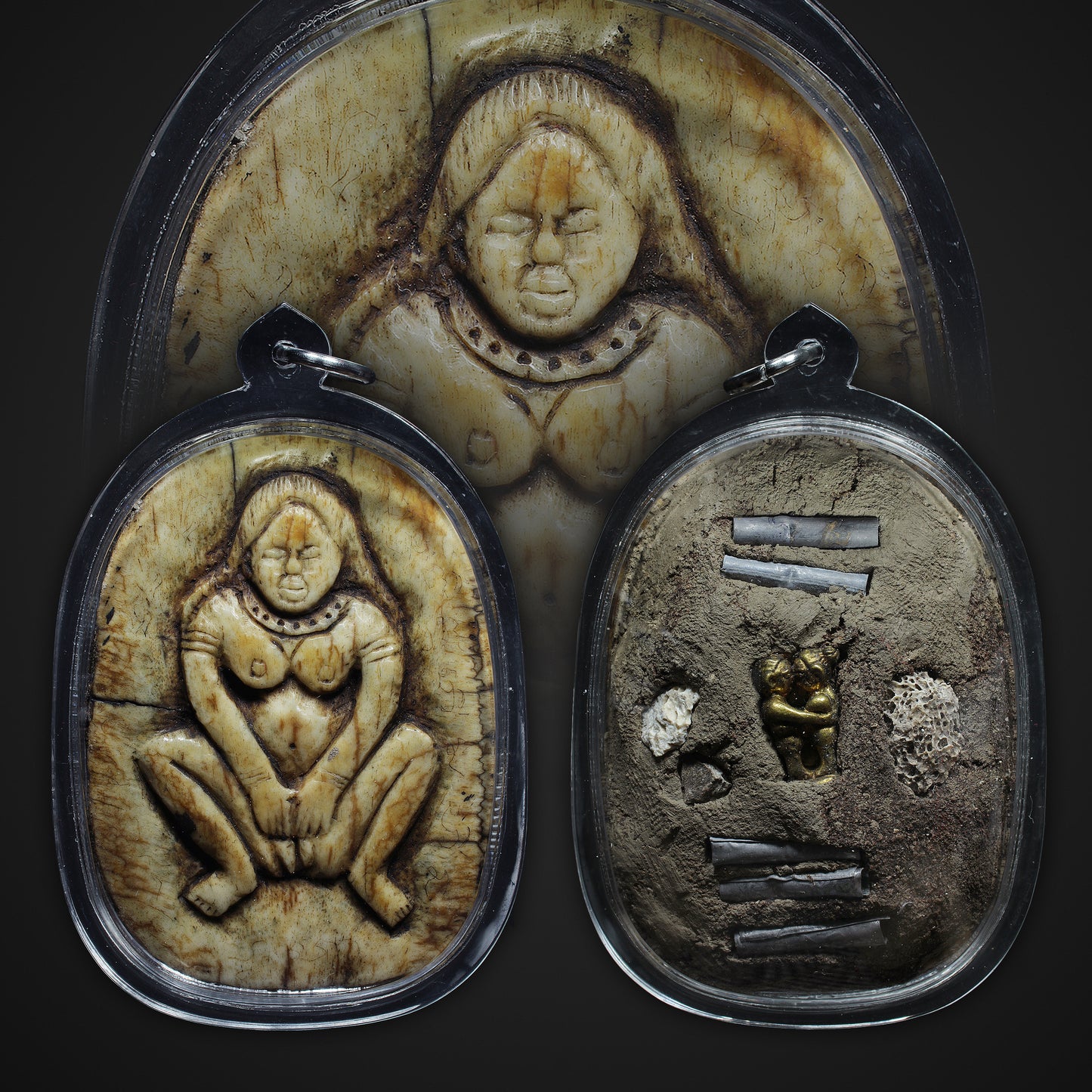
The second is Por Sala Tan's intervention. Rather than carving a new Mae Per, he retained the old figure and constructed an extensive activation arrangement behind it using takruts, a brass embracing couple, sacred materials, hive material and prepared powders.
Its subsequent history adds another layer. After being submitted for a Wai Kru blessing and never collected, the piece remained with Por Sala Tan for years and continued to be present around his personal ritual environment.
Its traditional emphasis is strongly directed towards Seneh, sensual magnetism, attraction and interpersonal influence.
Historical Background
Mae Per belongs to a strand of regional folk spirituality concerned with fertility, attraction, sexuality and the generative power of the human body.
Such imagery sits outside the restrained iconography normally associated with formal Buddhist devotional art. Its meaning is better understood within the wider landscape of Southeast Asian animist and folk practices, where fertility and sexuality could themselves become symbols of abundance, attraction and creative force.
The exaggerated feminine characteristics of Mae Per are therefore purposeful.
They express fertility and attraction openly rather than symbolically concealing them.
Por Sala Tan's treatment of this particular piece is also characteristic of another aspect of traditional sacred-object practice: an old object was not necessarily considered spiritually active simply because its material was regarded as powerful.
According to the account surrounding this Mae Per, prolonged isolation within the cave had left the old carving dormant. Por Sala Tan's task was consequently not to create the underlying object, but to restore activity and give that activity a clearly defined direction.
Origins of the Materials
The principal carving is described within its lineage as Gaduk Chang Boran, an old material that had reportedly remained for an extended period within a remote cave system.
Its age and prolonged contact with the cave environment were important to the way the original owner understood its Baramee. However, age alone was not regarded as sufficient to make the piece active.
Por Sala Tan supplemented the old carving with an array of materials at the reverse.
Several lead and copper takruts were installed. A miniature brass figure depicting an embracing couple was added specifically for its association with Seneh and attraction.
Fragments of additional sacred material and a hive element were incorporated alongside them. Within traditional nature-based symbolism, the hive carries associations with gathering, drawing and concentrated activity around a central point, making it particularly meaningful in attraction work.
These components were secured within a prepared sacred powder base, incorporating materials selected for Seneh-oriented ritual work.
The original carving and the later additions therefore belong to different stages of the object's history but now form a single completed sacred piece.
Ritual
When the Mae Per was first presented to Por Sala Tan, the problem was understood to be one of dormancy.
The luksit had already attempted for months to establish a response from the old carving without success.
Por Sala Tan considered the underlying presence to remain embedded within the material but inaccessible after its prolonged period in the cave. His ritual work therefore concentrated upon awakening, anchoring and redirectingwhat was already there.
The reverse was opened as the principal working surface.
Lead and copper takruts established the ritual framework. The embracing brass figure gave the work its Seneh orientation, while the additional sacred fragments, hive material and prepared powders created the supporting ritual base.
Por Sala Tan then performed the chanting and activation.
According to the account passed down with the piece, the response was achieved during a relatively short session.
Its consecration history did not end there.
The Mae Per was later placed into Por Sala Tan's Wai Kru mass-blessing basket. When the original owner did not retrieve it, the piece remained with Por Sala Tan for years and was consequently present through continued altar practice and later ritual activity until the master's passing.
Blessings and Effects
The principal traditional function of this Mae Per is Seneh.
It is particularly associated with sensual attraction, personal magnetism, romantic attention and stronger interpersonal presence.
The brass embracing couple installed at the reverse reinforces this direction, while the takrut array was intended to organise and strengthen the ritual function of the older material.
Within the beliefs surrounding the piece, its influence is understood primarily as drawing attention and increasing attraction, rather than guaranteeing control over another person.
The original luksit's account of three new romantic relationships following the reactivation became part of the object's history, but remains an individual experience rather than evidence of a predictable effect.
As with Por Sala Tan's other Seneh works, personal conduct and Baramee remain important. Attraction may create an opportunity for connection, but the quality and continuation of any relationship ultimately depend upon the people involved.
Modern Application
The Mae Per is most naturally associated with circumstances where attraction and personal presence are important.
Its traditional application includes romance and relationships, but Seneh can also be understood more broadly. Those working in sales, entertainment, hospitality, negotiation or other occupations dependent upon interpersonal engagement may value the same qualities of approachability, attention and personal magnetism.
Because this is an old and individually reworked object rather than an ordinary mass-produced amulet, it may equally be kept respectfully upon an altar rather than worn continuously.
The long period it subsequently spent with Por Sala Tan also gives the piece significance beyond its intended Seneh function. For collectors of his work, it preserves a direct connection with his ritual practice and personal altar environment.
Physical Details
This Mae Per is an old hand-carved Gaduk Chang Boran piece depicting a seated female figure with strongly emphasised feminine and fertility characteristics. The aged material displays natural colour variation, lines, staining, wear and surface changes consistent with an old organic material. The reverse has been filled with a prepared sacred powder base containing multiple lead and copper takruts, a miniature brass embracing couple, sacred fragments and a hive element. The completed object is presently protected within a clear casing.
Recommended Pairing
As the Mae Per is strongly specialised towards Seneh and attraction, it can be balanced with a Buddhist amulet associated with Baramee, mindfulness and general auspiciousness.
A Buddha image or an amulet from a respected monastic lineage provides a particularly suitable counterpart. The intention is not to increase the Mae Per's sensual character indefinitely, but to place Seneh alongside merit and spiritual stability.
For those following Por Sala Tan's approach, merit-making may be equally important. Dedicating merit and maintaining respectful conduct provide a traditional counterbalance to a sacred object whose principal character is rooted so strongly in desire, attraction and human relationships.
-
Free Shipping for Singapore| $15 Worldwide | $60 USA For Items Below $350