
OOBThaiAmulets
Por Sala Tan
Por Sala Tan
Couldn't load pickup availability
PST02
Mae Per Saneh
Por Sala Tan
2.5 Inches
Barang Artifact
Sacred Craftsmanship
This Mae Per Saneh is a highly specialised Barang piece created by Por Sala Tan exclusively for Seneh — attraction, personal magnetism and emotional influence.
Each Mae Per was individually carved and assembled by hand from prepared sacred and natural materials. Differences in carving, relic colour, surface texture, ritual deposits and overall form are therefore inherent to the workmanship, making every surviving example individually distinct.
Personal Experiences Shared by Luksits
Among Por Sala Tan's luksits, this Mae Per is regarded as a particularly direct form of Seneh work.
Owners tend to describe its character not in terms of authority or commanding others, but through changes in attention and interpersonal response. They may notice people becoming more receptive to conversation, maintaining eye contact for longer, remembering them more readily or showing a greater willingness to remain close.
For those using the piece in romantic circumstances, the emphasis is traditionally placed upon strengthening attraction where an existing connection or opportunity is already present.
Por Sala Tan's followers also maintain that a piece of this nature should be supported by the owner's own Baramee. Merit-making, responsible conduct and Buddhist practice are consequently regarded as important complements rather than something separate from the Barang itself.
This is especially relevant to Mae Per because its traditional function concerns attraction and human relationships. The owner is still responsible for how that influence is approached and how other people are treated.
Summary
The Mae Per Saneh is a compact spirit vessel carved from a hip relic selected by Por Sala Tan following a completed liberation rite.
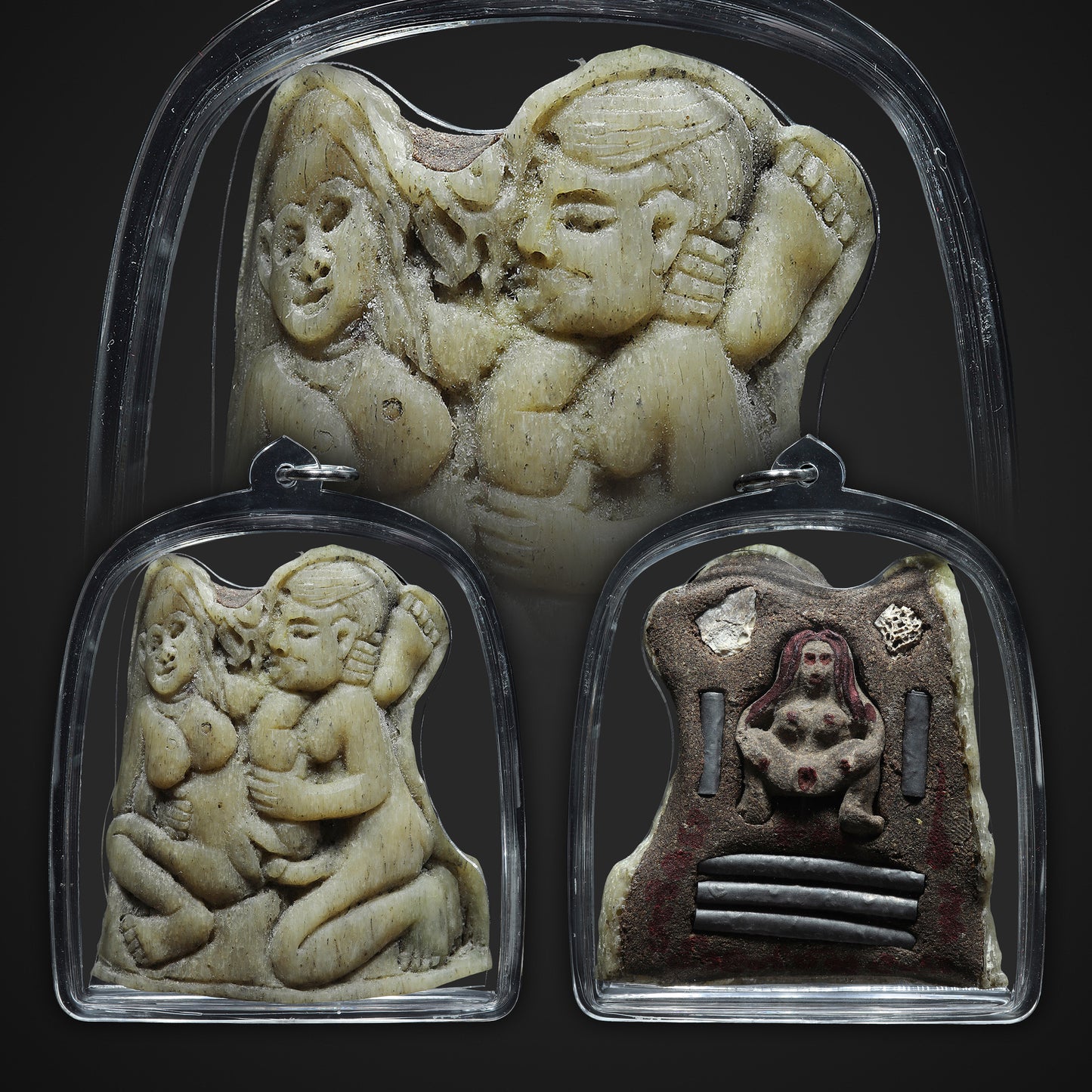
Its construction is unusually explicit in its purpose. The embracing figures on the front represent physical and emotional attraction, while the ritual chamber behind them contains the Mae Per effigy and accompanying sacred materials that form the spiritual centre of the piece.
This is not primarily a Baramee, wealth or general protection object.
Its purpose is concentrated upon Seneh — attraction, charm, personal magnetism and the strengthening of interpersonal interest.
Within Por Sala Tan's practice, however, Seneh is not considered entirely independent of the bearer. Personal Baramee, merit and conduct remain important foundations for working with such an object.
Historical Background
The history given for this piece begins with a village woman remembered for an exceptionally passionate and troubled personal life.
According to the account preserved around the object, her relationships repeatedly caused conflict within the local community. Matters eventually culminated in an encounter involving an elderly village chief. During the encounter, the man suffered a fatal heart attack.
The woman was subsequently overwhelmed by guilt and shame. Unable to reconcile herself with what had happened, she later took her own life nearby.
Within the spiritual interpretation surrounding the relic, her death left behind an unusually concentrated association with desire, attachment, guilt and unresolved emotion.
Por Sala Tan was subsequently called to conduct rites for the deceased.
The spirit was described as unrestful but responsive to the ceremony. The liberation work was reportedly completed within approximately one hour, which Por Sala Tan's tradition interpreted as the spirit accepting the merit and conditions being offered.
Only after this process was completed were relic materials retained for subsequent ritual work.
The Mae Per was therefore not understood simply as an object made from human remains. Its significance depended upon the preceding rites intended to address the deceased, transfer merit and establish the conditions under which the remaining material could become part of a structured sacred object.
Origins of the Materials
Following the liberation ceremony, Por Sala Tan selected the hip section of the remaining relic for the construction of this Mae Per.
Within his working tradition, the location of a relic could influence the type of object for which it was considered appropriate. The hip was chosen here because of its symbolic relationship with the physical body, sensuality, attraction and grounded desire.
The material was subsequently carved into the embracing figures visible on the front.
At the reverse, Por Sala Tan prepared a recessed ritual area containing the Mae Per effigy together with additional ritual substances and sacred components.
These materials were not treated merely as decoration. Each formed part of the completed spiritual architecture of the piece, with the carved relic providing the principal vessel and the rear chamber providing its ritual anchor.
Ritual
Before the Mae Per was created, Por Sala Tan first performed rites intended to address the circumstances surrounding the deceased.
According to the lineage account, merit was transferred and unresolved karmic ties were addressed before the spirit was invited into further ritual work.
The process was understood as agreement rather than coercion.
This distinction is important within Por Sala Tan's Barang practice. The intention was not to seize an unrestful spirit immediately after death and force it into service. The liberation rite came first, followed by the preparation of the relic and establishment of a defined spiritual function.
The rear chamber was then prepared around the Mae Per effigy and associated ritual materials.
During consecration, the function of the completed object was directed specifically towards Seneh. The spiritual presence was given a defined role rather than being treated as an uncontrolled wandering entity.
For practitioners within this tradition, merit-making remains an important part of maintaining the relationship surrounding such an object.
Blessings and Effects
The principal traditional quality of this Mae Per is Seneh.
It is associated with strengthening personal attraction, increasing one's social presence and encouraging greater emotional receptiveness from those with whom the bearer interacts.
Its traditional applications therefore include romantic attraction, charm in speech, personal magnetism, social engagement and favourable interpersonal attention.
The embracing figures provide a direct visual expression of this purpose.
Rather than being regarded as an object for domination, its influence is traditionally described by followers as strengthening attraction and making the bearer's existing presence more noticeable.
Por Sala Tan's tradition further maintains that Baramee supports Seneh. A person with established merit, responsible conduct and spiritual practice is believed to provide a stronger foundation for the workings of such a piece.
These effects belong to traditional spiritual belief and should not be understood as guaranteed influence over another person's feelings or choices.
Modern Application
The Mae Per is particularly suited to situations where personal presence and interpersonal connection are important.
This may include dating and relationships, but its application is not limited to romance. Those working in sales, hospitality, entertainment, negotiation or other client-facing environments may carry Seneh objects because their livelihood depends heavily upon rapport and personal interaction.
The piece may also be kept respectfully at an altar rather than worn.
Because this is a specialised Barang object connected with a deceased spirit, traditional practice places importance upon respectful treatment and merit-making rather than viewing it merely as an instrument for obtaining attraction.
Its purpose is therefore best understood as enhancing the bearer's Seneh while the bearer remains responsible for his or her own behaviour and relationships.
Physical Details
The Mae Per measures approximately two inches and is carved from a hip relic. The front presents an intimate embracing couple, with the two figures occupying almost the entire surface of the relic. The reverse contains a recessed ritual chamber centred upon a small Mae Per effigy, accompanied by additional sacred substances and ritual components installed by Por Sala Tan. Natural differences in colour, grain, ageing, carving marks and surface texture are inherent to the original relic material. The piece is presently protected within a clear casing for preservation and carrying.
Recommended Pairing
Por Sala Tan's tradition regards Baramee as an important foundation for Seneh, making Buddhist and merit-oriented sacred objects particularly appropriate companions for this Mae Per.
A Buddha image may be carried alongside it to emphasise merit, mindfulness and spiritual stability. Sacred objects associated with respected monks or established Buddhist lineages may similarly provide a Baramee-centred counterpart to the Mae Per's highly specialised attraction function.
The principle behind such a pairing is balance: the Mae Per remains focused upon Seneh, while the Buddhist piece represents merit, discipline and Baramee.
For practitioners following Por Sala Tan's approach, regular merit-making and dedication of merit can be considered as important as the physical pairing itself.
-
Free Shipping for Singapore| $15 Worldwide | $60 USA For Items Below $350