
OOBThaiAmulets
Por Sala Tan
Por Sala Tan
Couldn't load pickup availability
PST02
Yonikid Relic Amulet
Por Sala Tan
2 Inches
Barang Artifact
Sacred Craftsmanship
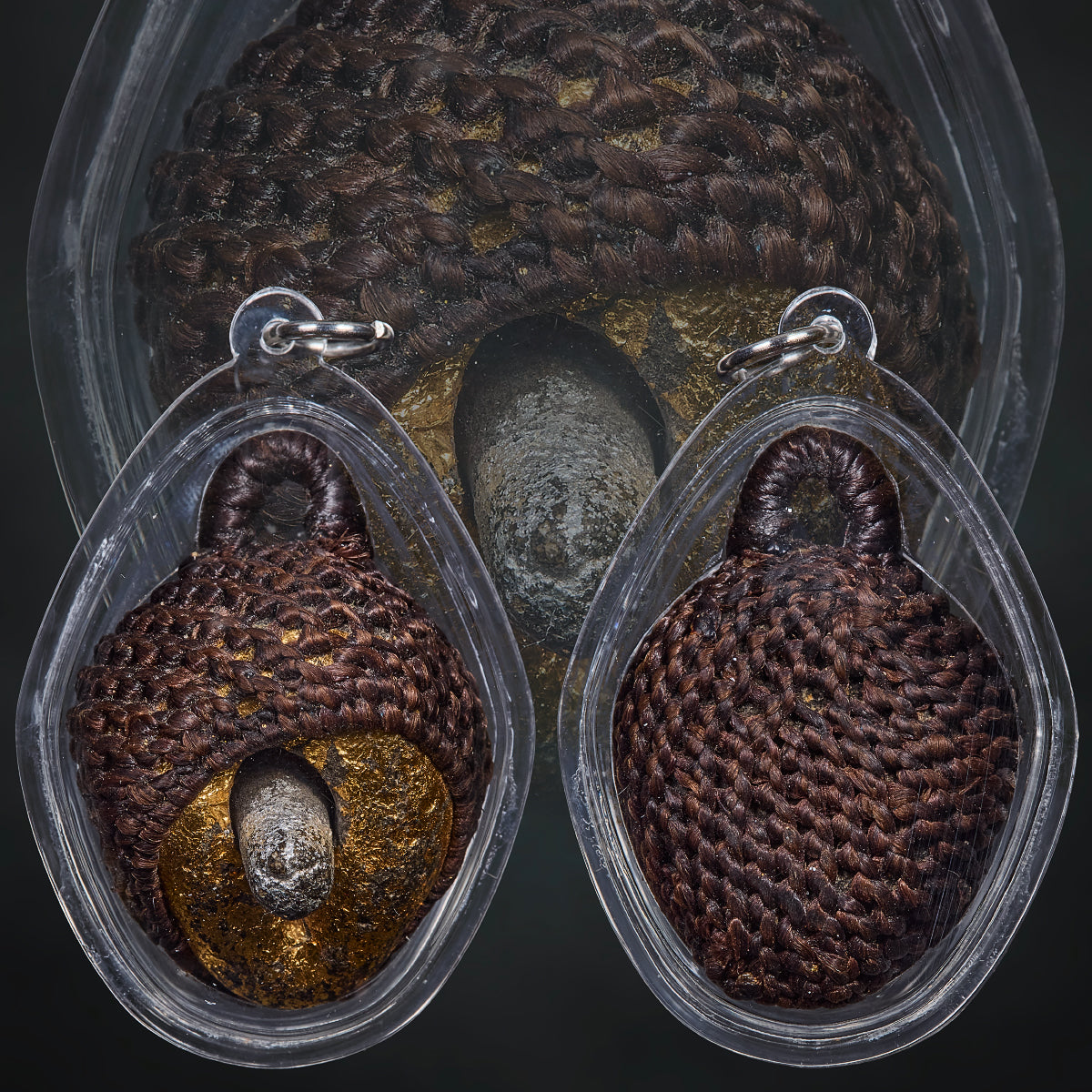
Each Yonikid was individually assembled and wrapped from prepared natural and sacred materials. Differences in the weave, shape, texture, exposed Lingam and surviving gold leaf are therefore part of the handmade character of each individual piece rather than manufacturing defects.
Personal Experiences Shared by Luksits
Among Por Sala Tan’s luksits, the Yonikid has generally been discussed as a specialised Seneh piece rather than something carried for every purpose.
Those who favour it often work in situations where personal interaction is important — dealing with customers, entertaining, hosting, negotiating, selling or simply meeting large numbers of people. Some have described becoming more noticeable socially, with strangers appearing more willing to initiate conversation or remain engaged.
Others speak more specifically about relationships. Their accounts describe a gradual return of attention or affection where communication had previously become cold, as well as feeling that their speech and personal presence carried greater attraction.
Within these accounts, the Yonikid is not described as forcing another person’s feelings. Rather, luksits traditionally interpret its effect as strengthening the bearer’s existing Seneh and making their presence easier for others to notice and respond to.
Summary
The Yonikid is an unusually direct expression of Por Sala Tan’s Seneh wicha.
Its character comes from the deliberate meeting of opposites: Mae Prai and Mae Nur Hom relic materials representing the feminine Yoni principle, and the Chiang Rai waterfall-earth Lingam representing the masculine principle.
For collectors of Por Sala Tan’s Barang work, its importance lies as much in this construction as in its traditional purpose. It was not intended primarily as a Baramee or general protection amulet. Its emphasis is Seneh — attraction, personal magnetism, relationships, persuasive presence and the ability to draw favourable attention.
Historical Background
The symbolism of Yoni and Lingam is considerably older than Por Sala Tan’s individual practice. Across South and Southeast Asian traditions, these complementary forms have long represented generative power and the meeting of feminine and masculine principles.
Por Sala Tan adapted this concept through his own Barang tradition.
Instead of presenting the Yoni and Lingam simply as symbolic forms, he constructed the amulet from materials which, within his practice, already carried corresponding associations. The feminine component was connected with Mae Prai and Mae Nur Hom, while the masculine component was formed from earth gathered from a naturally flowing landscape.
The wrapping technique adds another layer to the piece. Its enclosed, bound construction recalls the practical logic of Bia Gae, where a sacred core is contained and secured through successive layers rather than left exposed.
The result is therefore neither a conventional Yoni talisman nor a conventional Bia Gae, but a distinctly Por Sala Tan interpretation combining elements of both traditions.
Origins of the Materials
The principal feminine materials came from relics associated with Mae Prai and Mae Nur Hom, retained by Por Sala Tan from his earlier spiritual fieldwork. These were selected specifically for their connection with Seneh and feminine spiritual influence.
The Lingam was prepared from soil gathered from a waterfall area in Chiang Rai. The importance of this material was not simply that it was earth, but that it came from a place characterised by continuous natural movement and flowing water.
Gold leaf was applied over the Lingam after its formation.
Most distinctive are the 108 relic strands used around the body. These form the dense woven exterior visible on surviving examples and physically bind the various components into a single object.
Ritual
The making of the Yonikid was itself part of the ritual process.
The feminine relic materials and Lingam were first prepared as complementary sacred components. The Lingam was formed from the Chiang Rai waterfall soil and subsequently covered with gold leaf.
Por Sala Tan then enclosed the core using 108 individual relic strands, wrapping and binding them progressively in a manner derived from older Bia Gae construction principles.
The significance of 108 is familiar throughout Buddhist and regional sacred traditions, where the number repeatedly appears in prayer, meditation, ritual enumeration and sacred construction.
Within this particular work, the repeated wrapping also served a practical symbolic purpose: the separate feminine and masculine elements were brought together and enclosed as one completed Seneh object.
Blessings and Effects
Traditional use of the Yonikid is concentrated principally upon Seneh and Metta Maha Niyom, particularly where attraction and interpersonal response are important.
Collectors associate it with increasing personal charm, encouraging warmer reactions from others, improving attraction between partners, strengthening presence during conversation and making social interaction flow more naturally.
It has also been carried by those involved in sales, hospitality, entertainment and other client-facing occupations, where being remembered, liked and listened to can be particularly valuable.
The Yoni–Lingam combination gives the piece a further association with opposite attraction and polarity. Within Por Sala Tan’s tradition, this is understood symbolically as bringing complementary forces together rather than treating either feminine or masculine energy in isolation.
Modern Application
In contemporary use, the Yonikid is most naturally suited to situations involving relationships and human interaction.
It may be carried when meeting clients, attending social functions, negotiating, dating, rebuilding communication within an existing relationship or working in environments where personal presentation and rapport matter.
Some practitioners also regard it as particularly appropriate when they feel their social presence has become stagnant — what traditional language might describe as Seneh becoming obscured or weakened.
The later protective casing makes an otherwise delicate wrapped relic object considerably easier to carry while preserving the original construction beneath.
Physical Details
The Yonikid is an individually handmade wrapped relic amulet constructed in a form influenced by traditional Bia Gae workmanship. Its exterior consists of tightly bound dark-brown sacred strands, with the Yoni opening revealing a projecting Lingam formed from Chiang Rai waterfall soil and originally finished with gold leaf. The reverse retains the dense woven wrapping. Surviving pieces may show natural differences in weave, proportions, surface wear and remaining gold leaf. The original sacred construction is presently protected within a clear modern casing.
Recommended Pairing
Because the Yonikid is deliberately specialised towards Seneh and attraction, it can be paired with an amulet of a different character rather than unnecessarily duplicating the same function.
A traditional Metta Maha Niyom piece can broaden its social aspect towards goodwill and assistance, while a Baramee-oriented amulet may provide a more authoritative presence for business or professional environments.
For collectors who prefer Por Sala Tan’s Barang tradition, it may also be carried alongside one of his protective pieces, allowing the Yonikid to remain focused upon the purpose for which it was constructed: Seneh, attraction and interpersonal magnetism.
-
Free Shipping for Singapore| $15 Worldwide | $60 USA For Items Below $350