
OOBThaiAmulets
Por Sala Tan
Por Sala Tan
Couldn't load pickup availability
PST08
Waen Yant Kru
Por Sala Tan
Mainstream Artifact
Sacred Craftsmanship
These early rings were individually prepared rather than produced to a completely uniform standard. Natural differences in the relic material, hand-inscribed Yant Kru, sacred mixture, colour and ritual finish are therefore part of their original character.
Personal Experiences Shared by Luksits
Among Por Sala Tan's followers, the Yant Kru has long been regarded as one of the fundamental pieces for a luksit to carry.
These rings were commonly made for devoted followers rather than simply as general sacred objects. Wearing one served as a physical reminder of Por Sala Tan, his teachings and the responsibilities of belonging to his lineage.
Older luksits describe the meaning very simply: when wearing the ring, remember the teachings of your kru.
Before seeking specialised artifacts for wealth, attraction, protection or other purposes, some followers regarded the Yant Kru as the more fundamental piece because it established the relationship between kru and luksit — master and disciple.
Luksits also traditionally associate these rings with Metta, favourable reception and smoother relationships with people. Those involved in business have spoken of customers becoming easier to approach, conversations developing naturally and opportunities sometimes emerging through existing relationships.
Its deeper significance remains remembrance of the kru and connection to his lineage.
Summary
The Waen Yant Kru Early Batch represents one of the more personal forms of sacred artifact associated with Por Sala Tan.
These particular examples are significant because they were remaining early pieces obtained from AC Lek, Por Sala Tan's son, rather than later rings newly prepared around the same concept.
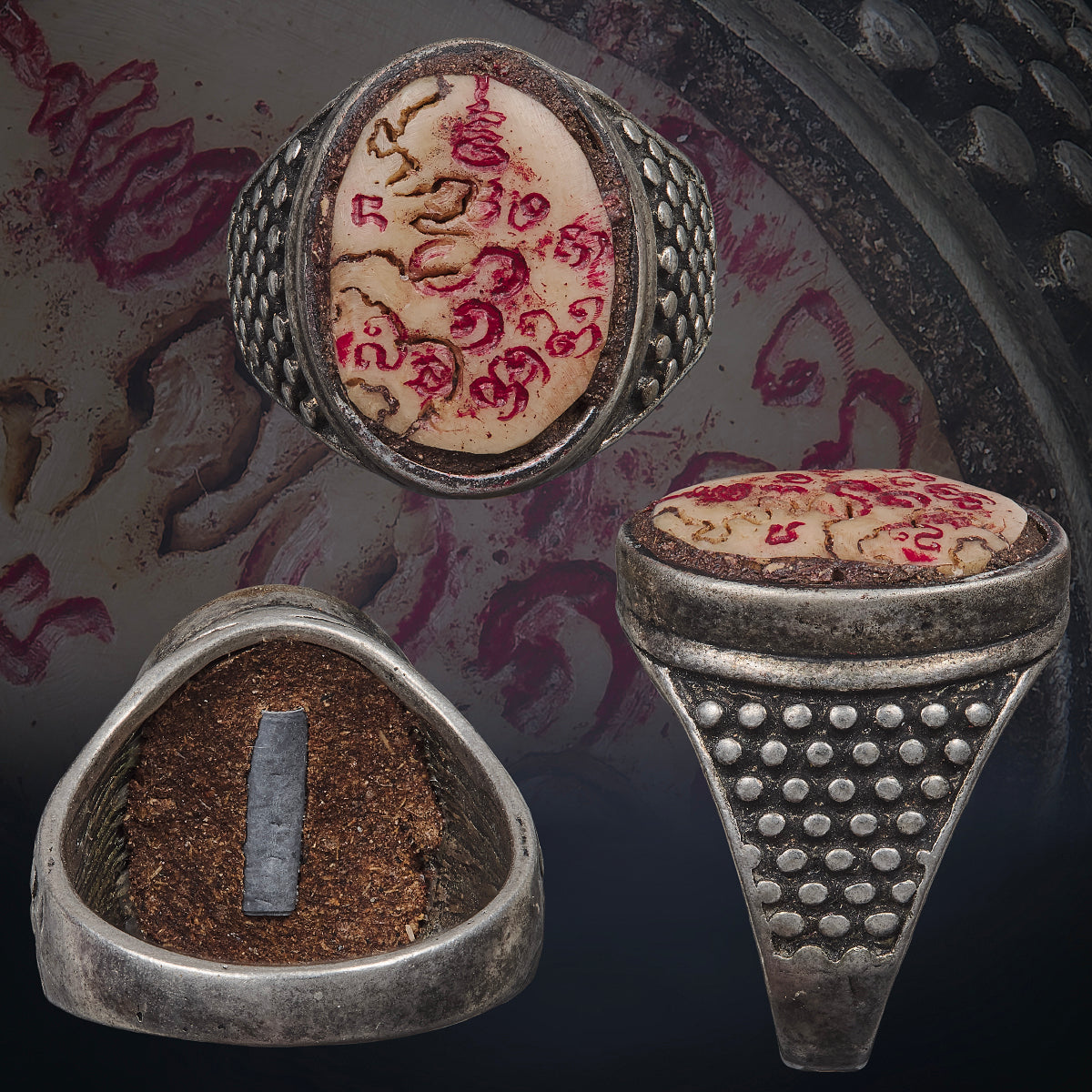
Each incorporates an old relic associated with a highly revered Lersi, Por Sala Tan's personally hand-carved Yant Kru, soil from 7 holy Northern temples, his prepared blend of 108 sacred herbs and a Baramee takrut.
Its purpose is not limited to one specialised effect.
The Waen Yant Kru represents Kru, Baramee, Metta, guidance and lineage — a piece intended to remind the luksit of the teacher before the individual branches of wicha.
It is a must have piece for anyone who follows Por Sala Tan.
Historical Background
The concept of Yant Kru occupies an important position within traditional Thai and Southeast Asian esoteric practice.
Kru means teacher or master.
A Yant Kru is therefore more than a yantra selected for a particular objective. It represents the teacher, the lineage through which knowledge has been transmitted and the body of wicha associated with that tradition.
This distinction is particularly relevant to Por Sala Tan's work.
His practice incorporates traditions associated with Northern Thailand, Lanna and Burma, together with knowledge concerning sacred natural materials, relics, yantra and different forms of ritual preparation.
Within this wider body of work are specialised forms of Metta, Saneh, protection, authority, Baramee and spirit-associated practice.
The Yant Kru sits before these specialised branches.
For a devoted luksit, it represents the source from which those different forms of knowledge were learnt.
In this sense, the ring is not simply about what the artifact can provide to its keeper. It also concerns what the keeper should remember about the teacher from whom the knowledge originated.
Origins of the Materials
The central relic is traditionally attributed by Por Sala Tan's luksits to a fellow Lersi whose remains Por Sala Tan had preserved many years earlier.
Because the Lersi was considered highly revered, his surviving relic materials were particularly suitable for artifacts concerned with Baramee.
Por Sala Tan subsequently used portions of these materials for Yant Kru pieces given to followers.
The preparation beneath the relic contains another important group of materials: soil from 7 holy temples in Northern Thailand.
These soils were blended with Por Sala Tan's own preparation of 108 sacred herbs.
Rather than gathering such ingredients only when an individual artifact was being made, Por Sala Tan accumulated suitable sacred materials over time. They were chanted over, blessed and preserved so that they could later be incorporated into appropriate ritual work.
A single takrut concerned with Baramee accumulation completes the internal preparation.
Ritual
The most important ritual element is Por Sala Tan's personal inscription of his Yant Kru onto the relic itself.
Within traditional yantra practice, writing or carving the yantra is not merely decorative work.
The characters are formed according to the practitioner's wicha and subsequently worked through concentration, katha and adhitthana. In this way, the Yant Kru becomes the organising spiritual structure of the piece.
The relic establishes the connection with the earlier Lersi.
The seven temple soils and 108 sacred herbs establish the prepared sacred foundation.
The takrut directs the work towards the accumulation of Baramee.
Por Sala Tan's own Yant Kru then establishes the final relationship with his lineage and teachings.
Blessings and Effects
The Waen Yant Kru is principally associated with Baramee, Metta and connection to the kru.
Baramee concerns the gradual development of spiritual presence, personal standing and the qualities traditionally associated with accumulated merit and authority.
Metta supports favourable human relationships, goodwill and receptiveness from others.
The Yant Kru itself represents something more fundamental: the authority and guidance of the teacher's lineage.
Among luksits, the ring is therefore traditionally associated with:
- Kru Baramee — connection with the teacher and his spiritual authority.
- Serm Baramee — strengthening and accumulation of personal Baramee.
- Metta Maha Niyom — goodwill, acceptance and favourable reception.
- Guidance — remembering the kru's teachings when facing important decisions.
- Lineage — maintaining the relationship between master, disciple and transmitted wicha.
The emphasis is not upon commanding others.
Rather, it is upon developing sufficient Baramee and Metta that interactions can proceed with greater respect, goodwill and stability.
Modern Application
The Waen Yant Kru is particularly appropriate as an everyday piece for a devoted follower of Por Sala Tan.
It may be worn during work, meetings, business dealings or periods requiring interaction with many people. Its Metta aspect makes it relevant where communication and personal relationships are important.
Yet its deeper application is more personal.
When difficulties arise, wearing the ring can serve as a reminder to consider how the kru taught the luksit to approach the situation.
When opportunities arise, it reminds the wearer not merely to pursue results, but to retain discipline and respect for the lineage.
For this reason, the Waen Yant Kru can remain meaningful even to a follower who already possesses many specialised Por Sala Tan artifacts.
Those pieces may address individual circumstances.
The Yant Kru reminds the luksit where the teachings began.
Physical Details
An early Por Sala Tan Waen Yant Kru set into a traditional metal ring, with an old Lersi-associated relic forming the visible upper face and Por Sala Tan's Yant Kru individually carved across its surface. Beneath is a preparation incorporating soil from seven holy Northern temples and his blend of 108 sacred herbs, together with a single Baramee takrut. These examples were obtained from AC Lek, Por Sala Tan's son, as remaining pieces from an earlier group made by Por Sala Tan. Differences in inscriptions, relic texture, colouring, sacred mixture and surface ageing are characteristic of their individually prepared nature.
Recommended Pairing
For a devoted luksit, the Waen Yant Kru may be regarded as a foundation piece and does not require another artifact to complete its purpose.
It can nevertheless accompany specialised Por Sala Tan pieces according to individual needs.
A Saneh artifact may concentrate upon attraction. A protective piece may be carried for Klaew Klaad or spiritual protection. A wealth-oriented artifact may address opportunity and business.
The Waen Yant Kru occupies a different position.
It remains the connection running beneath them — the kru, the lineage, the Baramee of the tradition and the reminder to carry Por Sala Tan's teachings forward.
-
Free Shipping for Singapore| $15 Worldwide | $60 USA For Items Below $350