
OOBThaiAmulets
Por Sala Tan
Por Sala Tan
Couldn't load pickup availability
PST02
Hoon Mae Luk On
Por Sala Tan
9cm
Barang Artifact
Sacred Craftsmanship
Each piece is individually handmade, and natural variations in colour, texture, form and finishing are to be expected.
The photographs are representative only. A piece will be selected at random, and the item supplied may differ slightly from the exact piece shown in the images.
These individual variations are part of the character and uniqueness of each handmade piece.
Personal Experiences Shared by Luksits
The character associated with this piece has traditionally been described as unusually protective and compassionate for a spirit-based artifact.
The older accounts surrounding the female spirit tell of villagers becoming lost and subsequently finding the correct path, sometimes after experiencing what they interpreted as subtle guidance from her presence.
There were also stories of villagers narrowly avoiding accidents or unexpectedly changing their movements shortly before something dangerous occurred. Such incidents contributed to the local belief that the woman continued to watch over people even after her passing.
For those carrying Por Sala Tan’s effigy, this protective quality was often understood less as confrontation and more as warning, guidance and avoidance — a feeling to reconsider a journey, change direction or become more attentive to circumstances around them.
Other luksits associated the piece with Metta and assistance in everyday matters. Some described circumstances becoming unexpectedly favourable after making sincere requests, particularly concerning work, finances, family matters and finding a way through difficult periods.
Summary
This is an unusual early creation of Por Sala Tan, combining three important elements within a single artifact:
lightning-struck blackwood, the compassionate presence of a mother and child, and old Lanna spirit wicha.
Unlike Barang created around aggressive or unsettled Prai, the female presence associated with this piece was remembered as harmless, compassionate and protective.
Her story centred upon helping those who had lost their way and preventing misfortune from reaching villagers.
The resulting artifact consequently developed a reputation for guidance, protection, Metta, wish fulfilment and assistance during periods of uncertainty.
The lightning-struck wood adds another dimension — transformation through an exceptional act of nature, joining the forces of sky, earth, tree and spirit within one ritual vessel.
Historical Background
Lightning-struck trees occupy a particular place within older Southeast Asian animist and occult traditions.
A tree struck directly by lightning has undergone an event outside ordinary human control. Within esoteric interpretation, lightning represents celestial fire and sudden elemental force, while the tree represents the living earth.
When the tree survives or its timber remains suitable for ritual use, practitioners may regard the material as having passed through a natural transformation.
Por Sala Tan encountered such blackwood in the Mae Hong region and recognised its suitability for advanced Barang work.
The material became still more significant because of the female spirit associated with the location.
According to the account preserved around the artifact, she had died from complications connected with pregnancy, with her baby stillborn. Despite the tragedy of her death, local memory did not portray her as malevolent.
Instead, villagers regarded her as possessing considerable Baramee and compassion.
Stories circulated of her guiding people who had become lost, directing them towards the correct route and helping villagers avoid situations that might otherwise have resulted in accidents.
The belief eventually developed that the lightning-struck tree and her presence had become intertwined.
Por Sala Tan subsequently worked with this connection rather than attempting to suppress it, creating an artifact in which natural elemental force and a benevolent spiritual presence were brought together under ritual discipline.
Origins of the Materials
The foundation of the effigy is blackwood taken from the lightning-struck tree.
Its importance came from both its physical origin and the event that had transformed it. Por Sala Tan preserved the timber specifically for ritual use rather than treating it as ordinary carving material.
The binding is equally significant.
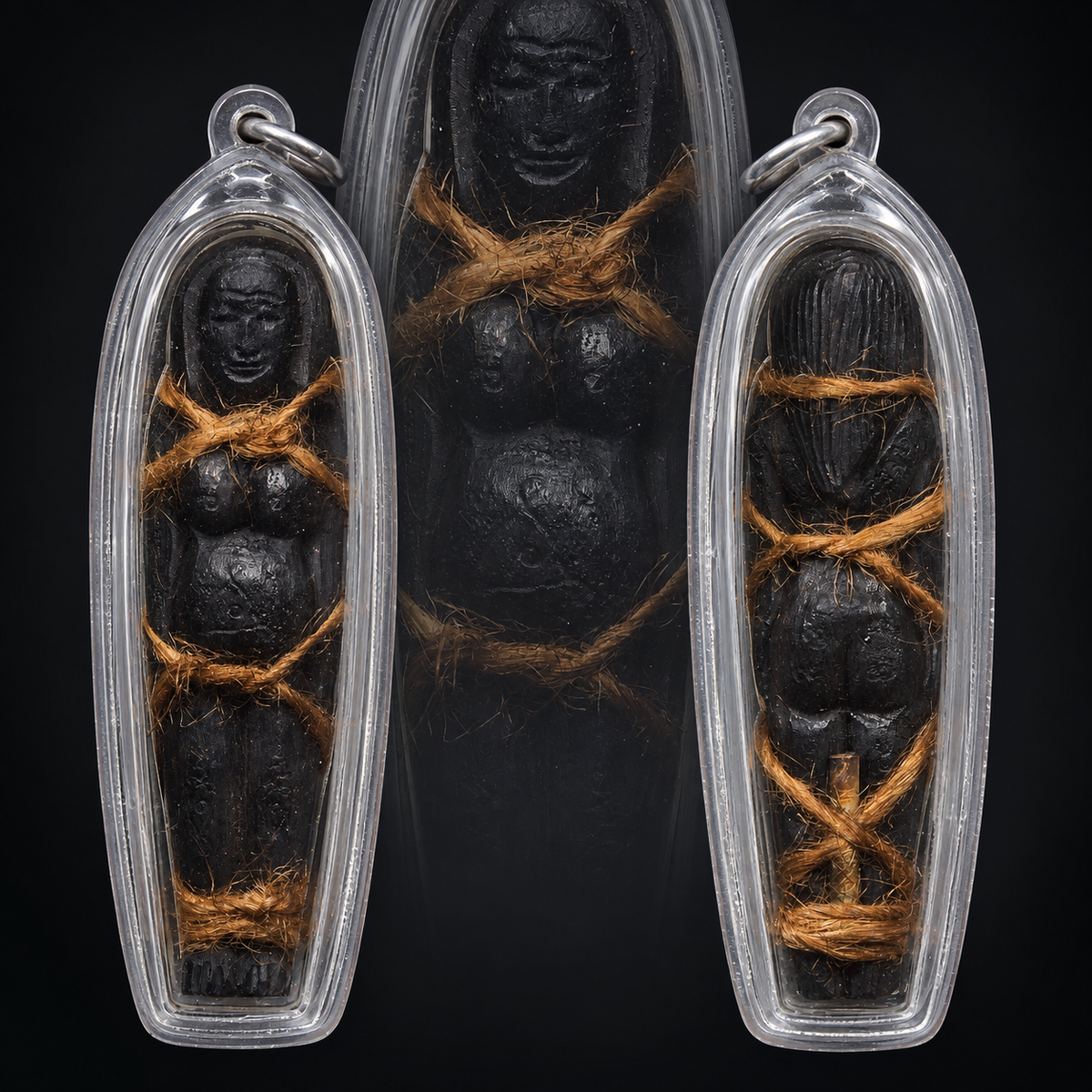
The rough natural rope seen wrapped around the body was prepared from fibres originating from the same ritual environment. It was not added merely as decoration.
Binding within this type of wicha represents establishment, continuity and the securing of the different components of an artifact into one working form.
The mother-and-child imagery was carved directly into the wood, giving physical expression to the female spirit and her unborn child.
Sacred herbal resin and relic powders were additionally employed during preparation and sealing, completing the physical foundation before consecration.
Ritual
Por Sala Tan prepared each effigy individually.
The carved mother-and-child form was first established from the lightning-struck blackwood before being wrapped with the natural ritual fibres.
Through chanting, meditation and the appropriate Lanna wicha, the spiritual association of the woman and child was invited and harmonised with the artifact.
The purpose was not to create an uncontrolled spirit vessel.
Rather, Por Sala Tan’s work centred upon directing the existing relationship between place, wood, elemental force and spirit towards constructive purposes.
The binding helped symbolically establish and stabilise this relationship, while the sacred herbal and relic materials supported the ritual foundation.
The resulting piece therefore represents a form of Barang in which the spiritual presence was understood to work through compassion, guidance and protection rather than fear.
Blessings and Effects
The principal quality associated with this artifact is guidance.
Its older story of assisting lost villagers naturally developed into a wider belief that the piece could help its keeper recognise a path forward when circumstances became confused or uncertain.
Protection and Klaew Klaad form another important aspect. The traditional emphasis is particularly upon avoidance — receiving an instinctive warning, changing direction or becoming aware of potential trouble before it develops further.
Metta Maha Niyom reflects the compassionate character attributed to the female presence. It is traditionally carried for goodwill, assistance from others and smoother relationships.
The piece is also associated with wish fulfilment, particularly where the request concerns work, livelihood, family welfare, finances or finding a solution to an existing difficulty.
Its attraction aspect is consequently warmer than the more forceful forms of Saneh found in certain Prai-based artifacts. It centres upon sympathy, receptiveness and the willingness of others to offer assistance.
The lightning-struck blackwood contributes the qualities of movement and transformation — traditionally useful when circumstances have remained stagnant and the owner wishes to break through an existing obstacle.
Modern Application
In modern life, this artifact is particularly suited to someone seeking a combination of protection, guidance and human goodwill.
Those who travel regularly may appreciate its traditional association with warning and avoidance of danger.
Business owners, salespeople and those whose work depends upon relationships may use its Metta qualities for smoother communication and favourable interactions.
It may also appeal to someone passing through a period of uncertainty — changing career, establishing a business, dealing with financial pressure or making an important life decision — where the emphasis is upon finding the correct direction rather than forcing an immediate result.
The artifact may be worn respectfully as an individual amulet or maintained upon a personal altar.
Physical Details
An early Por Sala Tan mother-and-child effigy carved from lightning-struck blackwood from the Mae Hong region, retaining its naturally dark aged surface. The figure is traditionally bound with natural ritual fibres associated with the original site and incorporates sacred herbal resin and relic materials used during preparation. The mother and child forms remain visible within the elongated carving, while the reverse retains the hand-worked character of the original wood. The present example has subsequently been protected within a custom silver casing.
Natural variations in wood grain, carving, binding, ageing and surface texture are expected and form part of the individuality of each handmade artifact.
Recommended Pairing
Because this artifact already combines guidance, Metta and protection, it can comfortably be carried alone.
For stronger authority and professional presence, it may be paired with a Suer or Baramee artifact, allowing the mother-and-child piece to retain its softer protective and interpersonal qualities while the companion artifact strengthens command.
For commerce, customer relations or work requiring persuasion, pairing with a Metta Maha Niyom or Saneh pieceplaces greater emphasis upon attraction, goodwill and favourable assistance.
A Lersi artifact is particularly suitable for those approaching the piece from a spiritual-practice perspective, adding the qualities of Kru, discipline and wisdom.
Ultimately, however, this is a piece whose character comes from an unusual combination: a woman remembered for helping rather than harming, a child who never entered ordinary life, and blackwood transformed by lightning— brought together through Por Sala Tan’s early Lanna wicha as a vessel of guidance, protection and compassionate assistance.
-
Free Shipping for Singapore| $15 Worldwide | $60 USA For Items Below $350