
OOBThaiAmulets
Por Sala Tan
Por Sala Tan
Couldn't load pickup availability
PST02
Prai Ngan
Por Sala Tan
2 Inches
Barang Artifact
Sacred Craftsmanship
Each artifact was individually assembled from genuine ritual materials. Natural variations in the Graduk Pee, Paneang, inscriptions, gold leaf, bindings and relic components mean that every surviving example possesses its own individual character.
Personal Experiences Shared by Luksits
Experiences surrounding this particular type of Prai Ngan have usually centred upon personal attraction and the way other people respond to the owner.
Luksits describe entering ordinary social situations and noticing that conversations seem to begin more easily. People who might normally remain distant become more willing to talk, while existing conversations can become warmer and more receptive.
For those working in business, sales or customer-facing environments, this has been interpreted less as simple romantic attraction and more as personal magnetism — the ability to hold someone’s attention long enough for trust and rapport to develop.
My own experience with this type of piece has been particularly noticeable in casual social settings. When carrying it, I have observed occasions where the atmosphere around an interaction appeared to shift subtly in my favour. People seemed more receptive, conversations opened naturally and connections sometimes developed with considerably less effort than expected.
It was never a feeling of loud or uncontrolled force. The character was quieter — a persistent pull that seemed to work through attention, curiosity and receptiveness.
Other luksits have valued the piece for precisely this reason. It combines the harder character of a spirit-based artifact with an attraction quality that can remain surprisingly subtle in everyday situations.
Summary
This Prai Ngan represents a particularly layered form of Por Sala Tan’s Barang work.
Its foundation is Graduk Pee, providing the relic structure upon which the sacred inscriptions and figure were established.
Behind this sits Paneang Mae Prai, traditionally connected with Saneh, emotional attraction and the drawing of human attention.
The third element is the Jinn-level Prai Ngan, providing the spirit-working dimension associated with assistance, manifestation and the movement of circumstances around the owner.
Together, these components were directed towards Saneh, Metta, personal magnetism, Baramee, protection and spiritual assistance.
Rather than being solely a love charm or solely a protective artifact, it occupies the territory between the two — drawing people closer while maintaining a strong presence around the owner.
Historical Background
Prai Ngan belongs to a considerably different tradition from conventional Buddhist amulets.
Within the Barang and spirit practices surrounding Por Sala Tan, the physical object could serve as a prepared structure through which particular forms of wicha were established. Materials were therefore selected not simply because they were old or visually unusual, but because of their ritual associations.
Graduk Pee occupied an important position within this form of work.
Relics connected with old funerary locations and spirit-related sites were traditionally regarded as appropriate foundations for certain Prai practices because of their connection with death, transition and the unseen world.
Por Sala Tan was known among his luksits for collecting and preserving such materials when circumstances permitted. Rather than immediately using everything gathered, selected substances could be blessed, prepared and retained for years before eventually becoming part of an artifact.
The materials used for this group are associated with the period before 2014, after which access to some of the older locations from which such relics had traditionally been obtained became increasingly restricted.
Origins of the Materials
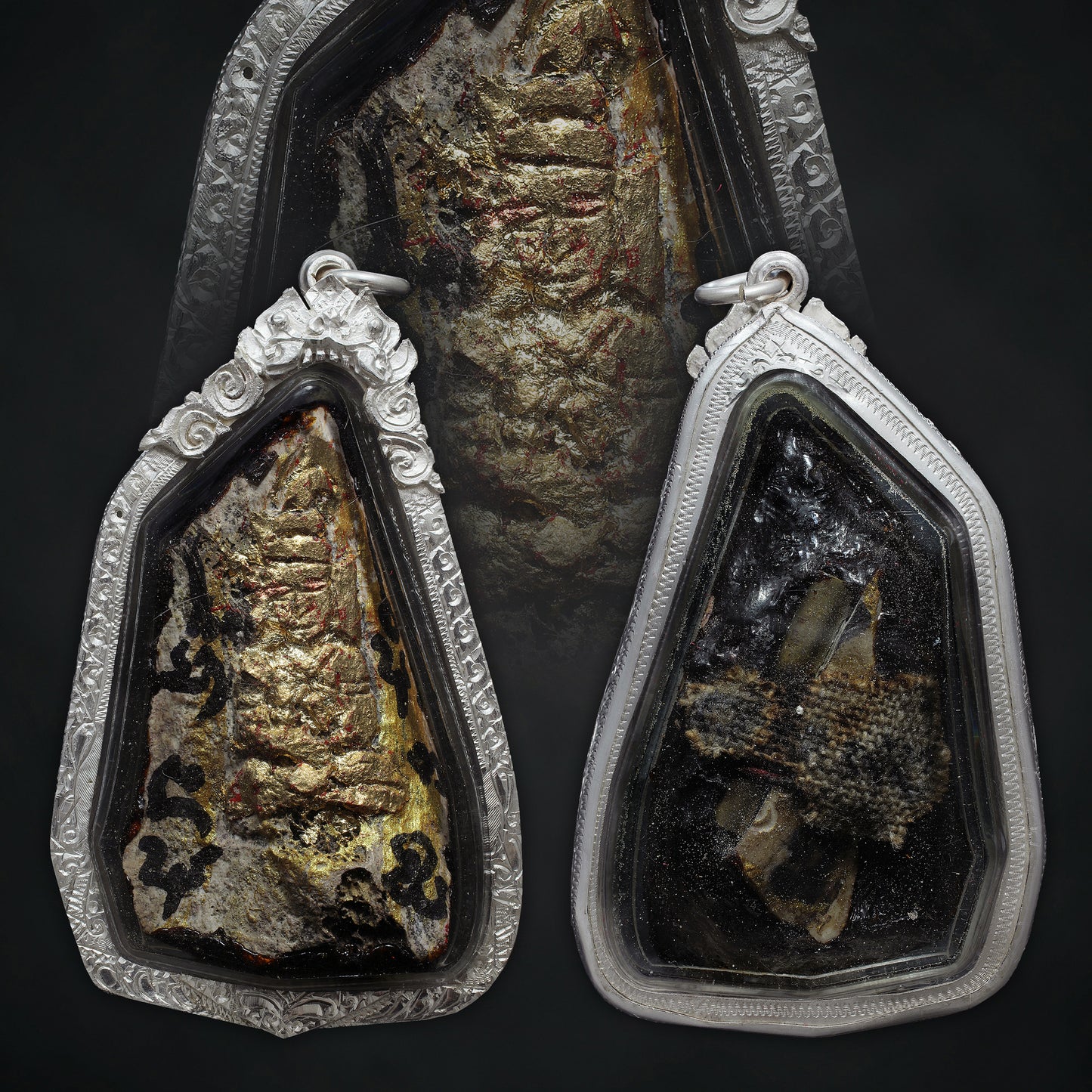
The most immediately visible component is the Graduk Pee relic forming the front of the artifact.
Its surface carries the sacred figure together with inscriptions and remnants of ritual gold leaf.
The reverse incorporates Paneang Mae Prai, forming the principal Saneh component of the construction. Within Por Sala Tan’s practice, such material was associated with attraction, emotional response and the ability to make one’s presence remain within another person’s thoughts.
Selected herbs and ritual oils were incorporated into this preparation.
Additional relic fragments were then secured within the reverse, creating a physical anchor for the deeper spirit working.
The Prai Ngan element forms the final layer. Within the account accompanying this piece, the presence was regarded as being of a Jinn level, distinguishing it from a simpler Prai construction.
The combination was therefore deliberate: relic, Saneh substance and spirit working, each contributing a different quality to the finished artifact.
Ritual
Preparation began with the Graduk Pee relic itself.
The sacred figure and yantra-related inscriptions were established upon its surface before portions were covered with gold leaf. Within traditional practice, the inscription is not merely decorative; it establishes the ritual structure through which the intended wicha is directed.
The Paneang Mae Prai preparation was then incorporated into the reverse together with the selected herbs, oils and accompanying relic materials.
The Prai Ngan working was subsequently connected to this prepared structure through Por Sala Tan’s spirit wicha.
The intention was not to leave the different components acting independently.
Through consecration, they were brought into a single working relationship: the Graduk Pee providing the foundation, the Paneang carrying the Saneh and attraction current, and the Prai Ngan providing the element of active spiritual assistance.
Blessings and Effects
The strongest traditional emphasis of this artifact is Saneh and personal magnetism.
This concerns attraction in its broader sense — being noticed, remembered and responded to favourably.
In relationships, it may traditionally be carried for opposite attraction, affection and stronger emotional attention.
In business, the same quality can be interpreted differently. A customer who feels comfortable remaining in conversation is easier to communicate with; someone who remembers the owner favourably may be more inclined to return.
The Prai Ngan component is associated with spiritual assistance and manifestation, particularly where the owner has a defined intention or objective.
The Graduk Pee foundation contributes the harder side of the artifact, traditionally associated with protection, Baramee and resistance against harmful unseen influences.
This creates the defining character of the piece:
attraction without leaving the owner spiritually exposed.
Modern Application
The Prai Ngan is particularly suited to people whose livelihood depends heavily upon human interaction.
Salespeople, business owners, negotiators and those working in customer-facing professions may carry it for stronger presence, smoother communication and greater receptiveness from the people they encounter.
Its Saneh qualities also make it appropriate for social situations where confidence, attraction and being remembered favourably are important.
For established relationships, the emphasis may instead be directed towards maintaining affection and emotional closeness.
Because this remains a strong spirit-based artifact rather than a conventional Metta piece, it should be approached respectfully and carried by someone comfortable with the character of Por Sala Tan’s Prai and Barang traditions.
Physical Details
A spirit-based artifact constructed around an old Graduk Pee relic, with the front bearing a sacred figure, ritual inscriptions and applied gold leaf. The reverse contains Paneang Mae Prai, selected herbs and oils, bound relic components and the prepared foundation associated with the Jinn-level Prai Ngan working. The complete artifact is protected within a fitted silver casing.
Recommended Pairing
Because this piece already combines Saneh, spirit assistance, Baramee and protection, it does not require another strong Prai artifact to complete its purpose.
A conventional Metta Maha Niyom piece can also soften the overall combination where the wearer deals continuously with customers, colleagues or members of the public.
The Prai Ngan itself, however, remains the central artifact — a distinctly Por Sala Tan construction in which Graduk Pee, Paneang Mae Prai and spirit wicha were brought together for attraction, protection and assistance within a single piece.
-
Free Shipping for Singapore| $15 Worldwide | $60 USA For Items Below $350