
OOBThaiAmulets
Por Sala Tan
Por Sala Tan
Couldn't load pickup availability
PST02
Suer Nang Noen
Por Sala Tan
4.5cm
Mainstream Artifact
Sacred Craftsmanship
Each artifact is individually handmade from naturally formed sacred material. Variations in colour, grain, markings, shape and carving are therefore inherent to the piece, ensuring that every example remains individually distinct.
Personal Experiences Shared by Luksits
Among Por Sala Tan’s luksits, Suer pieces are often carried by people whose daily lives require them to deal with competition, difficult personalities or positions of responsibility.
Owners commonly describe the effect less as aggression and more as a change in personal bearing. They feel more composed when entering difficult meetings, more willing to stand by their decisions and less easily pressured by stronger personalities.
Business owners and those supervising staff have similarly associated Suer wicha with Baramee and command presence. Rather than constantly having to establish authority verbally, some describe others as becoming more attentive when they speak and more respectful of boundaries.
Another recurring association concerns hidden opposition. Luksits traditionally carry Suer pieces when dealing with environments where backstabbing, jealousy or unseen hostility may be present.
For travellers and those frequently entering unfamiliar places, the protective character of the Suer is also valued as a form of watchfulness — the instinct to recognise an unfavourable situation before becoming unnecessarily involved.
Summary
Por Sala Tan’s Suer Nang Noen — the Suer seated upon the hill — represents a particularly calm expression of Suer wicha.
It is not shown charging, attacking or displaying uncontrolled aggression.
Instead, the Suer sits above its surroundings as the King of the Forest: observing, guarding and commanding its territory.
Carved from Keow Mii, the artifact centres upon Baramee, protection, courage, leadership and instinctive awareness.
Its character is therefore particularly suited to someone who requires authority without aggression — a person who needs to remain composed, maintain boundaries and command appropriate respect while navigating difficult circumstances.
Historical Background
The Suer has long occupied a powerful symbolic position within Thai sacred traditions.
As a forest predator, it came to represent strength, courage, survival and territorial command. Its presence does not depend upon constant confrontation; other animals recognise the territory of the Suer before confrontation becomes necessary.
This idea contributed naturally to its association with Baramee.
Within sacred practice, Baramee is broader than simple physical strength. It concerns personal standing, accumulated authority and the quality through which others recognise and respect an individual’s presence.
Different representations of the Suer consequently emphasise different aspects of its character.
A moving or attacking Suer may suggest active force.
A Suer seated upon elevated ground, however, presents another interpretation: authority already established.
The Suer does not need to chase everything around it. It watches from above.
Origins of the Materials
The carving was made from Keow Mii, a natural relic material preserved and used within Por Sala Tan’s practice.
Such materials were valued because they were not regarded simply as convenient substances for carving. Their natural origin formed part of the identity of the finished artifact.
For this piece, Keow Mii provides an appropriate foundation for a Suer image because both belong symbolically to the forest environment and the older animist understanding of powerful natural forces.
The material’s irregular form also means that the carving follows what the original piece permits.
Natural colouring, internal lines, darker areas, age marks and differences in surface texture should therefore be regarded as characteristics of the original material rather than imperfections in manufacture.
Ritual
After carving, Por Sala Tan consecrated the piece through his Suer wicha, directing the image towards protection, Baramee and authority.
The intention was not simply to create the physical likeness of a Suer.
Within the traditional understanding of such work, the carving provides the form through which the qualities represented by the Suer are established and directed.
Particular emphasis was placed upon commanding presence, courage, protection and the ability to overcome obstacles without becoming overwhelmed by them.
The seated position complements this purpose particularly well.
It represents controlled power — strength that remains still until action becomes necessary.
Blessings and Effects
The principal quality associated with this artifact is Baramee.
For people holding responsibility, this traditionally relates to leadership, confidence, credibility and the ability to command appropriate respect.
Its second major aspect is protection. Suer wicha has traditionally been associated with guarding against danger, hostile intentions, spiritual disturbances and people acting against the owner.
Courage forms another important element. The Suer represents the ability to face difficult circumstances without retreating simply because another person appears stronger or more intimidating.
There is also an association with instinct and awareness. Just as a wild Suer survives by remaining sensitive to its surroundings, the wearer traditionally seeks better awareness of people, situations and potential danger.
Finally, Suer symbolism can be connected with livelihood and opportunity. The predator must successfully seek what sustains it; in human terms, this became associated with the determination to pursue opportunities and secure resources for oneself and one’s household.
Modern Application
The Suer Nang Noen is particularly appropriate for those working in management, business ownership, negotiation or competitive professions.
Its character suits people who regularly have to make decisions while others are watching them.
Rather than being a Saneh piece centred upon attraction, its emphasis is upon presence — remaining composed, establishing boundaries and being taken seriously.
It can also be carried by people who frequently travel, work late hours or move through unfamiliar environments, where the protective and watchful symbolism of the Suer becomes particularly relevant.
At approximately two inches, the piece remains practical for regular wear despite the substantial natural material from which it was carved.
Physical Details
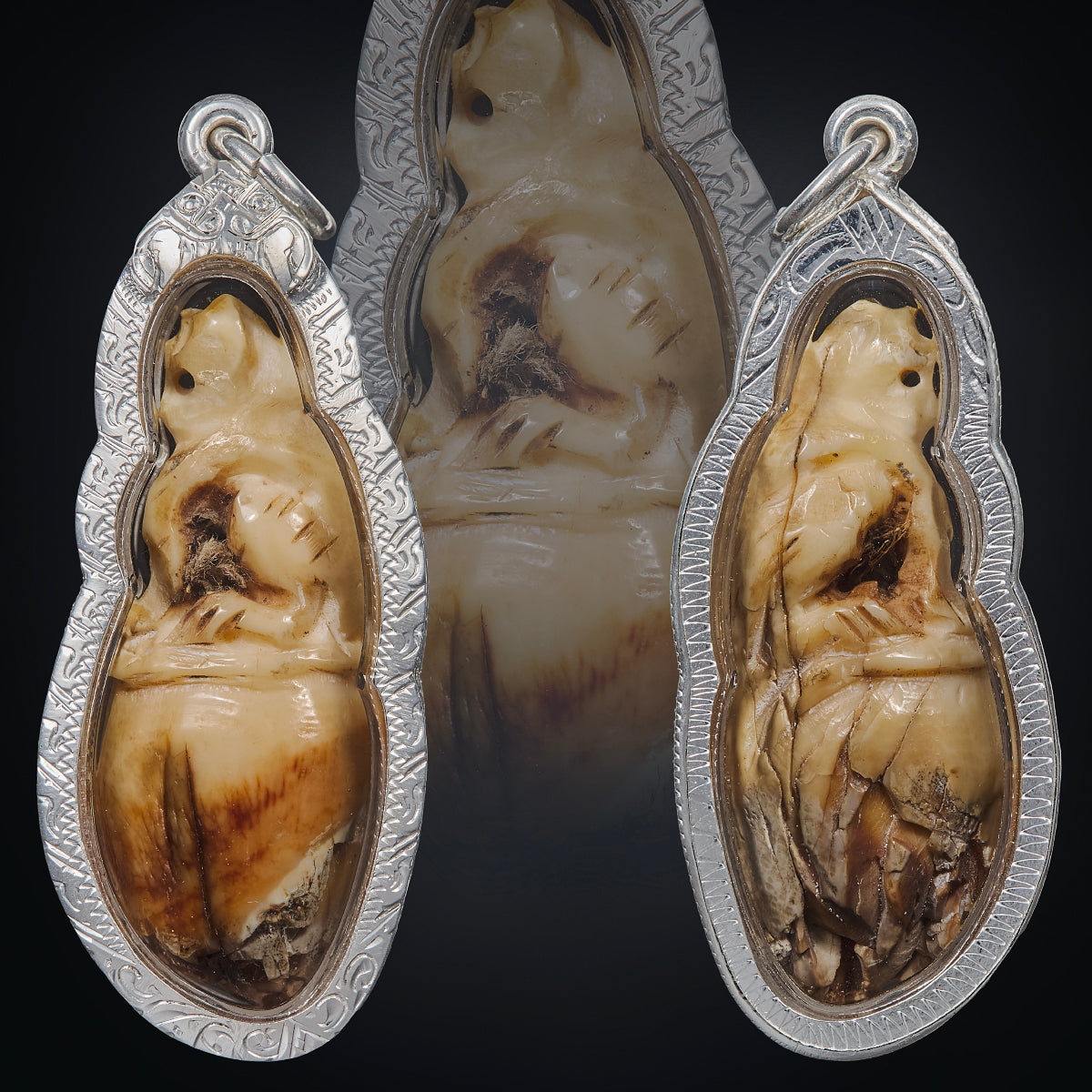
An individually carved Suer seated upon a raised hill, fashioned from natural Keow Mii and measuring approximately 2 inches. The carving is housed within a fitted silver casing for protection and everyday wear. Natural differences in colour, internal markings, surface texture and form are characteristic of the relic material and form part of the individuality of the artifact.
Recommended Pairing
This piece can be carried independently as a strong Baramee and protection artifact.
For business use, it pairs particularly well with Metta Maha Niyom. The Metta piece supports goodwill and receptiveness from customers or colleagues, while the Suer contributes firmness, confidence and authority.
It may also be paired with Chu Chok where negotiation and successful requests are important. Chu Chok traditionally concerns asking, persuasion and receiving assistance, whereas the Suer strengthens the presence behind the request.
For collectors already carrying stronger Saneh pieces, the Suer provides a useful counterbalance: attraction brings people closer; Baramee determines how one stands when they arrive.
-
Free Shipping for Singapore| $15 Worldwide | $60 USA For Items Below $350