
OOBThaiAmulets
Por Sala Tan
Por Sala Tan
Couldn't load pickup availability
PST02
Ong Krut Keow Moo Tong Deang
Por Sala Tan
5 Inches
Mainstream Artifact
Sacred Craftsmanship
This imposing Ong Krut was personally prepared by Por Sala Tan as a working ritual artifact rather than simply as a piece intended for ordinary carrying.
Each artifact of this nature was individually carved and assembled from old natural and ritual materials. Variations in the fang, carving, inscriptions, relics, bindings, colour and surface patina form part of the character of the piece and its history of use.
Personal Experiences Shared by Luksits
According to Ac Lek, this was not an artifact that remained stored away after its consecration.
The Ong Krut was a substantial working piece, approximately five inches in size, which Por Sala Tan kept within his ritual environment and personally used during ceremonies.
It could be held during ritual work or positioned beside him when dealing with particularly heavy conditions. Accounts from those close to the lineage associate its use with clearing harmful energies, breaking or dissolving occult interference, stabilising ritual spaces and supporting demanding consecration work.
Interestingly, its use was not limited to Por Sala Tan himself.
Ac Lek recalled that visiting monks and masters would sometimes borrow the Ong Krut for use during their own ceremonies when additional ritual support was required. It was therefore regarded less as a personal amulet and more as a recognised working instrument within Por Sala Tan’s circle.
It was also brought into ceremonies involving Metta and Saneh work. Here, its purpose was not necessarily to provide attraction by itself, but to establish and control the ritual environment so that other workings could proceed within a stable field.
For collectors of Por Sala Tan’s lineage, this history of repeated ceremonial use is particularly important. Its significance comes not simply from the rarity of the materials, but from having been actively worked with over many ceremonies.
Summary
This Ong Krut Keow Moo Tong Deang represents the heavier protective and ritual side of Por Sala Tan’s practice.
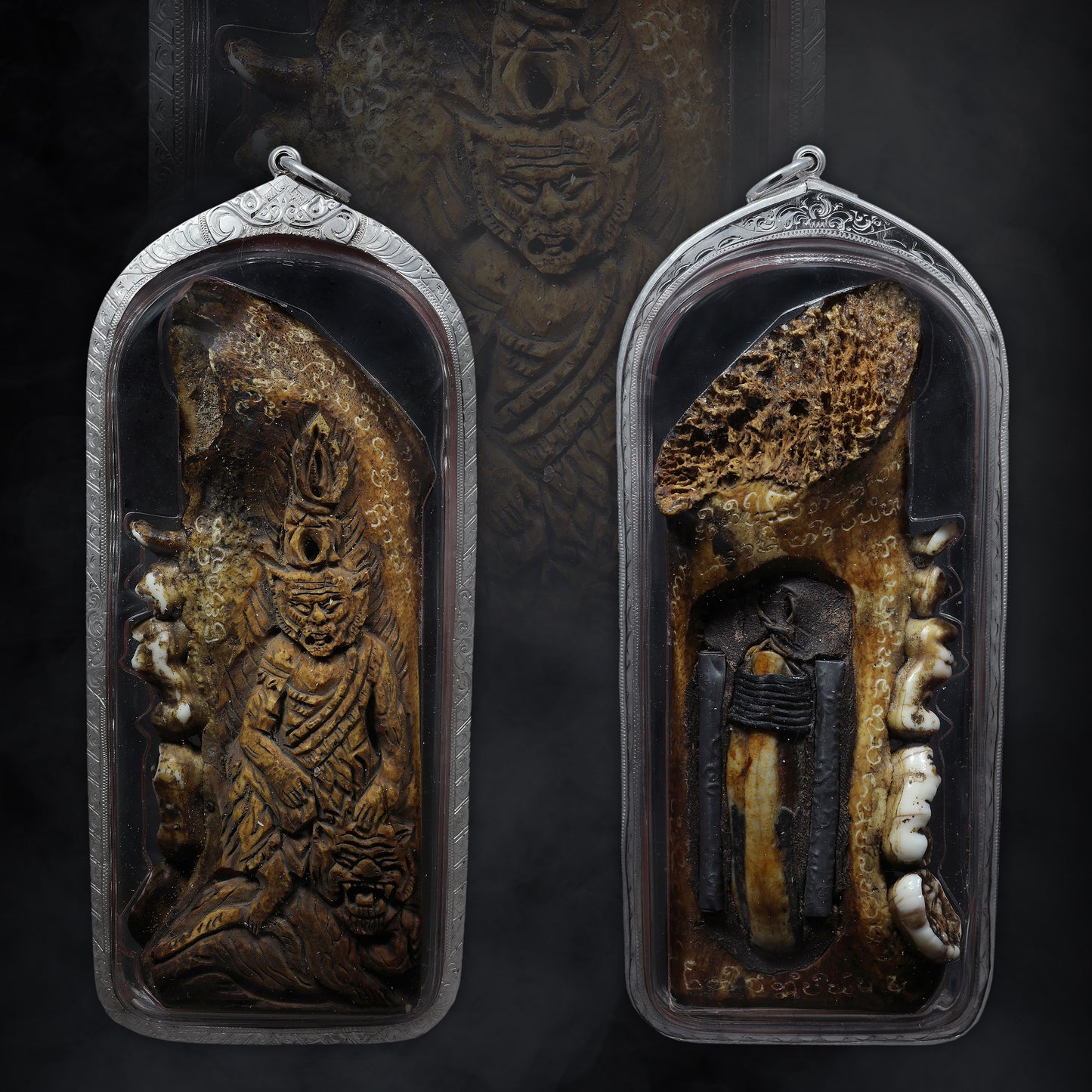
Carved from Keow Moo Tong Deang with Lersi Ser Ming Pai upon its face, the reverse combines 100+ year-old Nga Chang Graden Boran, ancient Kon Chang and two takruts into a powerful traditional construction.
Its principal qualities centre upon Baramee, protection, obstacle clearing, command and the stabilisation of difficult spiritual environments.
More significantly, this example was remembered as one of Por Sala Tan’s own working ritual pieces. It was used during ceremonies and, according to Ac Lek, was occasionally loaned to visiting monks and masters who required its support.
It is therefore better understood as a ritual tool with accumulated history rather than simply an oversized personal amulet.
Historical Background
Large Ong Krut pieces occupy a different position from the smaller amulets normally associated with personal wear.
Within traditional practice, certain sacred objects were deliberately made larger because their intended environment was the altar, ritual room or ceremonial space. They could be held during a rite, placed beside the practitioner or positioned among the materials being consecrated.
The imagery of Lersi Ser Ming Pai is particularly appropriate to such an object.
Within Por Sala Tan’s lineage, Lersi traditions were closely connected with the transmission of wicha, discipline, knowledge, protection and the management of forces encountered during ritual practice.
The Lersi is therefore not treated simply as a protective figure. He represents the kru — the body of knowledge and authority behind the practice itself.
This explains why a piece of this scale could remain relevant across very different ceremonies. Its underlying purpose was to provide Baramee, protection and stability while the specialised work of the ceremony was carried out.
Origins of the Materials
The principal body is Keow Moo Tong Deang.
Old fang materials occupy an established place within Por Sala Tan’s work, particularly where a strong natural material was required to carry carved yantra, Lersi imagery or protective wicha.
The reverse contains Nga Chang Graden Boran, described within the lineage as being more than a century old. Such old Nga Chang material was not treated casually and was generally reserved for artifacts where Baramee, strength and ritual authority were important.
Accompanying it is Kon Chang, likewise said to be more than 100 years old.
Rather than being added merely as another relic, the Kon Chang was incorporated into the physical binding of the rear assembly, connecting the old elephant materials into a single construction.
Finally, two takruts were installed beside the central relic, strengthening and balancing the protective and commanding aspects of the artifact.
Ritual
Por Sala Tan worked the artifact through Lersi Ser Ming Pai wicha.
The Lersi image carved directly into the Keow Moo Tong Deang provided the central ritual form. Through invocation, katha, concentration and the practitioner’s established wicha, the piece was consecrated so that the Lersi influence was directed into the carved relic.
Its subsequent ceremonial history became another important layer.
Rather than receiving one blessing and then being completed, the Ong Krut continued to be present during Por Sala Tan’s ritual work. It was repeatedly exposed to chanting, consecrations and the preparation of other sacred materials.
In traditional understanding, this repeated use matters. A working object gradually becomes associated not merely with its original consecration but with the many ceremonies in which it subsequently participated.
This helps explain why experienced practitioners within the circle were willing to borrow it when carrying out demanding work of their own.
Blessings and Effects
The principal quality attributed to this Ong Krut is Baramee — spiritual authority, presence and the strength to remain composed when confronted by difficult circumstances.
Its protective aspect is traditionally directed towards harmful energies, occult interference, hostile spiritual conditions and unseen obstacles.
The Lersi Ser Ming Pai component further connects the artifact with guidance, discipline, wisdom and the practitioner’s ability to work through complicated situations without becoming overwhelmed by them.
The old Nga Chang materials add another dimension of firmness and commanding presence.
For this reason, the piece is traditionally understood not as uncontrolled aggression, but as controlled ritual force: establishing authority, holding a space and preventing disruptive influences from easily entering or taking hold.
Modern Application
Because of its approximately five-inch scale and its history as a ceremonial object, this Ong Krut is best understood as an altar or premises-based artifact.
Within a home, it may traditionally be kept in a respectful dedicated location for protection, Baramee and the stabilisation of the surrounding environment.
Within a business, its character is particularly suited to owners, senior decision-makers or individuals who require authority, resilience and protection while operating in competitive surroundings.
For practitioners or serious collectors maintaining several consecrated objects, it may also serve as a central Lersi and Baramee piece, particularly where the collection includes stronger spirit-based or protective artifacts.
Its original history, however, remains its most natural application: a ritual guardian and supporting instrument positioned where serious wicha is being practised.
Physical Details
A substantial Ong Krut measuring approximately five inches, carved from Keow Moo Tong Deang with the image of Lersi Ser Ming Pai and sacred inscriptions across the surface. The reverse houses an ancient Nga Chang Graden Boran relic, 100+ year-old Kon Chang and two protective and harmonising takruts. Its aged surface, natural cavities, carving marks and variations belong to the original fang material and traditional handmade construction.
Recommended Pairing
As a large working artifact, this Ong Krut does not require another piece to complete its principal purpose.
For an altar arrangement, it can nevertheless form the Baramee and protective foundation around which more specialised pieces are placed.
Metta, Saneh, wealth or opportunity artifacts may complement it particularly well. Those pieces address attraction, relationships and commercial movement, while the Ong Krut maintains the stronger foundation of authority, protection, obstacle clearing and ritual stability.
Its most appropriate role remains the one for which Por Sala Tan himself is remembered as using it: standing behind the work, strengthening the practitioner and holding the ceremonial environment steady.
Personal Notes
What distinguishes this Ong Krut is not simply the age or rarity of its materials.
Many artifacts can contain unusual relics. Far fewer have a remembered history as an actual working piece belonging to the master who created them.
According to Ac Lek’s account, Por Sala Tan kept this piece close during his ceremonies and allowed other visiting monks and masters to use it when necessary. That history gives the object a very different character from an artifact prepared solely for distribution.
The Keow Moo Tong Deang, old Nga Chang Graden, Kon Chang, takruts and Lersi Ser Ming Pai carving are important individually. Together with decades of ceremonial use, however, they form an artifact closely connected with the practical side of Por Sala Tan’s wicha and ritual life.
-
Free Shipping for Singapore| $15 Worldwide | $60 USA For Items Below $350