
OOBThaiAmulets
Por Sala Tan
Por Sala Tan
Couldn't load pickup availability
PST08
Hoon Payon
Por Sala Tan
3 Inches (yellow)
Barang Artifact
Sacred Craftsmanship
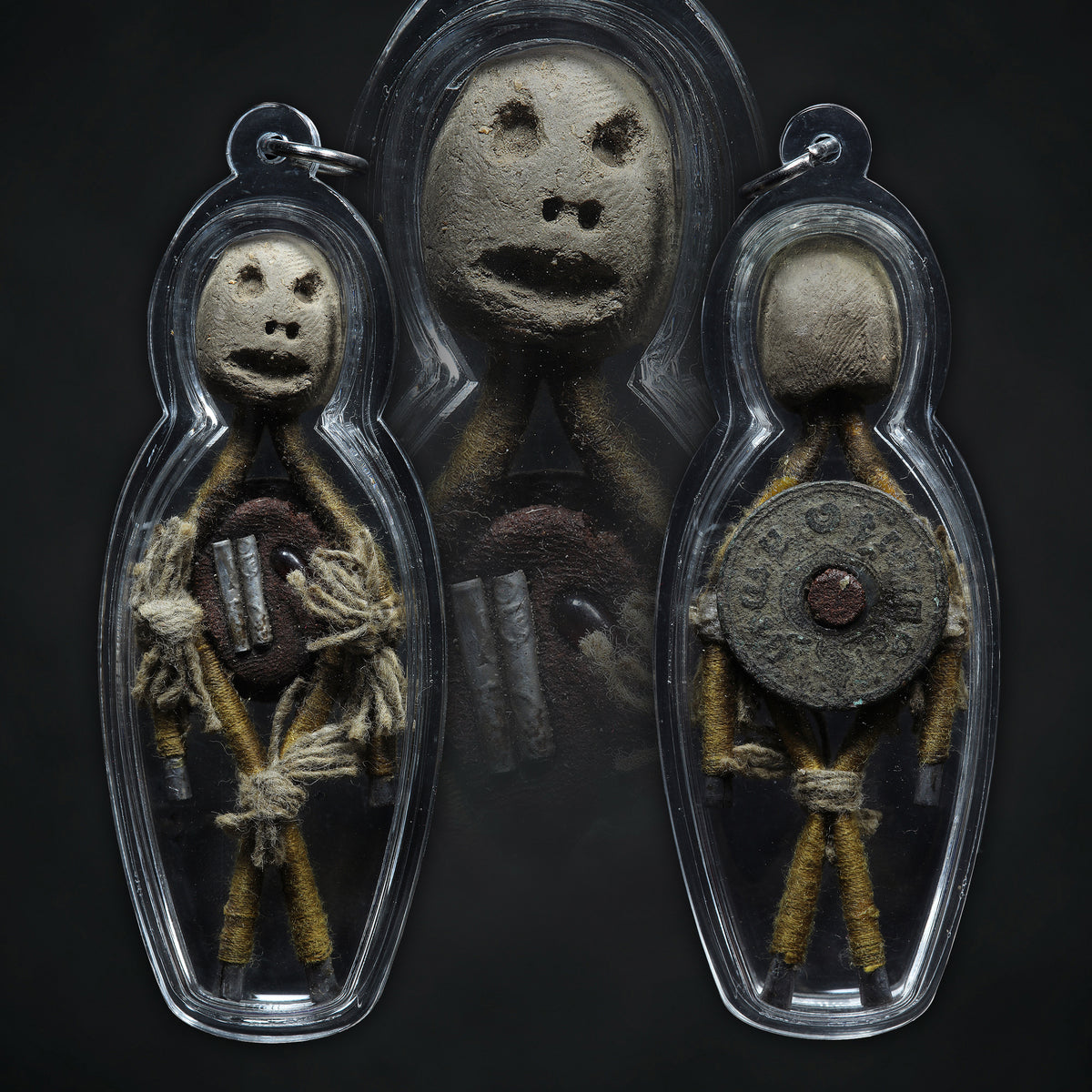
This early first-batch Hoon Payon belongs to a particularly old and serious category of Por Sala Tan's spirit-based work. Rather than creating a symbolic guardian from ordinary sacred powders, Por Sala Tan incorporated materials connected with combat soldiers who lost their lives during the prolonged civil and border conflicts in Myanmar.
Each piece is individually handmade, and natural variations in colour, texture, form and finishing are to be expected. The photographs are representative only. A piece will be selected at random, and the amulet supplied may differ from the exact piece shown in the images.
Each Hoon Payon was individually assembled and bound by hand. Natural differences in the Pong Prai Graduk head, thread, knots, Tidjai, Ploi Sek and overall proportions are therefore characteristic of the batch, with no two examples being entirely identical.
Personal Experiences Shared by Luksits
Among Por Sala Tan's older luksits, these Hoon Payon were remembered primarily as protective guardians rather than aggressive spirit artifacts.
One of the recurring descriptions was that the Hoon Payon acted almost like a second presence accompanying its keeper. Owners spoke of feeling considerably safer when travelling, working late or entering places where they were uncertain of the people around them.
The older interpretation was that the Hoon Payon could serve as a form of body double. Danger, hostile intention or spiritual interference directed towards the owner was believed capable of being intercepted or diverted by the guardian.
Others associated the pieces with problems involving hidden enemies, betrayal and people acting behind one's back. Rather than producing open confrontation, luksits described the guardian as helping expose troublesome situations earlier or causing harmful intentions to lose their momentum.
Interestingly, the Tidjai incorporated within the chest gave the piece another characteristic beyond protection.
Some owners associated these Hoon Payon with people becoming easier to approach, remembering them favourably and maintaining stronger connections after meeting. For traders and people dealing regularly with customers, this was regarded as particularly useful.
The resulting character was therefore not simply fierce. Owners described a combination of protection, confidence, presence and human attraction.
Summary
This is an early first-batch Hoon Payon by Por Sala Tan, created from materials associated with combat soldiers whose deaths occurred during conflict in Myanmar.
Following their deaths, Por Sala Tan performed proper final rites and cremation. Pong Prai Graduk from the cremated remains was subsequently used to form the heads of these guardians.
Within each figure, Tidjai relic material forms the spiritual heart, accompanied by Ploi Sek blessed gemstone fragments. Sai Sin from the ceremony binds the body and connects the completed effigy back to its ritual origin.
Traditionally, the principal function is guardian protection — watching over the keeper, intercepting harmful influences and acting as a spiritual body double.
The Tidjai component introduces a second quality: attachment, remembrance and attraction, particularly useful where business and personal relationships depend upon people remembering, trusting and returning to the owner.
This combination gives the first batch a distinctive character: the discipline and protective presence of the soldier joined with the binding and attraction qualities of Tidjai.
Historical Background
The concept of Hoon Payon belongs to an old current within Thai occult practice.
Hoon refers to a figure or effigy, while Payon carries the concept of something empowered or animated through wicha. A Hoon Payon is therefore not merely a miniature human figure. Within traditional belief, it becomes a ritually activated guardian or spiritual servant.
Different lineages construct them differently.
Some are woven from sacred threads. Others are carved, modelled from powders or assembled from ritual metals and natural materials. Their forms may represent humans, animals, guardians or other beings depending upon the intended work.
The underlying principle remains similar: the form is prepared as a vessel appropriate to its function.
Traditional Hoon Payon have consequently been kept around homes, farms, shops, warehouses and valuables. They have also been carried during journeys or into environments where their owners required an additional protective presence.
Spirit-based Hoon Payon represent a more specialised branch of this practice.
Instead of relying entirely upon yantra and consecration to establish the guardian quality, spirit-associated materials are incorporated into the figure. Por Sala Tan's first-batch examples belong to this stronger category.
Origins of the Materials
The defining material is the Pong Prai Graduk of the deceased combat soldiers.
The soldiers were said to have died during a landmine operation amidst the long-running conflicts in Myanmar. Without proper funeral rites, their circumstances were regarded as spiritually unresolved.
Por Sala Tan performed their final rites and cremated the remains.
Only after this process was part of the resulting material retained and transformed into sacred artifacts.
The heads were formed from the prepared Pong Prai Graduk, giving the otherwise simple human effigies their distinctive appearance.
Inside the chest is Tidjai.
Within the terminology surrounding these pieces, Tidjai should be understood as the heart relic and spiritual core of the Hoon Payon. Its placement at the chest is deliberate: it represents the centre through which the guardian's presence is stabilised.
Attached to the Tidjai are fragments of Ploi Sek (พลอยเสก) — gemstones that had undergone ritual blessing before being incorporated into the construction.
Finally, Sai Sin from the ceremony was used in binding the body, physically and ritually bringing the individual components together.
Ritual
The most important part of the preparation occurred before the Hoon Payon itself was constructed.
Por Sala Tan first provided the deceased soldiers with the final rites that had originally been absent.
Their remains were cremated, prayers and merit were dedicated, and only thereafter were selected materials retained for further ritual work.
This distinction is important within the lineage surrounding the piece.
The intention was not simply to obtain powerful materials from violent deaths. Por Sala Tan first addressed the condition of the deceased through proper rites before incorporating their remaining relic materials into a protective formula.
The Pong Prai Graduk was subsequently prepared into the head.
The Tidjai and blessed Ploi Sek formed the internal heart, while the figure was constructed and repeatedly bound using Sai Sin associated with the ceremony.
The completed Hoon Payon was then empowered for the role of guardian, watcher and protective substitute for its keeper.
Blessings and Effects
The strongest traditional quality is body-double protection.
Within this wicha, the Hoon Payon represents another body standing beside the owner. Harm, hostile spiritual influence or dangerous intention approaching the keeper is traditionally believed capable of being diverted towards the guardian rather than reaching its intended target directly.
This naturally extends into protection against hidden enemies, betrayal, backstabbing and unseen opposition.
The soldier origin also gives the piece a strong association with alertness, courage and disciplined protection. It is therefore particularly suited to individuals who regularly enter uncertain environments or must deal with competitive people.
The Tidjai adds a markedly different quality.
The term Tid Jai in ordinary Thai conveys becoming attached to, fond of or captivated by something. Within sacred-object practice, this idea is extended towards being remembered, attraction and the tendency for people's attention to remain with the owner.
In business this becomes especially relevant to customer relationships, sales, networking and repeat patronage.
Rather than creating attraction alone, its position within this Hoon Payon balances the more forceful protective qualities of the soldier materials with a socially favourable influence.
The result combines protection, Baramee, confidence, attraction and remembrance.
Modern Application
The Hoon Payon is particularly appropriate for people who require both protection and regular interaction with others.
Business owners may keep it around their workplace for guarding the premises while simultaneously supporting customer relationships.
Salespeople, traders and those working on commission may carry it where being remembered positively and maintaining returning relationships are important.
For people operating in competitive environments, its traditional role is broader: protection against unseen opposition while strengthening the confidence required to confront difficulties directly.
It may also be kept within the home, business premises, vehicle or near important possessions according to the owner's purpose.
The character of this batch, however, remains fundamentally that of a guardian first, with Tidjai attraction functioning alongside that protective foundation.
Physical Details
A handmade human-form Hoon Payon constructed around a distinctive head formed from prepared Pong Prai Graduk associated with combat soldiers. The figure is bound with aged Sai Sin connected with the original rites, while the chest contains Tidjai relic material and Ploi Sek blessed gemstone fragments forming its spiritual core. Small ritual components and bindings remain visibly exposed as part of its traditional construction. These examples have subsequently been protected within clear casings while preserving the original figures inside.
Recommended Pairing
This Hoon Payon is already unusually complete because its construction combines protection, spirit guardianship and Tidjai attraction.
For those requiring stronger authority in professional life, it may be paired with a Baramee-oriented artifact. The Hoon Payon performs the guarding and interception role, while the Baramee piece supports leadership, standing and personal authority.
For business use, a Metta Maha Niyom piece can further develop the attraction aspect already present through the Tidjai.
It does not, however, require another spirit artifact to function. Its original construction was intended to establish a complete guardian in its own right.
Personal Notes
This batch also carries an interesting collecting history.
According to the provenance accompanying these examples, the first production was acquired in full by a Hong Kong dealer. The surviving pieces shown here came from that dealer's old stock and were only retrieved again much later before being placed into protective casings.
That history helps explain why examples from this particular early batch are not commonly encountered amongst later Por Sala Tan pieces.
More importantly, the construction reveals a side of Por Sala Tan's work that should not be reduced simply to the use of Prai materials.
The soldiers' circumstances came first.
They had died violently and, according to the lineage account, had been left without the proper final rites. Por Sala Tan's first action was therefore to conduct those rites and cremate their remains properly.
Only afterwards were selected materials incorporated into the Hoon Payon.
The completed guardian consequently carries two seemingly opposite qualities. The combat origin contributes discipline, vigilance and protection, while the Tidjai heart introduces attachment, attraction and favourable human connection.
For me, this balance is what makes the first batch particularly interesting.
It is not simply a fierce Hoon Payon.
It is a guardian constructed to stand in front of its keeper when danger approaches, while helping the same keeper remain favourably remembered when dealing with people.
-
Free Shipping for Singapore| $15 Worldwide | $60 USA For Items Below $350