
OOBThaiAmulets
Por Sala Tan
Por Sala Tan
Couldn't load pickup availability
PST08
Phra Pikanet
Por Sala Tan
3 Inches
Mainstream Artifact
Sacred Craftsmanship
Each artifact was individually cast and assembled from prepared sacred materials. Natural differences in the old alloy, herbal mixture, relic material, surface texture and ritual finishing are therefore expected, making every surviving example individually distinct.
Personal Experiences Shared by Luksits
Among Por Sala Tan's luksits, feedback surrounding these Phra Pikanet pieces has generally concerned movement after periods of difficulty.
Some owners described carrying the piece when work or business seemed to have reached a dead end. Problems did not necessarily disappear immediately, but situations that had remained stagnant began to develop again — a conversation restarted, another opportunity appeared, or somebody previously unwilling to cooperate became more receptive.
Business owners particularly associated the piece with smoother dealings with people. Customers became easier to communicate with, negotiations felt less confrontational, and assistance sometimes appeared through people already within their existing network.
The Nang Kwai component was valued differently. Luksits working in competitive environments associated it with stronger Baramee and greater confidence when dealing with difficult personalities, gossip, jealousy or people attempting to create problems behind the scenes.
The three takruts were regarded as an important balance to this stronger element. Rather than encouraging confrontation, their purpose was directed towards harmony — allowing matters to be resolved with less unnecessary conflict.
For this reason, followers often regarded this Phra Pikanet as particularly useful during periods involving career changes, business expansion, negotiations or important decisions affecting the next stage of life.
Summary
This Phra Pikanet is a Cambodian-border formula centred upon obstacle clearing, wish fulfilment, Baramee, opportunity and harmonious relationships.
Its construction reflects the older mixed-material approach found within Por Sala Tan's wider circle.
The old Cambodian temple brass forms the sacred body.
The 108-herb preparation provides the traditional foundation of accumulated sacred plant materials.
The Nang Kwai contributes Baramee, resilience and protection against jealousy, gossip and hidden opposition.
The three takruts are directed towards harmony and smoother relationships with those surrounding the keeper.
Rather than functioning purely as a wealth artifact, its character is broader: to clear what is preventing progress and help create the conditions through which progress can continue.
Historical Background
Phra Pikanet, the Thai form of Ganesha, has long been associated with wisdom, successful undertakings and the removal of obstacles.
These qualities made the deity particularly relevant to traders, craftsmen, business owners and people beginning important undertakings.
During Por Sala Tan's travels through Northern and Northeastern Thailand, he maintained contact with disciples who had settled in different areas. Some of those living close to the Cambodian border remained connected with Cambodian practitioners and exchanged moulds, sacred materials and traditional ritual knowledge.
The border region preserved a distinctive approach to sacred-object making.
Rather than depending upon a single sacred ingredient, practitioners commonly brought together old metals, herbal preparations, takruts and other ritual materials, each serving a particular purpose within the completed artifact.
Phra Pikanet became particularly suitable for this approach because the principal intention was practical: when the path ahead had become obstructed, the deity was invoked to help open it again.
Origins of the Materials
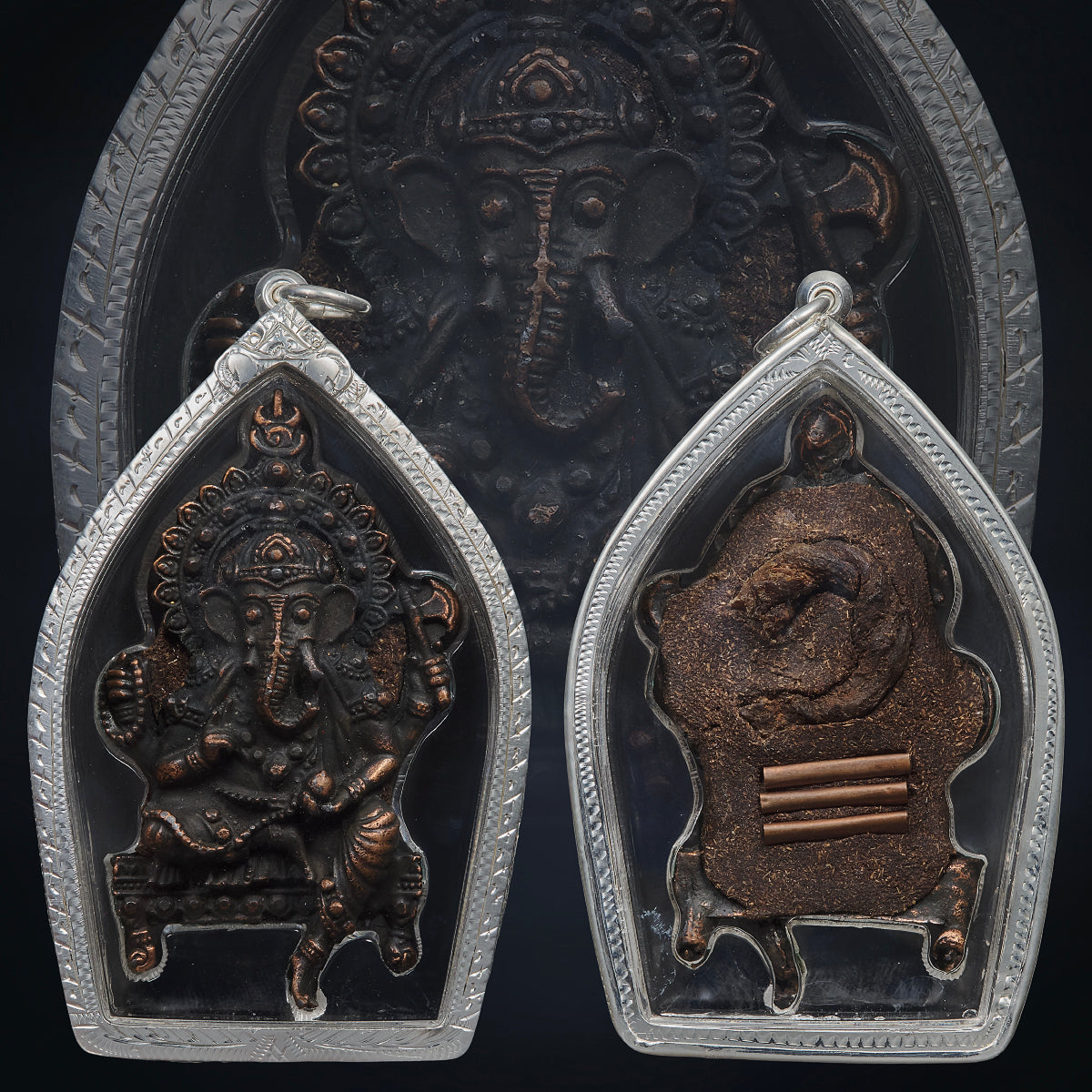
The principal image was cast using old brass associated with Cambodian temple structures and ritual objects.
Such material was valued not simply because of its age. Within traditional practice, metal that had remained within a sacred environment for many years was regarded differently from newly purchased commercial metal.
The reverse contains a prepared mixture of 108 sacred herbs.
The number 108 carries longstanding sacred associations throughout Buddhist and wider South and Southeast Asian traditions. Within this artifact, the herbal blend represents a broad and complete preparation rather than a single-purpose herb.
Por Sala Tan and practitioners within his circle commonly gathered suitable materials when they became available, blessed and prepared them, and retained them for later ritual work.
The second important component is Nang Kwai.
Among Por Sala Tan's disciples, this material was associated particularly with Baramee, resilience, personal authority and resistance against jealousy, gossip and concealed opposition.
Finally, three takruts were incorporated directly into the herbal backing.
Their purpose was harmony — particularly where the keeper's progress depended upon cooperation, negotiation and maintaining workable relationships with others.
Ritual
The preparation brought together several separate forms of wicha rather than relying upon the Phra Pikanet image alone.
The old metal was first used to establish the physical sacred image.
The 108-herb preparation was separately gathered, prepared and blessed before being applied to the reverse.
Nang Kwai was incorporated as the Baramee component, while the three takruts were prepared towards harmonising people and circumstances surrounding the keeper.
Phra Pikanet was then invoked as the principal sacred figure governing the complete construction.
The intention centred upon removing obstacles, opening pathways and allowing important undertakings to move towards completion.
In this sense, the different materials work towards the same objective from different directions: Phra Pikanet opens the path, Nang Kwai strengthens the keeper, while the takruts address the relationships encountered along that path.
Blessings and Effects
The foremost quality associated with this artifact is obstacle clearing.
It is traditionally carried when circumstances have become repeatedly delayed, complicated or difficult to move forward.
A second quality is wish fulfilment, particularly where the wish concerns work, business, career development or the successful completion of an undertaking.
The 108 sacred herbs broaden the formula towards Metta, favourable circumstances and assistance from others.
Nang Kwai introduces a stronger Baramee element. This is especially relevant for people operating within competitive environments where jealousy, gossip, office politics or hidden opposition can become obstacles of their own.
The three takruts moderate this stronger character through harmony and cooperation.
The complete formula is therefore associated with progress, opportunity, Baramee, favourable relationships and the removal of obstacles standing between the keeper and an intended objective.
Modern Application
This Phra Pikanet is particularly appropriate for business owners, entrepreneurs, salespeople, managers and those undertaking major projects or career changes.
It may be carried when beginning a new venture, entering an important negotiation, seeking advancement or attempting to restart something that has remained stagnant.
Its formula is particularly relevant to modern working environments because professional obstacles are rarely physical.
They often involve people, communication, approval, competition and timing.
The three harmonising takruts therefore become as relevant as the stronger Baramee materials. Progress sometimes requires authority, but it also requires other people to cooperate.
For this reason, the artifact may be understood as supporting movement without unnecessary confrontation.
Physical Details
A seated Phra Pikanet cast from aged brass associated with old Cambodian temple material, displaying the darker surface and irregular character expected from an older ritual alloy. The reverse is heavily packed with a hand-prepared mixture of 108 sacred herbs, incorporating Nang Kwai relic material and three clearly visible takruts. The present example is housed within a custom silver casing that preserves both the principal image and its original ritual backing.
Recommended Pairing
This Phra Pikanet already combines obstacle clearing, Baramee and harmony, making it suitable as an independent working piece.
For a devoted follower of Por Sala Tan, it may be paired naturally with his Yant Kru. The Yant Kru represents the relationship between kru and luksit and maintains the connection with Por Sala Tan's teachings and lineage, while Phra Pikanet is directed towards practical movement and the clearing of obstacles.
A Suer or other protection-oriented Baramee piece may also complement it for those operating in particularly difficult or competitive environments.
Personal Notes
What makes these Northeastern Cambodian-border pieces particularly interesting is the way several traditions are brought together without losing their individual purpose.
The artifact is not simply an old brass image of Phra Pikanet.
Behind the image sits an entire second layer of construction — 108 sacred herbs, Nang Kwai and three takruts, each prepared for a different aspect of the keeper's circumstances.
The philosophy behind the combination is quite practical.
Removing an obstacle alone may not be enough. A person still requires the Baramee to stand firmly, the goodwill of those around them and sufficient harmony for the newly opened path to remain usable.
That balance between progress, authority and human relationships is what gives this particular Phra Pikanet its distinctive character within Por Sala Tan's wider body of work.
-
Free Shipping for Singapore| $15 Worldwide | $60 USA For Items Below $350