
OOBThaiAmulets
Por Sala Tan
Por Sala Tan
Couldn't load pickup availability
PST08
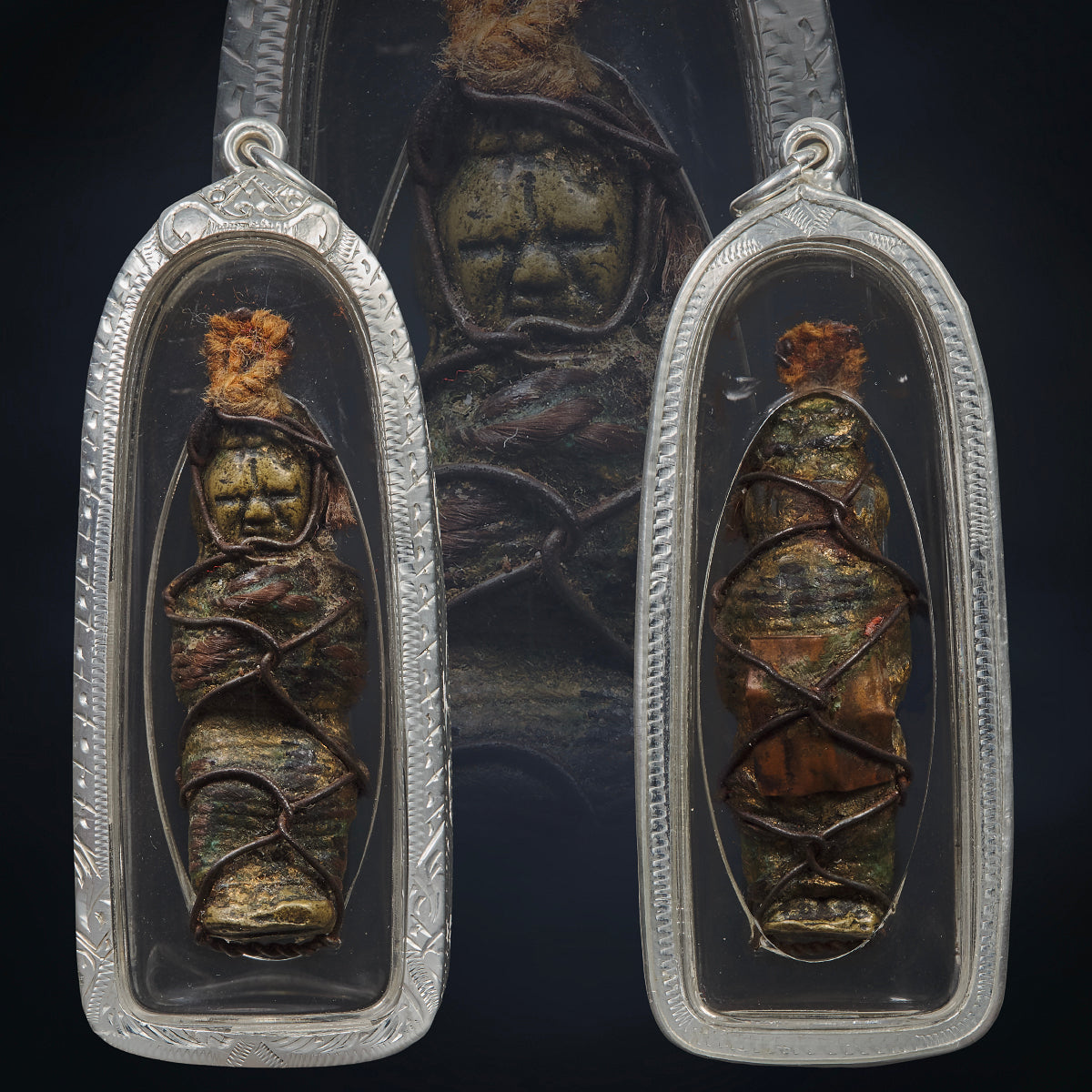
Guman Keow — Guman Teap “Dek Wat”
Por Sala Tan
Early B.E. 2530 Era
2.5 Inches
Mainstream Artifact
Sacred Craftsmanship
This Guman Keow belongs to an early village-made batch created jointly by Por Sala Tan and the abbot of Wat Duang Den during the early B.E. 2530 era.
Each artifact was individually cast, wrapped and prepared by hand. Natural differences in casting, surface, sacred thread, cloth, patina and overall form are therefore expected, making every surviving example individually distinct.
Personal Experiences Shared by Luksits
Older devotees remembered these Guman Teap primarily as friendly and approachable guardians, particularly associated with opportunity, Metta and everyday fortune.
Traders and salespeople carried them when meeting customers or conducting business. Feedback commonly centred upon people becoming easier to approach, conversations flowing more naturally and customers appearing more receptive.
Some owners associated their Guman with returning customers and unexpected business opportunities, particularly during periods when sales had previously been slow.
Another longstanding association concerns Chok Lap and unexpected fortune. Owners sometimes carried these pieces when buying lottery tickets, travelling to markets or entering circumstances where an unexpected opportunity might arise.
What distinguishes many of these accounts is the relationship between the keeper and the Guman. Older followers did not necessarily describe the artifact simply as something from which to demand results. Merit-making, generosity and dedicating merit back to the Guman formed an important part of maintaining that relationship.
Summary
This Guman Keow / Guman Teap is an uncommon early Por Sala Tan village piece associated with Wat Duang Den and the early B.E. 2530 era.
Its history begins with a landslide that disturbed an old children's burial ground. Following years of difficulties within the surrounding village, Por Sala Tan and the temple abbot became involved in restoring proper ritual order to the site.
Unidentified remains were respectfully cremated and merit was dedicated to the deceased. Old coffin nails recovered from the burial area were subsequently melted through Lor Boran and transformed into a small group of Guman guardians.
The resulting figures became associated with the idea of Dek Wat — Temple Children who had received sufficient merit and blessings to move towards a higher spiritual condition.
Traditionally, these pieces are associated with Chok Lap, Metta Maha Niyom, customer attraction, business opportunities, fortunate encounters and guardianship.
Historical Background
The origins of this batch are connected with a landslide that affected a rural community during the early B.E. 2530s.
Part of an old children's cemetery on the outskirts of the village was disturbed. Burial markers were displaced or lost beneath the earth, leaving some of the remains difficult or impossible for surviving families to identify.
In the years following the disturbance, villagers experienced poor harvests, financial difficulties and a general decline in local prosperity.
Within the traditional beliefs of the community, the disturbance of the burial ground was regarded as one possible reason for the imbalance.
Por Sala Tan was eventually invited to assist.
Together with the abbot of Wat Duang Den and members of the community, arrangements were made to deal respectfully with the disturbed burial area.
Where remains could be recovered, proper rites were performed. Those which could no longer be identified were cremated with ceremony and merit dedicated to them, restoring dignity to individuals whose original resting places had been lost.
Rather than allowing the remaining burial materials to be discarded, suitable ritual materials were preserved.
It was from this community effort that the small group of Guman Teap eventually emerged.
Origins of the Materials
The principal casting material came from coffin nails recovered from the damaged burial ground.
Only after the merit-making and cremation rites had been completed were these old metals gathered for ritual use.
Within older village wicha, the transformation of such material is significant. Something connected with death and disturbance is not simply reused in its original condition. It passes through ceremony, merit-making, blessing and transformation before becoming part of another sacred object.
The coffin nails were therefore melted and recast into the small guardian form.
Sacred thread and cloth were subsequently used to wrap the finished figure according to the village practice of the period.
This construction is important to the identity of the piece. It preserves the character of a time when rural sacred-object making still depended heavily upon local materials, temple ceremonies, village craftsmen and hand preparation.
Ritual
The Guman were created through a traditional Lor Boran casting ceremony.
A village blacksmith familiar with older metalworking methods was required to melt and cast the prepared metal. Such batches depended upon the opportunity to organise a proper casting ceremony and were consequently very different from later mass-produced pieces.
After casting, Por Sala Tan and the abbot of Wat Duang Den participated in the blessing and ritual preparation.
The spiritual intention remained connected with the earlier cemetery rites.
Merit had first been made for the deceased children. The Guman were subsequently prepared around the understanding that these spirits had received merit and blessings, allowing them to become protective and helpful Temple Children rather than remaining connected solely with the tragedy of the burial ground.
This is the origin of the name Guman Teap within the account surrounding the batch.
Older villagers also referred to them more affectionately as Dek Wat.
Blessings and Effects
The traditional qualities of this Guman centre upon fortune, opportunity, Metta and assistance in everyday affairs.
Chok Lap is one of the strongest associations. Owners traditionally carried such pieces when seeking fortunate opportunities or circumstances in which unexpected luck might be helpful.
Metta Maha Niyom concerns goodwill and favourable treatment from others. This made the Guman particularly relevant to traders, merchants and people whose livelihood depended upon dealing directly with customers.
The business aspect is therefore not understood purely as “bringing money”.
It is more closely connected with people — attracting attention, creating goodwill, encouraging conversation and opening opportunities through human interaction.
The Guman is also regarded as a guardian. Within the Temple Child tradition, the relationship is often described as friendly rather than severe, with the Guman accompanying and assisting its keeper in ordinary daily life.
Modern Application
For modern owners, the Guman Keow remains particularly suited to sales, retail, entrepreneurship and customer-facing professions.
It may be carried during work or kept respectfully within a business environment.
Those involved in commission-based work may appreciate its traditional association with approachability, customer rapport and unexpected opportunities.
Collectors interested in lottery participation and occasional games of chance have also traditionally associated older Guman pieces with Chok Lap. Such associations remain matters of devotional belief rather than guarantees of financial results.
The older practice of making merit and dedicating merit to the Guman remains particularly appropriate to the history of this batch.
Its origin, after all, lies not simply in the recovered cemetery materials but in the ceremony undertaken to restore dignity and merit to those whose resting places had been disturbed.
Physical Details
An early village-made Guman Keow / Guman Teap, traditionally dated to the early B.E. 2530 era and associated with Por Sala Tan and the abbot of Wat Duang Den. The small guardian figure was cast from reclaimed coffin-nail metal following the cemetery merit-making rites and subsequently wrapped by hand with sacred thread and cloth. The surviving traditional wrapping, aged metal surface and individually prepared construction are characteristic of its rural origin and early period.
Recommended Pairing
The Guman Keow may be kept independently, particularly where the keeper's principal interests are Metta, opportunity, customer relationships and Chok Lap.
Within the wider Por Sala Tan tradition, it can also be paired with a Lersi or Yant Kru piece where the keeper wishes to introduce greater Baramee and connection with the kru lineage.
A Suer or another protection-oriented artifact may complement it where stronger courage, authority and protective qualities are desired.
The principle is one of balance: the Guman supports opportunity and human goodwill, while the accompanying artifact provides Baramee, authority or protection.
Personal Notes
Among the Guman-related artifacts associated with Por Sala Tan, these older village-made examples are particularly interesting because their history is inseparable from the community that produced them.
They were not conceived simply as another batch of amulets.
Their origin began with a damaged burial ground, unidentified remains and a village attempting to restore proper order after a difficult event. The subsequent merit-making, cremation and transformation of the remaining ritual metal into Guman Teap gave the materials an entirely different purpose.
The hand-wrapped construction also preserves something increasingly difficult to find in later pieces.
It reflects a period when sacred-object making could still involve the temple, villagers, local blacksmith, traditional casting methods and hand preparation within one ceremony.
For collectors of Por Sala Tan's earlier work, the importance of this piece therefore lies as much in its village provenance and ritual history as in the blessings traditionally attributed to the Guman itself.
-
Free Shipping for Singapore| $15 Worldwide | $60 USA For Items Below $350