
OOBThaiAmulets
Por Sala Tan
Por Sala Tan
Couldn't load pickup availability
PST04
Jinn – Kao Kwai Fapar
Por Sala Tan
Barang artifact
2 inch
Sacred Craftsmanship
As with Por Sala Tan's individually prepared ritual pieces, variations in the natural horn, bone structure, carving, wax and embedded sacred components make every example unique.
Personal Experiences Shared by Luksits
Luksits who kept Jinn pieces prepared by Por Sala Tan often spoke less about dramatic manifestations and more about warnings, intuition and circumstances that seemed to redirect them away from trouble.
Some described suddenly feeling that they should delay a journey, reconsider an agreement or avoid a particular situation. Only afterwards, when circumstances became clearer, did they interpret the earlier feeling as a timely warning.
Others associated their Jinn pieces with unexpected assistance during periods of difficulty — an opportunity appearing at the right moment, someone offering help, or an obstacle becoming easier to overcome.
Such experiences are personal accounts shared among practitioners and collectors, but they illustrate why Por Sala Tan's Jinn pieces became particularly associated with guidance and protective awareness.
Summary
This is a specialised Jinn artifact by Por Sala Tan from Kao Kwai Fapar, using the rare section where the buffalo horn joins the head.
According to the history accompanying the relic, when the buffalo was struck, a Jinn presence remained lingering around the animal. During the preparation of the amulet, Por Sala Tan invited this Jinn to reside within and work through the completed sacred object.
The construction brings together several distinct elements of his Barang practice: Kwai relic, horn, garduk, Jinn carving, Metta wax, Nam Man Prai and takrut.
Its traditional emphasis is upon protection, guidance, timely warning, overcoming obstacles, opportunity and spiritual assistance, with an additional Metta and attraction dimension arising from the prepared wax and Nam Man Prai.
Historical Background
Kao Kwai Fapar may be understood literally as buffalo horn associated with a lightning strike.
Materials connected with unusual natural deaths or powerful natural events occupy a particular position within Southeast Asian folk-wicha. Lightning especially represents an abrupt and tremendous force of nature, and materials surviving such an event may be regarded by practitioners as having undergone an extraordinary transformation.
In this case, however, the importance extends beyond the lightning-struck horn itself.
According to the lineage account attached to the piece, a Jinn was found lingering with the buffalo following the strike. Por Sala Tan recognised this presence and subsequently incorporated it into the ritual purpose of the relic.
The resulting object was therefore prepared not simply as a buffalo-horn talisman, but specifically as a Jinn companion piece.
Origins of the Materials
The principal relic comes from the root of the Kao Kwai, immediately where the horn meets the buffalo's skull.
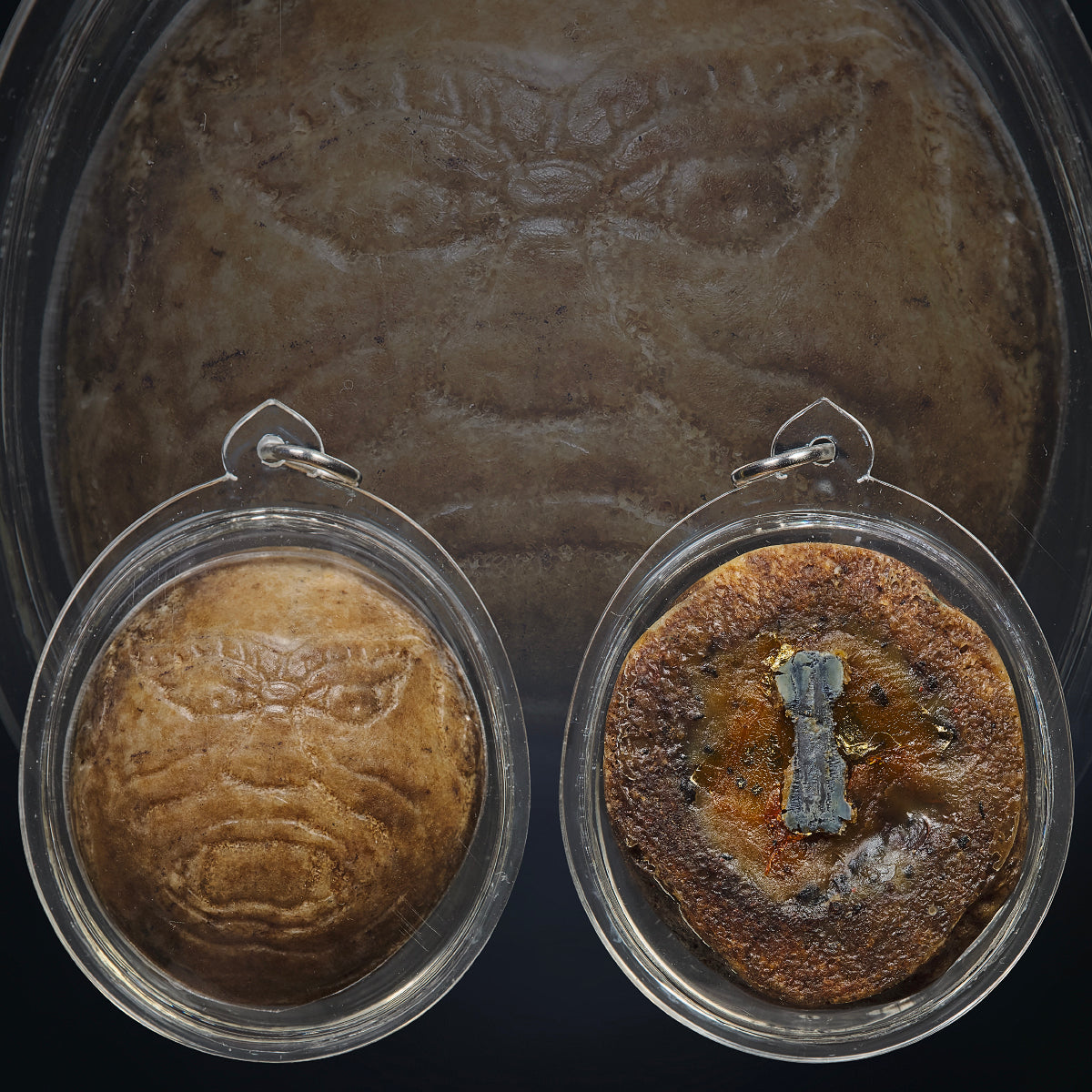
This is particularly visible in the construction. The front presents the smoother horn surface upon which Por Sala Tan formed the Jinn image, while the reverse exposes the more porous natural structure associated with the adjoining section.
This physical connection between horn and skull is an important characteristic of the piece.
Por Sala Tan further prepared the relic with Metta wax mixed with Nam Man Prai. Within his Barang practice, these materials were employed where the intended wicha involved attraction, favourable interaction, movement of circumstances and spiritual assistance.
A takrut was then incorporated as an additional inscribed ritual component.
Ritual
Por Sala Tan first worked upon the naturally connected horn-and-bone relic, carving the Jinn form into the Kao Kwai side while preserving the graduk at the reverse.
The completed carving was ritually prepared and the Jinn associated with the lightning-struck buffalo was invited into the piece.
This distinction is important within the traditional account: the Jinn was not described as an unrelated entity selected afterwards. It was said to have already been lingering around the buffalo following the lightning strike, creating a direct relationship between the spiritual presence and the physical relic used to house it.
Por Sala Tan subsequently applied his prepared Metta wax and Nam Man Prai and incorporated the takrut before completing the necessary invocation and consecration.
The result is therefore both a natural relic and a deliberately constructed spiritual vessel.
Blessings and Effects
The principal traditional quality attributed to this Jinn is guidance — particularly the heightened intuition to recognise when circumstances may not be favourable.
This may manifest in subtle ways: hesitation before travelling, an instinct to postpone something, discomfort surrounding an agreement, or an unexpected thought that encourages the keeper to reconsider a decision.
Its second important quality is protection and avoidance of danger. Rather than being understood only as a defensive talisman, the Jinn is traditionally regarded as helping its keeper recognise trouble early enough to avoid it.
Collectors also associate such pieces with overcoming obstacles and opening opportunities, especially when circumstances appear blocked or uncertain.
The addition of Metta wax and Nam Man Prai introduces another dimension of Metta, attraction, favourable encounters and movement of fortune.
Modern Application
For modern practitioners, this Jinn is particularly suited to those who travel frequently, negotiate, conduct business or regularly enter unfamiliar environments.
Its traditional emphasis upon warning and intuition also makes it meaningful for people whose work requires judgment — knowing when to proceed, when to wait and when something deserves greater caution.
The Metta aspect makes the piece relevant where favourable human relationships are important, while its Jinn lineage centres the amulet upon companionship, assistance and guidance through changing circumstances.
It may be carried as a pendant or maintained respectfully within a personal altar according to the keeper's practice.
Physical Details
This is an oval natural relic carved from the base of a lightning-struck buffalo horn where the horn connects with the graduk The front has been shaped into a simple Jinn face, with pronounced eyes, nose and mouth emerging directly from the natural horn surface. The reverse retains the coarse, porous structure of the adjoining skull material and shows the prepared Metta wax and Nam Man Prai, together with an incorporated takrut. The complete relic is preserved within a fitted clear protective casing.
Recommended Pairing
Because the Jinn already combines guidance, protection and Metta, it can function as a specialised companion alongside a mainstream Buddhist amulet.
A Buddha-form amulet may provide the principal foundation of the set, while this piece serves specifically for awareness, assistance and obstacle avoidance.
For business use, it may also be paired with an amulet associated with Chok Lap or wealth, allowing the Jinn's Metta and opportunity-opening character to complement a more directly prosperity-focused piece.
Personal Notes
What distinguishes this piece is not simply that it was made from Kao Kwai Fapar, but precisely which part of the relic Por Sala Tan chose to use.
The material comes from the point where the horn becomes physically joined to the buffalo's head. The Jinn is carved upon the horn side, while the reverse retains the head-bone structure — leaving both aspects of the original relic visibly connected within one object.
Its lineage is equally important. According to the account preserved with the piece, the Jinn was already associated with the buffalo at the time of the lightning strike and remained lingering there until Por Sala Tan prepared the relic and invited it into the completed amulet.
Together with the Metta wax, Nam Man Prai and takrut, it represents a particularly characteristic example of Por Sala Tan's Barang work: an unusual naturally occurring relic transformed through wicha into a spiritual companion centred upon guidance, protection, opportunity and timely warning.
-
Free Shipping for Singapore| $15 Worldwide | $60 USA For Items Below $350