
OOBThaiAmulets
Por Sala Tan
Por Sala Tan
Couldn't load pickup availability
PST04
Wua Thanu
Por Sala Tan
Sacred Craftsmanship
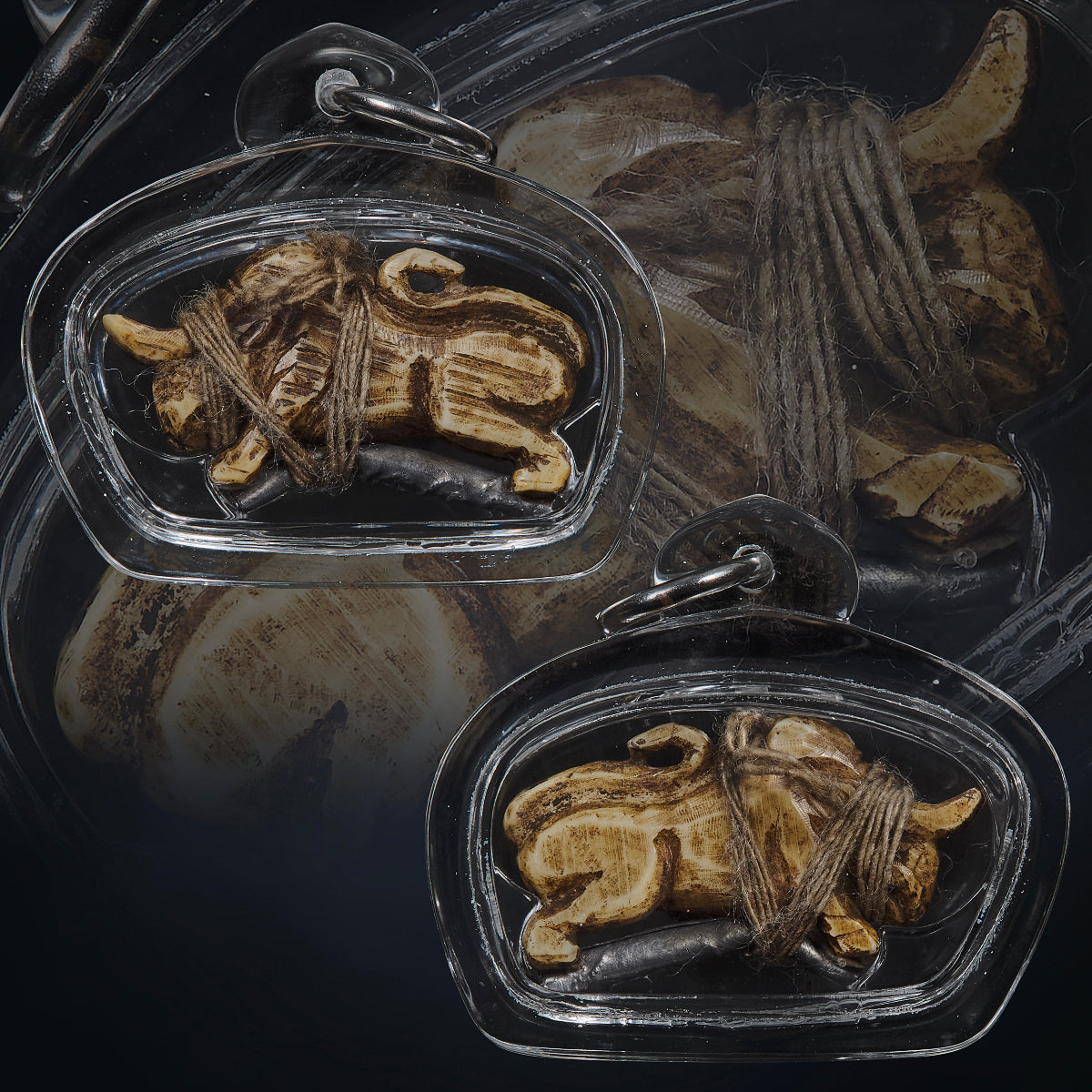
Each Wua Thanu was individually carved and ritually assembled by hand from prepared natural materials. Variations in the bone, carving, Sai Sin bindings and construction make every surviving piece individually distinct.
Personal Experiences Shared by Luksits
One account associated with this tradition was shared by a villager from a farming community where buffaloes remained important working animals.
During a period when several neighbouring farmers reportedly suffered losses through animal sickness and theft, one farmer kept a Wua Thanu within his land as a guardian.
Over the following years, he reported that his own buffaloes remained safe and he suffered none of the losses affecting some neighbouring farms.
As the story spread, several neighbours began adopting the same practice, keeping guardian buffalo figures around their own properties. Among the villagers, the explanation was simple: the “spirit buffalo” remained on the land and watched over the herd when its owner could not.
Such accounts remain matters of personal belief and oral tradition, but they illustrate particularly well why Wua and Kwai Thanu became so closely associated with farmers and landowners. Their traditional role was not merely personal protection, but guardianship over the household, animals, livelihood and territory entrusted to them.
Summary
Wua Thanu and its closely related buffalo form, Kwai Thanu, belong to an old tradition of magical animal guardians found within Thai folk wicha and neighbouring Southeast Asian practices.
Por Sala Tan's example is carved directly from Gaduk Kwai, bound with Sai Sin and accompanied by a protective takrut beneath the body.
Traditionally, Wua Thanu are associated with protecting the home and land, discouraging thieves and hostile influences, resisting harmful spiritual forces and safeguarding the owner's livelihood.
Their agricultural origins are important. The bull and buffalo were once indispensable to rural households, providing the strength required to cultivate land and transport goods. Within folk wicha, this dependable working animal became the model for a guardian believed symbolically to never sleep, never tire and never abandon its territory.
Historical Background
The Wua Thanu tradition developed within agricultural communities where cattle and buffaloes were closely connected with survival.
Before mechanised farming became widespread, these animals represented far more than livestock. They were essential working partners responsible for ploughing fields, transporting crops and sustaining the livelihood of entire households.
Protecting the animals, fields and home was therefore a serious concern.
Within folk belief, practitioners transformed the familiar strength and territorial character of the bull or buffalo into the concept of a magical guardian.
The resulting Wua or Kwai Thanu was traditionally stationed within the owner's territory as a spiritual watchman — protecting the household against thieves, enemies and unseen disturbances.
Elements of Wua Thanu practice are also associated with older Khmer-influenced and regional animist wicha, with different lineages developing their own methods of construction, invocation and maintenance.
Origins of the Materials
The principal material used for this piece is Gaduk Kwai.
This has a particularly direct relationship with the identity of the artifact. Buffaloes traditionally represent physical strength, endurance, patience and the ability to withstand difficult conditions.
Older Wua and Kwai Thanu traditions can employ many forms of ritual material depending upon lineage. These may include animal bone or horn, sacred woods, old ritual metals, prepared herbs, sacred powders, auspicious earths, yantras and takruts.
Por Sala Tan's example combines Gaduk Kwai with Sai Sin and a protective takrut, concentrating the construction around the guardian and protective character of the Wua Thanu.
Ritual
Wua Thanu belongs to a considerably different current of wicha from softer practices centred upon Metta or attraction.
Its ritual character is fundamentally protective and territorial.
The guardian is established to symbolically recognise its keeper and the territory placed under its protection. Traditional practitioners may direct this guardianship towards a house, farm, business, livestock or the immediate surroundings of its owner.
In Por Sala Tan's construction, the buffalo bone was first shaped into the guardian form before being combined with Sai Sin and its takrut and subsequently empowered according to the intended protective purpose.
More advanced traditions describe masters ritually directing the guardian against hostile spiritual influences before calling it back. Such practices belong to trained ritual lineages rather than ordinary devotional use.
For most owners, the purpose remains much simpler: keep the guardian close and allow it to stand watch.
Blessings and Effects
The foremost quality of Wua Thanu is guardianship.
Traditional belief associates it with protecting homes, land, family members, livestock and businesses from theft, intrusion, enemies and threatening circumstances.
It is also strongly connected with anti-black magic and spiritual protection, including resistance against hostile spirits, curses and unwanted occult influences.
Within some traditions, Wua Thanu carries a forceful repelling quality — pushing harmful influences away rather than merely shielding against them.
For farmers and business owners, another traditional association is livelihood and prosperity. By guarding the land, animals, merchandise and opportunities upon which income depends, the Wua Thanu becomes both protector and symbolic keeper of prosperity.
The buffalo itself adds the qualities of endurance, stability and persistence: remaining firm even when circumstances become difficult.
Modern Application
Traditionally, Wua Thanu were primarily guardians of place.
Larger examples could be kept upon an altar or positioned within the house, farm or boundaries of a property rather than worn as conventional necklace amulets.
Smaller contemporary examples such as Por Sala Tan's piece allow the guardian tradition to become more personal and portable.
It may be kept within a home, shop, office, vehicle or work bag. Farmers and landowners may retain it for its original territorial symbolism, while business owners may keep it within their premises as a guardian of livelihood and property.
Despite the smaller format, the underlying concept remains the same: a guardian assigned to watch what matters to its keeper.
Physical Details
A compact Wua Thanu hand-carved from Gaduk Kwai, depicting the guardian bull with prominent horns and a clearly defined body. The figure is tightly bound with Sai Sin, with a protective takrut placed beneath the body, and is presently preserved within a clear protective casing.
Recommended Pairing
Wua Thanu can function independently as a principal protective artifact.
For stronger protective emphasis, it may be paired with Tao Wessuwan, Hanuman, tiger-form pieces or protective takruts, particularly for owners concerned with property, travel or hostile environments.
For a shop or business, it can also complement wealth and Metta Maha Niyom pieces. The roles are distinct but complementary: Metta encourages goodwill and opportunity, wealth wicha supports livelihood, while Wua Thanu stands guard over what has already been established.
Personal Notes
Wua Thanu is one of those traditions whose meaning becomes much clearer when viewed through the lives of the people who originally depended upon it.
For an old farming household, wealth was not simply money.
It was the land.
It was the harvest.
It was the buffalo that worked the fields.
It was the safety of the family who depended upon all three.
A guardian capable of symbolically watching over these things therefore represented protection and prosperity at the same time.
Por Sala Tan's decision to carve this example directly from Gaduk Kwai preserves that agricultural connection in a particularly direct form. The buffalo is simultaneously the material, the image and the symbolic character of the guardian.
The old description of Wua/Kwai Thanu perhaps expresses its role most clearly:
A guardian that does not sleep, does not tire, and does not abandon the land entrusted to it.
-
Free Shipping for Singapore| $15 Worldwide | $60 USA For Items Below $350