
OOBThaiAmulets
Por Sala Tan
Por Sala Tan
Couldn't load pickup availability
PST04
Seur Jinn
Por Sala Tan
Barang artifact
Sacred Craftsmanship
Each artifact was individually carved and ritually assembled by hand from naturally differing sacred materials. Variations in the grain and colour of the Mai Niu Dam, carving, ritual compounds and placement of the embedded materials make every piece individually unique.
Personal Experiences Shared by Luksits
The surviving examples of this Seur Mai Niu Dam are particularly closely held. Only a small number were made, and the pieces encountered today have largely been collected directly from Por Sala Tan’s own luksits, many of whom had kept and used them since the original period of creation.
Over the years, these tiger pieces found their way into the hands of people from many walks of life. Some were carried by business owners and working professionals, while others were kept by individuals whose occupations regularly placed them in difficult or unpredictable situations. Many remain with their original owners and are still actively used rather than circulated among collectors.
One particularly striking account was shared concerning a police officer who carried one of these tiger pieces.
During an encounter with a suspect, the officer was unexpectedly attacked from behind with an iron pipe. The attacker reportedly aimed the blow towards the officer’s head. The pipe struck, but somehow failed to land directly upon the head, instead catching the shoulder and causing only a relatively minor injury.
What made the incident particularly memorable came afterwards.
According to the account passed down by the luksit, when the suspect was questioned by investigators about what had happened during the attack, he described suddenly losing his nerve at the critical moment. He reportedly told them that he “felt like something huge lunged at me.”
Among Por Sala Tan’s luksits, the incident became associated with the protective and intimidating character traditionally attributed to tiger wicha — particularly its reputation for Klaew Klad, protection from sudden danger, and the fierce guardian presence of the tiger.
Summary
This Seur Mai Niu Dam is one of Por Sala Tan's authority and protection-oriented tiger artifacts.
Its foundation is particularly important.
Por Sala Tan personally collected the Mai Niu Dam from an area where tigers were known to roam. Villagers had encountered signs of their presence, including footprints and fur.
While collecting the wood, Por Sala Tan sensed what he understood to be a lingering tiger-spirit presence within the surrounding area.
Rather than immediately using the material, he performed chanting and meditation there, respectfully requesting permission for the tiger spirit to reside within the Mai Niu Dam so that the wood could later be prepared for ritual purposes.
The material was subsequently carved into the fierce tiger image seen here and empowered through specialised tiger-related wicha performed by Por Sala Tan together with a small number of practitioners.
Its principal quality is Maha Amnaj — authority, decisiveness and force of intent.
Historical Background
The tiger occupies a distinctive position within traditional Thai and regional occult practice.
Unlike figures principally connected with Metta, attraction or wealth, the tiger represents command, courage, territorial authority, strategic instinct and the willingness to confront resistance.
Old practitioners frequently regarded tiger wicha as particularly suitable for individuals whose responsibilities required them to command others or remain composed when facing hostility.
This explains its historical association with leaders, soldiers, officials, merchants and people working in competitive or dangerous environments.
The tiger does not merely represent physical strength.
Its deeper symbolism concerns the state of mind required before decisive action.
A tiger observes before moving. Once its direction is established, however, it commits completely.
That quality became one of the central principles behind Por Sala Tan's preparation of this piece.
Origins of the Materials
The principal material is Mai Niu Dam, gathered personally by Por Sala Tan from land associated with the presence of wild tigers.
According to the account surrounding the material, villagers had observed tiger footprints and fur within the area. Por Sala Tan subsequently sensed a lingering tiger-spirit presence and performed chanting and meditation before requesting permission for that presence to reside within the collected wood.
The reverse contains a particularly significant component: a chanting bead carved from Gaduk Seur, reinforcing the physical connection with tiger lineage material.
This was accompanied by takruts prepared for protection, sacred soil from auspicious land and a mixture of ritual herbs.
Together, these materials established three interconnected foundations within the piece: tiger authority, territorial protection and spiritual grounding.
Ritual
The completed artifact underwent specialised tiger rites performed by Por Sala Tan together with several practitioners familiar with tiger-related ritual work.
Within older practitioner traditions, such ceremonies are sometimes described as mentally exhausting.
The reason lies in the intention of the ritual.
Where Metta-oriented ceremonies cultivate attraction, receptiveness and goodwill, tiger rites traditionally emphasise commanding aggression rather than being controlled by it.
The practitioner must maintain concentration upon territorial awareness, authority, decisiveness and controlled force.
The objective is therefore not uncontrolled anger.
It is precisely the opposite.
The tiger should possess tremendous force while remaining under command.
Por Sala Tan's earlier invitation to the tiger presence within the Mai Niu Dam formed the spiritual foundation. The later collective ritual served to awaken and direct that character towards the finished artifact.
Blessings and Effects
The strongest traditional quality associated with this piece is Maha Amnaj — commanding authority and force of intention.
Tiger-form wicha is particularly associated with strengthening decisiveness. For individuals who continually hesitate, change direction or allow outside opinions to weaken their decisions, the tiger represents a fixed heart: once the correct direction has been determined, remain with it.
It is therefore traditionally associated with clearer decision-making, stronger assertiveness, courage during confrontation and maintaining concentration under pressure.
Another major aspect is protection against jealousy, betrayal, sabotage and backstabbers.
The territorial character of the tiger represents guarding one's position and becoming more alert towards people whose intentions may not be straightforward.
Its qualities can therefore be understood as a combination of Maha Amnaj, courage, command, strategic awareness, protection and unwavering pursuit.
Modern Application
The character of this artifact makes it particularly relevant to people working in environments where hesitation carries consequences.
Business owners may relate to its emphasis upon making decisions and standing behind them.
Managers and leaders may use its symbolism to reinforce calm authority when directing teams.
Negotiators and sales professionals may appreciate the combination of confidence, presence and the willingness to hold their position when necessary.
It is equally relevant during competitive periods when the owner must remain focused despite criticism, rivalry or pressure from others.
The ideal expression of tiger energy is not aggression towards everyone around the wearer.
It is controlled strength — knowing when to remain still, when to establish boundaries and when decisive action is required.
Physical Details
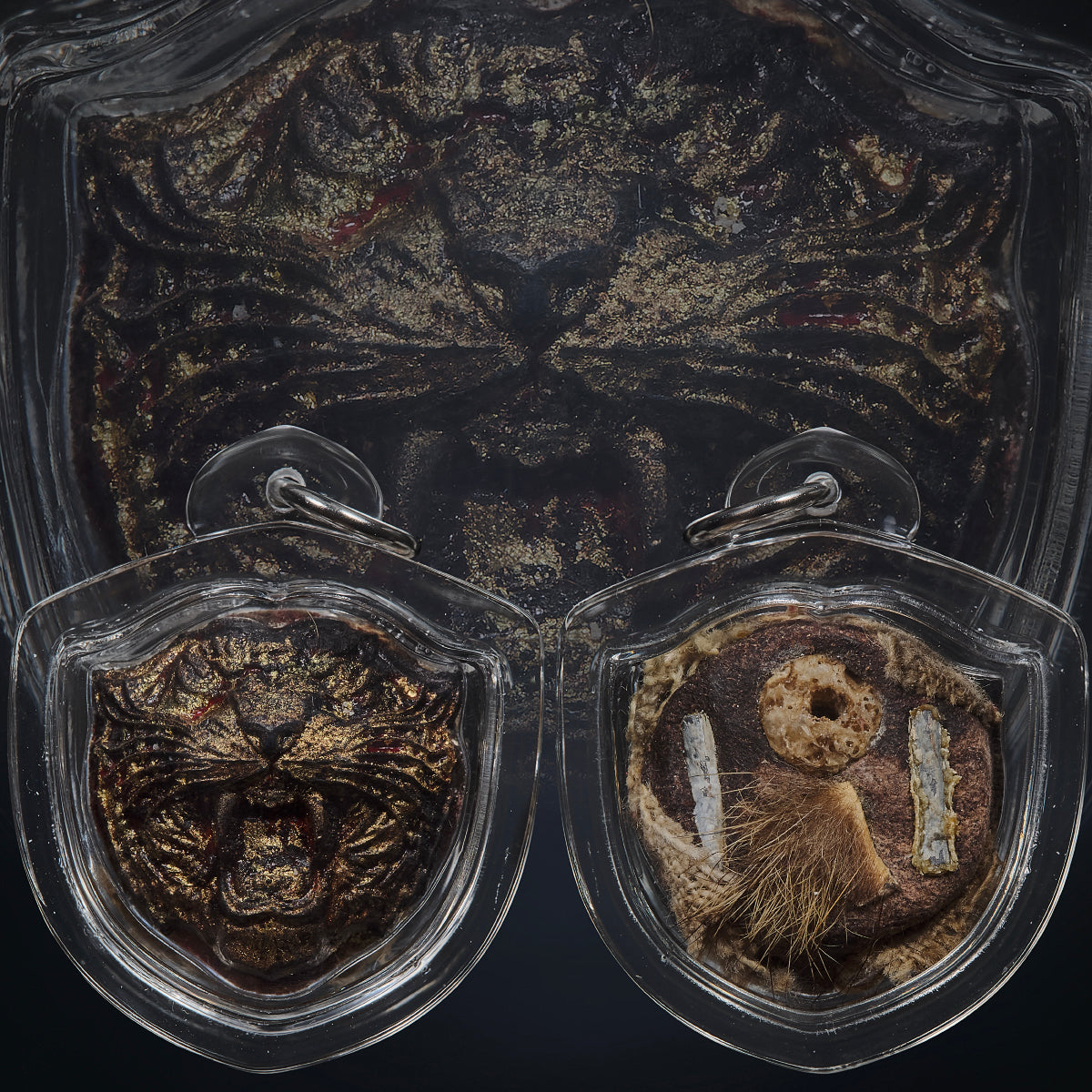
The front is individually carved from Mai Niu Dam into a fierce frontal tiger with prominent eyes, nose and exposed fangs, with traces of ritual finishing visible across the dark wood.
The reverse contains a Gaduk Seur chanting bead, protection takruts, auspicious sacred soil and prepared herbs, with Sai Sin surrounding portions of the ritual assembly. The artifact is preserved within a clear protective casing.
Recommended Pairing
This tiger piece pairs particularly well with calmer Baramee or meditation-oriented amulets.
The tiger contributes decisiveness, authority and defensive strength, while a meditation master can represent restraint, clarity and wisdom — creating a useful balance between the ability to act and the judgment to know when action is necessary.
For business owners, it may also be combined with Metta Maha Niyom or wealth pieces. The Metta component supports relationships and opportunity, while the tiger reinforces the authority and determination required to protect and develop those opportunities.
Personal Notes
There is an important distinction within the philosophy behind tiger wicha.
Fierceness is not the same as uncontrolled aggression.
A tiger that attacks without judgment wastes its strength. The more meaningful quality is the ability to remain composed while possessing the certainty to act immediately when circumstances require it.
This explains the old concept of strengthening the “fixed heart.”
Many people already recognise the correct decision but weaken themselves through repeated hesitation. They reconsider, seek another opinion, change direction and eventually lose the opportunity that originally stood before them.
Por Sala Tan's tiger was created around the opposite principle.
Observe carefully. Decide clearly. Then move without unnecessary hesitation.
The history of the Mai Niu Dam gives this particular artifact additional significance. The wood was not merely selected because a tiger was an appropriate image to carve upon it. It came from land where tiger presence had physically been observed, after which Por Sala Tan performed meditation and ritual permission before reserving the material for future work.
The Gaduk Seur chanting bead, protective takruts, auspicious soil and herbs further reinforce that original foundation.
For collectors drawn towards the stronger side of Por Sala Tan's wicha, this piece represents the tiger not simply as a guardian, but as a disciplined force of Maha Amnaj — command over circumstances, command over opposition and, most importantly, command over one's own hesitation.
-
Free Shipping for Singapore| $15 Worldwide | $60 USA For Items Below $350