
OOBThaiAmulets
Por Sala Tan
Por Sala Tan
Couldn't load pickup availability
PST04
Bobo Aung
Por Sala Tan
2.5" height
Each sacred artifact was individually prepared by hand from naturally formed ritual materials. Differences in the original Gaduk Wa Tanoo, carving, Jindamanee beads, Sai Sin and ritual preparation create natural variations in texture, colour and form, making every completed piece unique.
Personal Experiences Shared by Luksits
This particular Bobo Aung was obtained directly from Ac Lek, the son and disciple of Por Sala Tan, who continues to practise within the same northern esoteric tradition.
According to accounts surrounding pieces of this nature, Bobo Aung was particularly respected amongst devotees seeking guidance when making important requests, improvement in livelihood, movement in stagnant circumstances and protection while pursuing difficult goals.
The combination of Bobo Aung and Jindamanee also made the piece meaningful to practitioners of wicha. Rather than being regarded solely as a wealth object, it was kept as a representation of knowledge, discipline and the gradual cultivation of personal Baramee.
Some devotees describe making a clear request before Bobo Aung and subsequently noticing that circumstances began to open through unexpected introductions, opportunities or solutions. Others associate the piece with greater confidence and clarity when deciding which opportunities should be pursued.
For collectors familiar with Por Sala Tan's work, the importance of this example is strengthened by its direct transmission through Ac Lek and Por Sala Tan's family and disciple circle.
Summary
This unusual Bobo Aung by Por Sala Tan was individually carved from Gaduk Wa Tanoo that had been struck by Far Par — lightning.
Por Sala Tan placed particular value upon materials affected by lightning and reserved suitable examples for specialised ritual work. Within older Southeast Asian esoteric traditions, lightning-struck materials are regarded as having encountered an extraordinary natural force and are consequently valued for protection, authority and ritual activation.
The completed figure represents Bobo Aung, one of the most recognised figures within Burmese Weizza tradition.
Around the figure's neck is a necklace of Jindamanee beads, traditionally associated with sacred knowledge, wisdom, auspicious fortune and the higher accomplishments of practitioners.
After carving, the figure was further ceremonially prepared with the involvement of a Lersi practitioner closely associated with Por Sala Tan.
The finished artifact combines lightning-struck Gaduk Wa Tanoo, Bobo Aung imagery, Jindamanee and Por Sala Tan's ritual preparation, creating a piece traditionally directed towards wish-fulfilment, wealth movement, protection, wisdom and cultivation of Baramee.
Bobo Aung – The Burmese Weizza
Bobo Aung occupies an important position within Burmese popular religious and esoteric tradition.
He is remembered as a Weizza, an accomplished practitioner associated with meditation, sacred knowledge, mantra, alchemical practice and the pursuit of extraordinary spiritual attainment.
Within devotional tradition, Bobo Aung consequently became associated with wisdom, protection, overcoming difficulties and assistance in bringing favourable conditions into alignment.
His image is particularly popular amongst those who make sincere wishes connected with livelihood, work, business and important personal objectives.
For practitioners, however, his deeper symbolism extends beyond material fortune.
Bobo Aung represents the individual who develops ability through knowledge, concentration, discipline and sustained spiritual practice.
Gaduk Wa Tanoo Struck by Far Par
The foundation of this artifact is an unusual piece of Gaduk Wa Tanoo struck by Far Par — lightning.
Within traditional belief, lightning represents an immediate and powerful descent of celestial and elemental force.
Materials that survive such an event are consequently treated differently from ordinary examples. Practitioners may regard them as having already undergone an extraordinary natural transformation before any formal ritual preparation begins.
Por Sala Tan was known to value such lightning-struck materials and retain suitable examples for special sacred creations.
For this Bobo Aung, the Far Par Gaduk Wa Tanoo provided the physical and ritual foundation upon which the remaining wicha was constructed.
Jindamanee Necklace
One of the most distinctive features of the figure is the necklace of Jindamanee beads placed around Bobo Aung.
Within Burmese and Thai esoteric traditions, Jindamanee carries associations with wisdom, auspicious fortune, sacred knowledge and accomplishment in wicha.
Its inclusion is especially appropriate for Bobo Aung.
As a Weizza, Bobo Aung represents mastery acquired through learning and disciplined practice. Jindamanee therefore reinforces the image's connection with the knowledge and accomplishments of the practitioner.
The necklace also gives this particular figure a distinctive physical identity, forming an important part of both its ritual construction and appearance.
Preparation by the Lersi Practitioner
Following the carving of Bobo Aung, the image was further ceremonially enhanced by a Lersi practitioner closely associated with Por Sala Tan.
The involvement of the Lersi practitioner creates an additional relationship between two traditions centred upon sacred knowledge.
The Lersi represents the teacher and transmitter of wicha within Thai esoteric culture.
The Weizza represents the accomplished practitioner within Burmese tradition.
Their meeting within one sacred object therefore emphasises knowledge, spiritual discipline, ritual accomplishment and the transmission of wicha between teachers and practitioners.
Ritual Awakening
Por Sala Tan subsequently performed the principal ritual awakening of the piece.
His preparation incorporated northern fire-based activation methods together with mantra recitation connected with Weizza practice.
The lightning-struck Gaduk Wa Tanoo served as the energetic foundation of the figure.
During the ritual process, the additional sacred components were intended to organise and stabilise the character of the piece so that its different ritual qualities worked together rather than independently.
Mantra invocation established the sacred identity of Bobo Aung within the completed image.
Within traditional practice, the figure could thereafter serve as a devotional focus through which the keeper directed prayers, wishes and personal intentions.
Wish-Fulfilment & Opening Opportunities
Bobo Aung is especially well known amongst devotees for wish-fulfilment.
This should not necessarily be understood as an immediate or effortless granting of whatever is requested.
Within traditional practice, wish-fulfilment can instead appear through the opening of circumstances — meeting the appropriate person, recognising an opportunity, finding a solution to an existing problem or gaining the clarity required to proceed.
This makes Bobo Aung particularly relevant when a devotee has a defined objective but requires circumstances to begin moving in a favourable direction.
The underlying principle remains one of opportunity combined with personal effort.
Wealth & Livelihood
The wealth aspect of Bobo Aung is closely connected with movement and opportunity.
For business owners, this may traditionally be interpreted through new customers, introductions, negotiations or opportunities that allow stagnant circumstances to progress.
For working professionals, it may represent career openings, useful connections or clearer judgement regarding important decisions.
Jindamanee strengthens this aspect through its traditional association with auspicious fortune and wisdom.
The result is a wealth character centred upon recognising and using favourable opportunities rather than simply waiting for sudden gain.
Protection
The lightning-struck material gives the artifact an equally important protective character.
Far Par materials are traditionally valued for their association with strong elemental force and resistance against harmful influences.
Bobo Aung himself is also regarded as a protective figure within devotional tradition.
Together, these qualities make the piece suitable for those seeking protection while travelling, conducting business, entering unfamiliar circumstances or undertaking demanding work.
Protection here sits alongside awareness and judgement — recognising difficulty early and responding appropriately.
Baramee & Sacred Knowledge
An important aspect of this Bobo Aung is Baramee cultivation.
Bobo Aung's traditional reputation rests upon accomplishment achieved through sustained spiritual discipline.
Jindamanee similarly carries associations with knowledge and wisdom.
The Lersi involvement adds the symbolism of the Kroo — the teacher responsible for preserving and transmitting sacred knowledge.
For practitioners of meditation or wicha, the artifact therefore represents more than obtaining favourable circumstances.
It also represents the gradual development of discipline, knowledge, confidence, judgement and spiritual authority.
Traditional Blessings
The principal traditional quality of this Bobo Aung is wish-fulfilment and the opening of favourable circumstances, particularly when the keeper has a clear objective.
It is associated with wealth movement and livelihood, helping opportunities, useful connections and productive circumstances develop around work or business.
The Far Par Gaduk Wa Tanoo contributes a strong aspect of protection and elemental force, while the Jindamanee beads reinforce wisdom, auspicious fortune and sacred knowledge.
Bobo Aung's Weizza character further supports clarity, spiritual development and accomplishment in practice.
Together, the artifact is traditionally centred upon wish-fulfilment, opportunity, wealth, protection, wisdom and Baramee.
Modern Application
For business owners and working professionals, the piece may be kept when seeking movement in stagnant circumstances, better opportunities and clearer judgement.
For those beginning an important project, negotiation or career transition, Bobo Aung represents the combination of intention, opportunity and disciplined action.
For practitioners of meditation and wicha, the Jindamanee and Weizza associations provide a deeper connection with knowledge and continual development of one's practice.
Its symbolism is therefore broad, yet coherent: ask clearly for what is needed, remain aware when opportunities appear, and possess the discipline to act when the appropriate path opens.
Physical Details
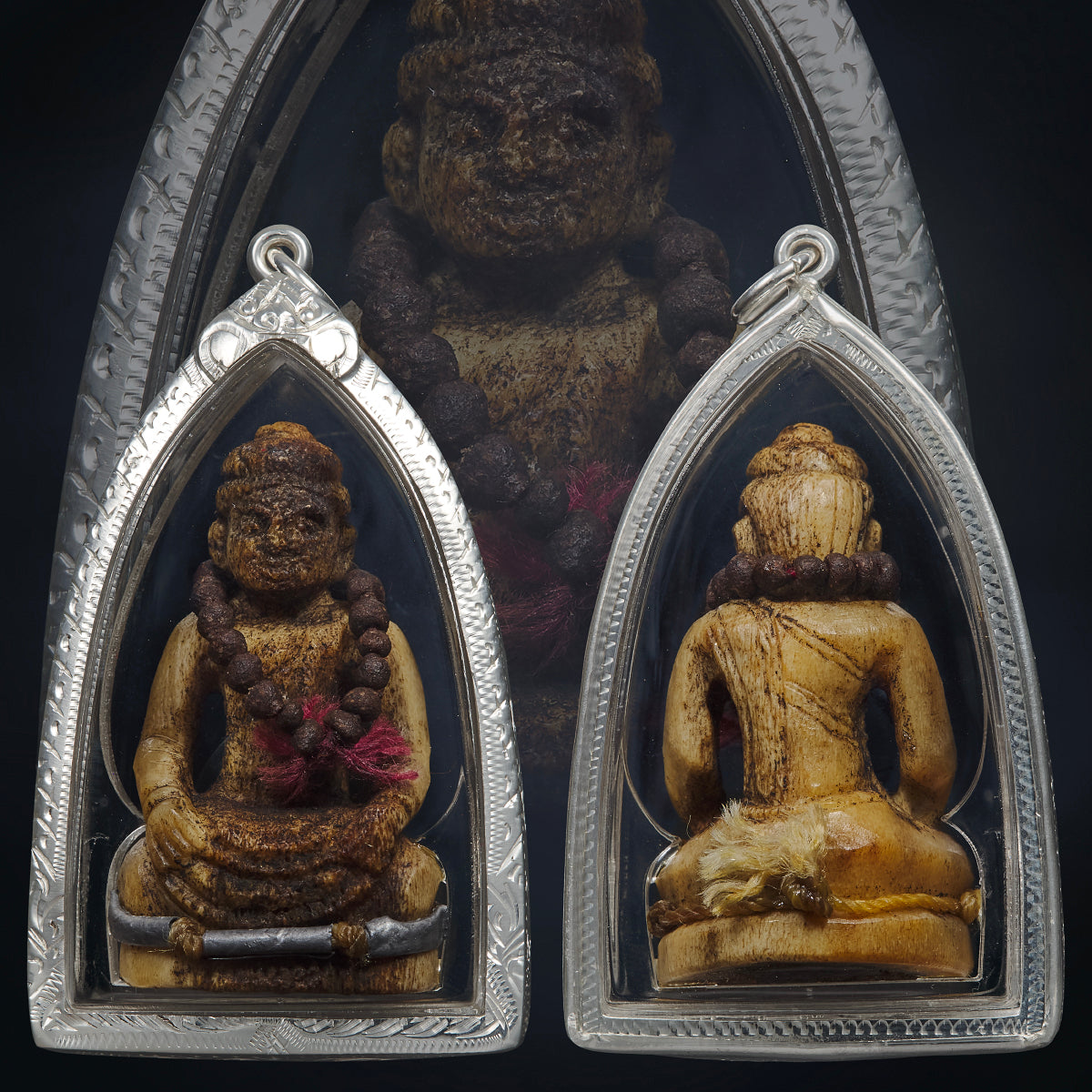
The figure of Bobo Aung is individually carved from the lightning-struck Gaduk Wa Tanoo, retaining the warm cream, brown and naturally aged tones of the original material.
The front presents Bobo Aung seated in meditation, with a strongly textured and darkened face contrasting against the lighter body.
Around his neck is a prominent necklace formed from individual Jindamanee beads.
Old red sacred cord remains visible around the lower front of the figure, while a substantial takrut arrangement is positioned across the base.
The reverse retains a comparatively restrained appearance, allowing the natural surface and carving marks of the Gaduk Wa Tanoo to remain visible. Old sacred material and cord are preserved around the lower portion.
The complete artifact is presently protected within a custom casing.
Recommended Pairings
Lersi — particularly appropriate for practitioners seeking to strengthen the themes of wisdom, learning, meditation and mastery of wicha.
A Rare Bobo Aung from Por Sala Tan's Lineage
This Bobo Aung brings together several elements rarely encountered within a single Por Sala Tan artifact.
Its foundation is Gaduk Wa Tanoo struck by Far Par, a material Por Sala Tan valued for specialised ritual work. It was carved into the image of the Burmese Weizza Bobo Aung, adorned with Jindamanee beads, further prepared by a Lersi practitioner associated with Por Sala Tan, and ritually awakened through Por Sala Tan's own methods.
Its later provenance is equally important.
The piece was obtained directly from Ac Lek, Por Sala Tan's son and disciple, preserving a close connection to the family and practitioner circle from which it originated.
For collectors of Por Sala Tan, Bobo Aung or Burmese-influenced Weizza wicha, it represents an uncommon convergence of lightning-struck sacred material, Jindamanee, Lersi tradition and Weizza practice — with its traditional character centred upon wish-fulfilment, wealth movement, protection, wisdom and the cultivation of Baramee.
-
Free Shipping for Singapore| $15 Worldwide | $60 USA For Items Below $350