
OOBThaiAmulets
Por Sala Tan
Por Sala Tan
Couldn't load pickup availability
PST04
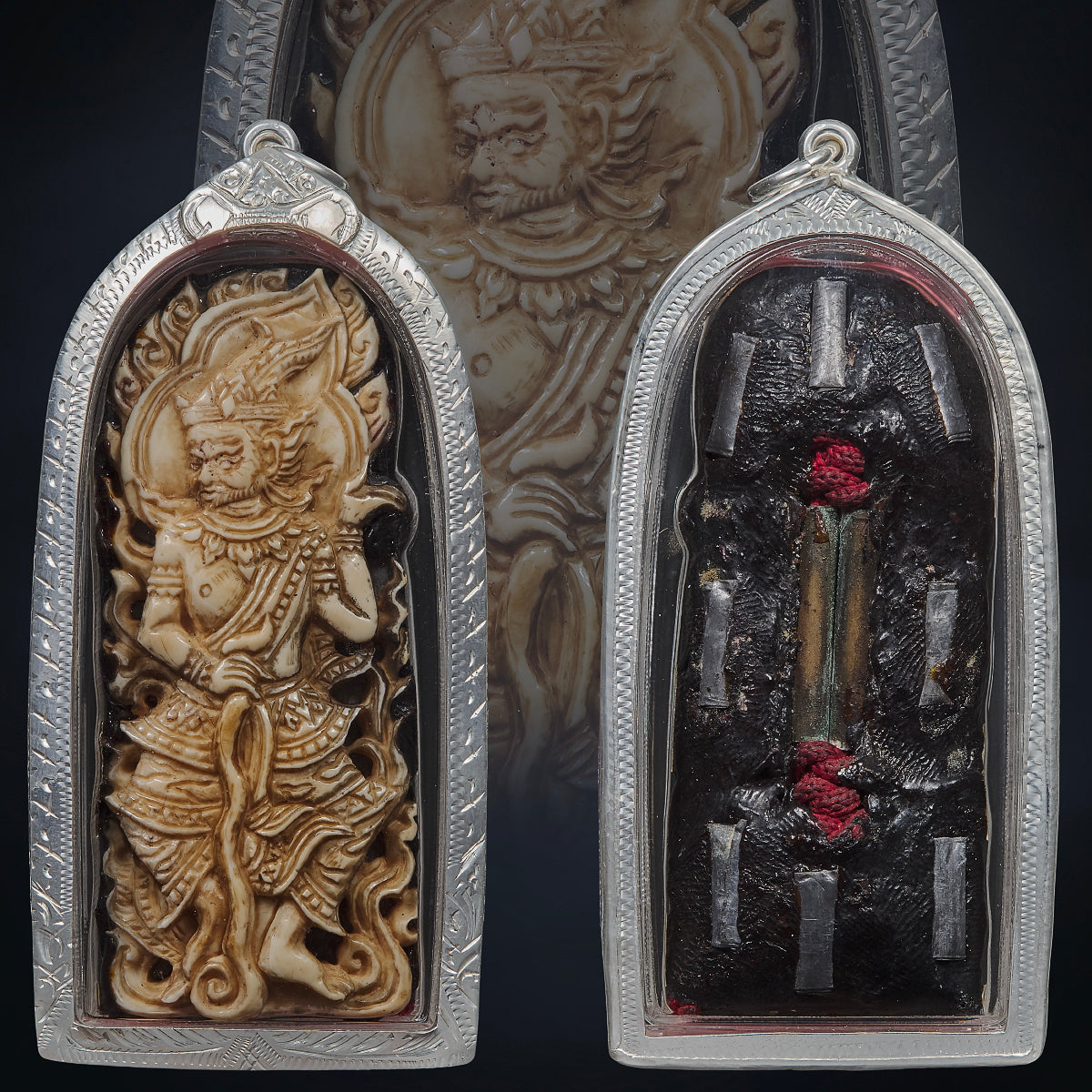
Phra Lersi Narod – Dancing Form of the Great Teacher
Por Sala Tan
3" height
This is a completely individual, one-off sacred creation. From the inherited Nga Chang relic and its hand-carved form to Por Sala Tan's final application of Burmese sacred wax and takruts, every element was prepared by hand. Its natural texture, colour, carving and ritual finishing belong uniquely to this piece.
Personal Experiences Shared by Luksits
The provenance of this Phra Lersi Narod is unusually personal.
Its former keeper was a close layman disciple of Por Sala Tan, deeply devoted to traditional Thai arts, dance, music and ancient history. These interests formed an important part of his life, and he maintained a particular respect for the old traditions surrounding teachers, craftsmen and performers.
The piece of Nga Chang relic used for this amulet had originally been inherited from his father. Rather than keeping the material untouched, he wanted to transform this family relic into a sacred image that reflected his own lifelong connection with history and the arts.
He therefore commissioned a professional craftsman to carve the material into Phra Lersi Narod in an unusual dancing posture.
After the carving was completed, he personally brought it to Por Sala Tan for blessing and further ritual preparation.
Por Sala Tan subsequently added Burmese sacred wax and several takruts, directing the piece towards Metta Maha Niyom, personal charm, opening the minds of others, clarity, eloquence and popularity.
The disciple kept this unique Lersi personally for many years.
After numerous meetings and conversations with him, the piece was eventually passed from the disciple's personal collection to the present collection.
It is therefore not simply a commissioned carving. Its history connects three stages: a relic inherited from father to son, the son's devotion to traditional arts, and Por Sala Tan's final blessing and wicha.
Summary
This Phra Lersi Narod is a unique, one-off sacred object associated with Por Sala Tan.
The figure was carved from an old piece of Nga Chang relic inherited by one of Por Sala Tan's close layman disciples from his father.
Because the disciple possessed a strong personal interest in traditional Thai dance, music, arts and ancient history, he chose to have the inherited material professionally carved into an unusual representation of Phra Lersi Narod in a dancing posture.
Once the carving was completed, it was taken directly to Por Sala Tan.
Por Sala Tan blessed the image, applied Burmese sacred wax to the reverse and incorporated multiple takruts for Metta Maha Niyom, Saneh, clarity, opening the minds of others, eloquence and popularity.
The result is an especially personal representation of the great Lersi teacher — connecting family inheritance, artistic devotion, craftsmanship and Por Sala Tan's wicha within a single piece.
Phra Lersi Narod – The Great Teacher
Phra Lersi Narod is revered within Thai Lersi traditions as one of the important Kroo, or sacred teachers.
The wider Lersi tradition represents the transmission of knowledge, discipline, healing, sacred sciences, craftsmanship and spiritual practice from teacher to disciple.
Lersi Narod carries a particularly appropriate relationship with music, performance, knowledge and refined expression.
For this reason, his image has special significance for musicians, dancers, performers, teachers, craftsmen and those whose livelihood depends upon creativity or communication.
The Lersi is therefore more than a symbol of acquiring knowledge.
He represents the ability to receive knowledge from one's teachers, develop it through disciplined practice and eventually express it through one's own work.
The Dancing Form – Pang Rai Ram Boek Sin
The dancing posture gives this particular image an unusual character.
A suitable descriptive name for the piece is:
Phra Lersi Narod, Pang Rai Ram Boek Sin
“Lersi Narod in the Dancing Form that Opens the Arts.”
The name reflects the personal intentions behind its creation rather than claiming an established historical iconographic posture.
Here, the movement of the Lersi represents knowledge becoming expression.
Wisdom becomes speech.
Discipline becomes performance.
Knowledge becomes craftsmanship.
Tradition becomes something that can be passed to another generation.
This symbolism is especially appropriate because the original keeper himself possessed a deep interest in traditional Thai dance, music, history and the arts.
Nga Chang – An Inherited Family Relic
The material used for the carving was particularly meaningful to its original keeper.
The Nga Chang relic had been inherited from his father and remained within the family before being transformed into the present Lersi.
Within traditional sacred-object culture, Nga Chang is associated with the qualities symbolised by the elephant: Baramee, dignity, strength, stability, memory and authority.
In this particular piece, however, its family provenance is equally significant.
A material inherited from one generation was transformed into the image of a Kroo — a teacher responsible for transmitting knowledge from one generation to another.
This creates a particularly fitting relationship between material and image: inheritance represented through the sacred teacher.
Professional Hand-Carving
Because the Nga Chang carried considerable personal importance, the disciple entrusted the material to a professional craftsman.
The figure was carved as a standing Lersi captured in a dynamic dancing posture. The body turns naturally through the composition, while the elaborate clothing and surrounding decorative elements give the figure a strong resemblance to traditional Thai performing-art imagery.
The naturally warm cream and brown tones of the Nga Chang remain visible throughout the carving.
This was not produced as part of a standard batch.
It was created as one individual object from the disciple's own inherited material, making its form and provenance impossible to duplicate exactly.
Por Sala Tan's Blessing & Wicha
After the carving was completed, the disciple brought the finished Lersi directly to Por Sala Tan.
Por Sala Tan then carried out the sacred preparation that transformed the carved image into the completed ritual piece.
The reverse was prepared with dark Burmese sacred wax, into which multiple takruts were incorporated.
The wicha was directed towards several complementary qualities:
Metta Maha Niyom — goodwill, acceptance and favourable response from others.
Maha Saneh — personal magnetism and an engaging presence.
Opening Minds — encouraging others to listen, understand and remain receptive.
Clarity — supporting clear thought and appropriate expression.
Speech & Eloquence — helping words carry naturally and effectively.
Popularity — particularly relevant to performers, teachers, salespeople and those whose work depends upon public response.
These qualities fit naturally with the character of Lersi Narod as a teacher associated with knowledge and artistic expression.
The Takruts
The reverse of the artifact carries an extensive arrangement of takruts individually positioned within Por Sala Tan's sacred preparation.
Rather than concentrating upon one single blessing, their purpose was to build a balanced character around communication and favourable human interaction.
Metta encourages goodwill.
Saneh strengthens personal presence.
Eloquence supports communication.
Clarity helps the keeper understand when and how to speak.
Opening the minds of others supports situations where an idea, performance, teaching or proposal must first be received before it can be appreciated.
Together, these qualities make the piece especially relevant to anyone whose success depends upon the relationship between skill and audience.
Arts, Music & Performance
The artistic character of this Lersi is central to understanding the piece.
For dancers and performers, it represents confidence, expression and respect towards the lineage of teachers behind their art.
For musicians, it represents disciplined practice, creativity and the ability to communicate emotion through performance.
For craftsmen and artists, it represents patience, inspiration and continual development of skill.
For teachers and students, the Lersi represents the traditional relationship between Kroo and Luksit — teacher and disciple.
The piece may therefore be understood as an especially appropriate sacred companion for anyone whose path involves learning, creating, teaching or performing.
Speech, Eloquence & Opening Minds
Por Sala Tan's addition of wicha connected with speech and opening minds expands the application beyond traditional performers.
The same qualities are relevant to teachers, negotiators, business owners, salespeople, presenters and public-facing professionals.
Clear communication involves more than speaking persuasively.
It also requires recognising one's audience, selecting appropriate words and creating sufficient goodwill for the other person to listen.
This combination of clarity, Metta and eloquence is an important aspect of the finished piece.
Traditional Blessings
The principal traditional qualities associated with this Phra Lersi Narod are wisdom and artistic development, reflecting the Lersi's position as a sacred teacher.
Its Por Sala Tan preparation adds Metta Maha Niyom and Saneh, supporting goodwill, social acceptance and personal magnetism.
For communication, the piece is associated with clear speech, eloquence and opening the minds of others, particularly where understanding and favourable response are important.
Artists and performers may associate it with creativity, confidence and audience appreciation, while students and teachers may value its connection with learning, concentration and respect for the Kroo lineage.
The Nga Chang contributes the symbolism of Baramee, stability and dignity, bringing a grounded quality to the more expressive aspects of the piece.
Together, the artifact centres upon wisdom, artistic expression, communication, Metta, clarity, popularity and the transmission of knowledge.
Modern Application
This is particularly suitable for people working within the arts and creative professions — dancers, musicians, actors, craftsmen, designers, writers and performers.
It is equally relevant to people whose profession depends heavily upon communication, including teachers, lecturers, salespeople, negotiators and presenters.
Before an important performance, meeting or creative session, the Lersi may serve as a focus for remembering one's teachers and approaching the task with preparation and composure.
Its symbolism is especially meaningful when talent alone is insufficient and the individual must also communicate that talent effectively to others.
Physical Details
The front presents Phra Lersi Narod in a distinctive dancing posture, professionally carved from the original Nga Chang relic.
The figure is shown with an expressive face and elaborate headdress, surrounded by flowing decorative elements that reinforce the sense of movement. Detailed clothing and ornamentation give the composition a strong traditional Thai artistic character.
The reverse contrasts sharply with the refined carving of the front.
It is covered with Por Sala Tan's dark Burmese sacred wax, creating the ritual foundation of the piece. Multiple takruts are embedded around the reverse, while a larger central ritual component is secured with red sacred cord.
The contrast between the finely carved front and heavily prepared ritual reverse clearly records the object's two stages of creation: the disciple's artistic commission and Por Sala Tan's subsequent wicha.
Recommended Pairings
Phra Chaiwat — adds a broader foundation of protection, success and general auspiciousness.
A One-Off Personal Creation
This Phra Lersi Narod was never conceived as a commercial batch.
Its story began with a Nga Chang relic inherited by a son from his father.
That son, a close disciple of Por Sala Tan and a devotee of traditional Thai arts, music, dance and history, chose to transform his inherited material into the image of the sacred teacher who best represented those interests.
A professional craftsman gave the material its unusual dancing form.
Por Sala Tan then completed its spiritual preparation with Burmese sacred wax and takruts for Metta Maha Niyom, Saneh, opening minds, clarity, eloquence and popularity.
The disciple subsequently kept the piece within his personal collection. Only after many meetings was it eventually passed on.
Its importance therefore comes not from quantity or batch rarity, but from its individual provenance.
There is only one example carrying this exact combination of inherited Nga Chang, dancing Lersi Narod imagery, personal artistic intention and Por Sala Tan's ritual preparation — making it a particularly distinctive piece for collectors of Por Sala Tan and traditional Lersi wicha.
-
Free Shipping for Singapore| $15 Worldwide | $60 USA For Items Below $350