
OOBThaiAmulets
Por Sala Tan
Por Sala Tan
Couldn't load pickup availability
PST04
Phra Yama – Guardian of Dharma
Por Sala Tan (3" Size)
Each Phra Yama was individually hand-carved by Por Sala Tan from naturally formed old sacred relics. Differences in the original material, surface, colour, carving and ritual preparation give every completed piece its own unique form and character.
Personal Experiences Shared by Luksits
Only a handful of Phra Yama images were carved from this group of old relics. After completing them, Por Sala Tan gave one of the pieces back to the villager who had originally discovered and presented the materials to him.
The villager regularly worked under harsh and physically demanding conditions, and the Phra Yama became one of the sacred objects he kept close to him.
After receiving the piece, he described feeling a noticeably stronger sense of protection and confidence, particularly when working in difficult or uncertain surroundings.
He also felt that he became more alert to his environment. When circumstances appeared unsafe, he found himself paying closer attention and making decisions with greater caution.
For the villager, the most noticeable quality was therefore not simply protection. It was the combination of confidence, awareness and steadiness that he associated with carrying the Phra Yama.
This experience closely reflects the traditional character of Yama: a figure associated with discipline, judgement, courage and remaining conscious of the consequences surrounding one's actions.
Summary
This rare Phra Yama by Por Sala Tan was individually hand-carved from an unusual group of old relics discovered beneath an abandoned hut within a cemetery.
A local villager had been rebuilding the old structure when several pieces of unidentified relic material were uncovered beneath it.
Recognising that the materials were unusual, the villager brought them to Por Sala Tan.
Upon receiving and examining the relics, Por Sala Tan felt that they carried an immense spiritual energy. He consequently decided that the material was appropriate for the image of Phra Yama — the guardian and judge associated with death, Dharma and karmic order.
Only a handful were carved.
The completed figure presents Phra Yama standing in a commanding posture, carrying his ritual weapon and displaying the stern character traditionally associated with the guardian of Yomlok.
The piece is principally associated with protection, courage, alertness, authority, spiritual defence and the strength to remain composed when confronting difficult circumstances.
Origin – Relics Beneath the Cemetery Hut
The materials used for this small group of Phra Yama originated from an old hut situated within a cemetery.
A villager was rebuilding the structure when several pieces of old relic material were discovered buried beneath the hut.
Because of the unusual location in which they had been preserved, the villager decided to bring the relics to Por Sala Tan rather than treating them as ordinary discarded material.
When Por Sala Tan received them, he sensed a particularly strong spiritual character from the old relics.
After the necessary consideration and ritual preparation, he selected Phra Yama as the appropriate sacred form to carve from them.
Why Phra Yama?
Phra Yama, also known in Thai tradition as Phra Yom or Yommarat, is the guardian and judge of the realm of the dead within Hindu-Buddhist cosmology.
His image can initially appear severe, yet his traditional meaning is deeper than death itself.
Yama represents Dharma, karmic accountability, judgement and the unavoidable consequences of one's actions.
He is therefore not simply a frightening underworld figure. He is an impartial guardian of spiritual order.
Within sacred-object traditions, this gives Phra Yama a particularly strong association with protection, discipline, courage and the ability to confront threatening or uncertain circumstances without losing awareness.
Yama – Guardian of Dharma
The origins of Yama extend back to ancient Indian religious traditions.
In early accounts, Yama became associated with the realm beyond ordinary human life. Later Hindu and Buddhist traditions developed his role as Dharmaraja — the King of Dharma and impartial judge of karmic conduct.
Every action carries consequences, and Yama represents the order through which those consequences cannot simply be ignored.
For this reason, the deeper symbolism of Yama is closely connected with responsibility and awareness.
His image reminds the keeper to remain conscious of one's surroundings, one's decisions and one's conduct.
This quality corresponds particularly well with the experience of the villager who kept one of Por Sala Tan's carvings and described becoming more alert while working in difficult environments.
The Cemetery Connection
The discovery of the old relic beneath a cemetery hut gives this particular Phra Yama an especially appropriate symbolic connection.
Cemeteries occupy an important position within certain older Thai wicha traditions as places associated with impermanence, spirits, meditation upon death and the boundary between ordinary life and the unseen world.
Phra Yama stands within this same symbolic territory as the guardian of karmic order and the realm of the dead.
Por Sala Tan's decision to carve Phra Yama from material recovered from such a place therefore created a natural relationship between the origin of the relic and the sacred form chosen for it.
The Skull & Staff
Phra Yama imagery commonly incorporates objects connected with judgement, mortality and authority.
The skull represents impermanence. It reminds the keeper that circumstances change, life is temporary and fear should be approached with awareness rather than panic.
The staff or ritual weapon represents authority, discipline and the enforcement of spiritual order.
Together, these attributes communicate the character of Phra Yama as a guardian who possesses the authority to confront disorder and harmful forces.
For the keeper, their symbolism may be understood through courage, stronger judgement and remaining disciplined when facing pressure.
Protection & Spiritual Defence
Within traditional belief, Phra Yama is particularly respected for protection against harmful spiritual influences and unsettling environments.
His authority over the realm of spirits gives the image a natural guardian character.
For this reason, such a piece may traditionally be kept when entering unfamiliar places, working in isolated environments or dealing with circumstances believed to carry heavy spiritual energies.
Its protective quality is closely connected with alertness.
Protection is strengthened by recognising danger early, remaining composed and avoiding unnecessary risks.
Authority & Courage
Phra Yama also carries a strong aspect of Maha Amnaj — commanding authority.
As an impartial judge, his authority does not arise from uncontrolled aggression. It comes from certainty, discipline and the ability to stand firmly behind a decision.
This symbolism can be particularly relevant to people who must manage others, enforce boundaries or remain decisive under pressure.
The image therefore represents controlled authority rather than intimidation.
Courage follows the same principle: facing difficult circumstances without allowing fear to dictate one's actions.
Traditional Blessings (Summary)
The principal traditional quality of this Phra Yama is protection, particularly in difficult, isolated or spiritually unsettling environments.
It is also associated with courage and confidence, helping the keeper remain steady when confronted with pressure or uncertainty.
Alertness and judgement form another important aspect, encouraging awareness of one's surroundings and greater caution before making consequential decisions.
Its guardian character traditionally extends towards spiritual defence and protection against harmful influences, while Yama's position as Dharmaraja contributes qualities of authority, discipline and personal baramee.
For those facing obstacles or demanding circumstances, the image symbolises the strength to stand firm, assess the situation clearly and continue without being controlled by fear.
Modern Application
The Phra Yama is particularly suited to people working in demanding or unpredictable environments.
Those involved in physical work, travel, security, management or occupations requiring constant awareness may appreciate its traditional association with protection and alertness.
For leaders, its symbolism supports fair authority, discipline and decisive judgement.
For spiritual practitioners, the cemetery origin and Yama imagery provide a reminder of impermanence, personal responsibility and the importance of remaining grounded when encountering difficult energies.
Its lesson is therefore practical as much as spiritual:
Remain aware, act with discipline and do not allow fear to control judgement.
Physical Details
This Phra Yama was individually hand-carved from an old relic recovered beneath the cemetery hut.
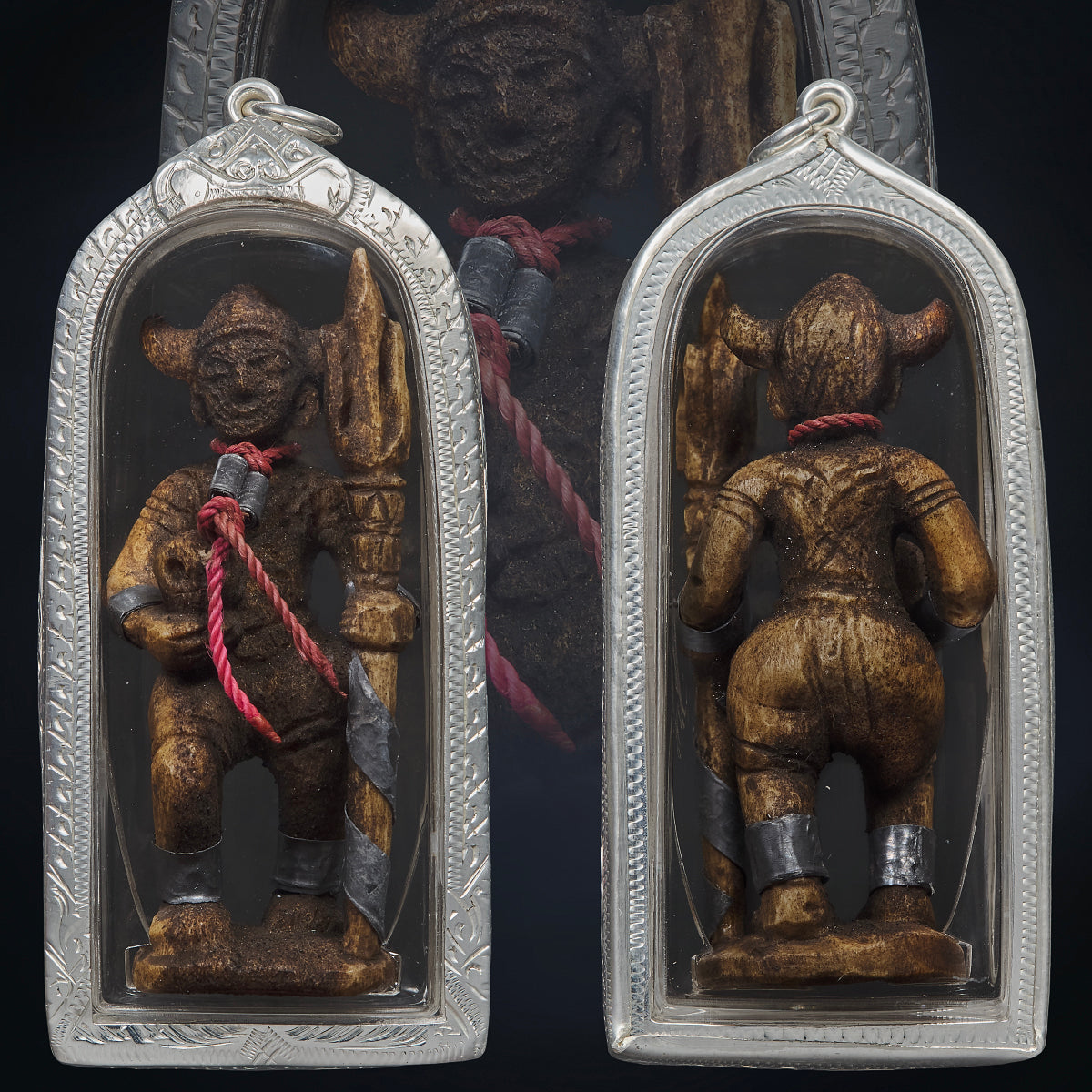
The standing figure has a strongly defined head with horn-like projections and a stern facial expression. One hand rests close to the body while the other holds a large ritual weapon extending beside the figure.
The natural cream, brown and darkened tones of the old relic remain visible throughout the carving, giving the surface an aged and organic appearance.
Several takruts are attached around the body and limbs, while old red Sai Sin is tied around the neck with an additional takrut.
The reverse retains a comparatively simple form, allowing the natural surface and grain of the original relic to remain clearly visible.
The complete piece is presently protected within a custom casing.
Recommended Pairings
Tao Wessuwan — complements Phra Yama with strong guardian qualities and protection against harmful spiritual influences.
Lersi — suitable for practitioners seeking to combine Phra Yama's discipline and protection with wisdom, meditation and guidance.
A Rare Cemetery Relic Creation of Por Sala Tan
This Phra Yama belongs to a very small group carved from the relics discovered beneath an old cemetery hut.
The materials reached Por Sala Tan through the villager who uncovered them while rebuilding the structure. After examining the relics and sensing their strong spiritual character, Por Sala Tan chose to transform them into the image of Phra Yama.
Only a handful were completed, with one returned to the villager who had originally found the materials.
That villager later associated his Phra Yama with a stronger feeling of protection, confidence and alertness, particularly while working under harsh conditions.
The combination of its cemetery provenance, individually carved old relic and limited creation makes this an unusual example of Por Sala Tan's work — a Phra Yama centred upon protection, spiritual defence, courage, disciplined authority and awareness in the face of difficult circumstances.
-
Free Shipping for Singapore| $15 Worldwide | $60 USA For Items Below $350