
OOBThaiAmulets
Por Sala Tan
Por Sala Tan
Couldn't load pickup availability
PST03
Phra Mae Per Nakhi – Pang Nang Prakhong Khamphi
Por Sala Tan
Barang Artifact
Personal Experiences Shared by Luksits
According to an account preserved among Por Sala Tan’s luksit, the son of one of his followers worked as an insurance agent but struggled with approaching strangers. His reluctance to speak with potential customers affected his sales, and his position eventually became uncertain, with his employer considering dismissal.
Knowing his situation, Por Sala Tan gave him this Mae Per Nakhi specifically for Metta Maha Niyom and career opportunity. After he began wearing it, the changes were described as gradual. He felt a gentle increase in confidence, found conversations easier to begin, and noticed that prospective customers were willing to listen longer while his explanations became smoother.
A significant turning point came when an important prospective client unexpectedly agreed to a substantial insurance contract. The sale helped him retain his position, and the client later introduced him to further prospects. These referrals gradually helped him rebuild his business and reflected the traditional qualities associated with Mae Per Nakhi — favourable communication, Metta Maha Niyom and the opening of career opportunities.
This account gives this particular surviving piece unusual personal significance: it was reportedly given directly by Por Sala Tan to address a specific difficulty faced by a luksit’s son, and remained connected with the career recovery that followed.
Summary
This unusual sacred figure by Por Sala Tan may be described as:
Phra Mae Per Nakhi – Pang Nang Prakhong Khamphi
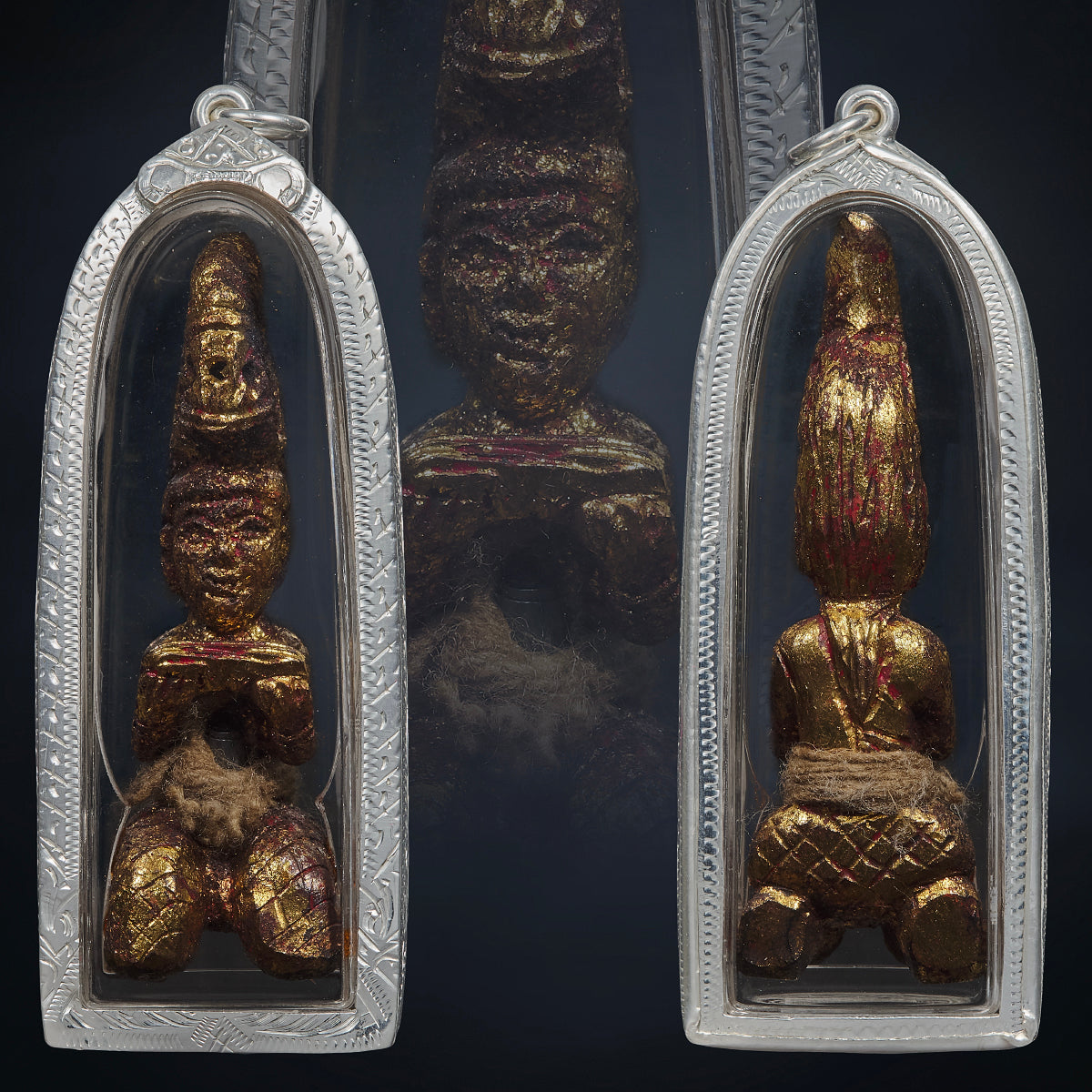
The name describes Mae Per in her Naga form, kneeling while respectfully holding a sacred scripture or Khamphi.
The iconography combines several powerful symbols within a single image.
Her kneeling posture represents humility before sacred law, teachers and spiritual knowledge. The book held carefully against her chest represents guarded wisdom, sacred formulas, mantras and knowledge capable of guiding one's path. Rising above her is the Naga head, symbolising guardianship, unseen power, abundance and spiritual protection.
The figure was individually handcrafted from old Graduk Chang Graden, sacred material carrying more than twenty years of ritual history before it came into Por Sala Tan's possession.
According to the provenance accompanying the material, it was preserved by an elderly Burmese shaman who blessed it daily for over two decades.
Por Sala Tan subsequently prepared the material according to his own Wiccha, individually handcrafted the Mae Per Nakhi and finished the figure with traditional red lacquer and gold foil.
A Takrut is concealed at the bottom, while old Sai Sin is bound around the figure, completing this layered Barang artifact.
The Story of Mae Per Nakhi
Within the esoteric story accompanying this form, Mae Per is entrusted with guarding the Khamphi Sakot Chat a mystical scripture associated with karma, fortune and the changing course of destiny.
The story tells of a sacred book preserved deep beneath a mountain within the realm of the Nagas.
The Naga kings gathered around the scripture and placed their oath upon it. Their breath became sacred letters, their scales symbolically became its pages, and their protective power became the mantras contained within.
Mae Per descended into the Naga realm carrying neither weapon nor force.
She approached through faith, humility and respect for sacred knowledge.
Recognising these qualities, the Nagas accepted her as a guardian of the Khamphi. The Naga head rising above her subsequently became the symbolic mark of this relationship — Mae Per carrying the guardianship and spiritual authority of the Naga lineage.
She therefore appears kneeling, carefully holding the sacred book against her body.
Within the symbolism of the image, she becomes the keeper of sacred knowledge and a bridge between human intention and Naga guardianship.
The Kneeling Posture
The unusual kneeling posture is central to the meaning of this piece.
Mae Per is depicted in a composed position with her body lowered and both hands supporting the Khamphi.
The posture represents respect towards teachers, sacred law and the spiritual forces from which knowledge is received.
It also carries an important lesson concerning power.
Wisdom is traditionally approached with discipline and humility. The person who receives sacred knowledge must first learn to respect its source and understand the responsibility that accompanies it.
For devotees, the posture consequently represents patience, disciplined learning and the ability to remain composed while facing difficult circumstances.
Khamphi Sakot Chat – The Book of Destiny
The book held against Mae Per's chest is traditionally interpreted within this form as the Khamphi Sakot Chat
Within the esoteric narrative, it represents a record of karma, fortune and the changing pathways encountered throughout life.
Its meaning extends beyond literal writing.
The Khamphi symbolises sacred knowledge: mantras, Yant, occult formulas, accumulated wisdom and the understanding required to recognise how circumstances may develop.
Because Mae Per holds the book tightly against her chest, she is represented as its protector and keeper.
For practitioners and collectors, this symbolism is particularly meaningful for learning, memory, intuitive wisdom, decision-making and the study of Wiccha, sacred characters, Yant and Kata.
It also gives rise to the traditional concept of opening roads — seeking favourable conditions when one's path has become obstructed and asking that difficult circumstances become easier to navigate.
The Naga Head
The elongated head above Mae Per represents the Naga connection of this particular form.
Naga traditions occupy an important place throughout mainland Southeast Asian religious and folk culture. Nagas are associated with water, fertility, abundance, hidden treasures, sacred knowledge and the guardianship of spiritually important places.
Within the Mae Per Nakhi narrative, the Naga head represents acceptance into this protective lineage.
It symbolises the vow of the Nagas to guard the keeper of the sacred Khamphi.
For the wearer, this imagery is traditionally interpreted as protection against visible and unseen dangers, hostile intentions and spiritual disturbances.
The Naga's association with abundance also complements Mae Per's traditional qualities of Metta and favourable opportunity.
Graduk Chang Graden
The physical body of this Mae Per Nakhi was individually handcrafted from old Graduk Chang Graden.
Its history extends considerably further back than the completed figure.
According to the provenance preserved with the material, the raw Graduk Chang Graden originally belonged to an elderly Burmese shaman who kept it for more than twenty years.
Throughout this period, he is said to have blessed the material daily as part of his spiritual practice.
It was eventually passed to Por Sala Tan.
He subsequently prepared the old material according to his own Wiccha before individually forming it into the distinctive Naga-headed Mae Per.
The finished artifact therefore combines more than two decades of earlier ritual history with Por Sala Tan's later preparation and consecration.
Red Lacquer & Gold Foil
After the figure had been formed, Por Sala Tan finished the surface using traditional red lacquer and gold foil.
The red foundation remains visible beneath and between the gold surfaces, producing the distinctive aged red-and-gold appearance of the piece.
Gold emphasises the elongated Naga head, facial features, clothing and sacred book, allowing the symbolism of the carving to remain clearly visible.
The surface also records the handmade nature of the artifact.
Small differences in lacquer, gold application, texture and wear form part of the individual character of each piece.
Takrut & Old Sai Sin
Additional sacred components complete the construction.
A Takrut is concealed within the bottom of the figure, placing Por Sala Tan's inscribed Wiccha directly within the artifact.
The body is also tied with old Sai Sin.
Sai Sin is traditionally connected with chanting, blessing ceremonies and protective ritual practice. Its inclusion physically links another consecrated material with the completed Mae Per Nakhi.
Together, the Takrut and old Sai Sin reinforce the ritual foundation beneath the visible symbolism of Mae Per, the Naga and the Khamphi.
Ritual & Consecration
The preparation of this piece began with Graduk Chang Graden that already carried a lengthy ritual history.
After receiving the material from the elderly Burmese practitioner, Por Sala Tan prepared it according to his own Wiccha.
Each Mae Per Nakhi was then individually handcrafted, forming the kneeling body, sacred book and characteristic Naga head.
The completed figure received traditional red lacquer followed by gold foil.
A Takrut was incorporated at the bottom, while old Sai Sin was bound around the body as part of the ritual construction.
Por Sala Tan then completed the appropriate chanting and consecration, bringing together the older ritual history of the Graduk Chang Graden with his own Wiccha and the symbolic qualities of Mae Per, the sacred Khamphi and Naga guardianship.
Traditional Blessings
Mae Per Nakhi is traditionally approached for a particularly broad combination of Metta, wisdom, opportunity and protection.
Her Mae Per aspect is associated with Metta Maha Niyom, helping the keeper receive goodwill, favourable attention and cooperation from customers, colleagues and influential people.
The Khamphi introduces the qualities of knowledge, memory, intuition and skilful decision-making. It is especially meaningful for those studying specialised subjects, sacred Wiccha, Yant, Kata or professions where knowledge and communication directly influence success.
Her Naga form contributes protection, prosperity and guardianship, traditionally shielding the keeper from hidden dangers and unfavourable spiritual influences.
The concept of opening roads is another important aspect of this form. Devotees approach Mae Per Nakhi when circumstances feel blocked, asking for obstacles to soften, opportunities to become visible and difficult situations to move towards a more favourable direction.
Together, the traditional qualities centre upon Metta Maha Niyom, wisdom, persuasive communication, opening roads, prosperity, intuitive awareness and Naga protection.
Modern Application
This Mae Per Nakhi is particularly suitable for those whose livelihood depends upon knowledge, communication and favourable relationships.
Business owners may approach her for customer attraction, smoother negotiations and movement during periods of stagnant trade.
Sales professionals, property agents, consultants and freelancers may value the combination of Metta and persuasive communication when meeting clients or presenting proposals.
Students, teachers and practitioners of specialised subjects may appreciate the symbolism of the sacred Khamphi for learning, memory and deeper understanding.
Collectors studying traditional Wiccha, sacred scripts, Yant and Kata may find the book symbolism especially meaningful.
The Naga element adds protection and abundance, creating a balanced piece for those seeking both opportunity and guardianship in everyday life.
Physical Details
This Phra Mae Per Nakhi – Pang Nang Prakhong Khamphi by Por Sala Tan depicts Mae Per in an unusual kneeling posture, respectfully holding a sacred book against her chest beneath an elongated Naga head. The figure was individually handcrafted from old Graduk Chang Graden, traditionally recorded as having been preserved and blessed daily for more than twenty years by an elderly Burmese shaman before being entrusted to Por Sala Tan.
Por Sala Tan prepared the material according to his own Wiccha before shaping the Naga head, kneeling body, patterned clothing and Khamphi. The completed figure was coated with traditional red lacquer and gold foil, producing the aged red-and-gold surface visible today. A Takrut is concealed at the bottom, while old Sai Sin is tied around the body as part of the ritual construction.
The completed artifact is housed within a silver-coloured waterproof protective casing suitable for wearing.
Each piece was individually prepared and handcrafted from naturally varying sacred material. Differences in the Graduk Chang Graden, carving, surface texture, lacquer, gold foil and arrangement of the old Sai Sin give every completed example its own individual character.
Recommended Pairing
Mae Per Nakhi + Nang Kwak
An excellent combination for business, customers and prosperity.
Mae Per Nakhi contributes wisdom, favourable communication and road-opening qualities, while Nang Kwak traditionally beckons customers and commercial opportunities towards the keeper.
Mae Per Nakhi + Phra Sivali
A balanced combination for opening roads, abundance and favourable circumstances.
Mae Per Nakhi represents wisdom and the navigation of destiny, while Phra Sivali is traditionally revered for receiving necessities, assistance and prosperity.
Personal Notes
This is one of Por Sala Tan's more symbolically layered female Barang forms.
The kneeling Mae Per, Khamphi held against her chest and Naga head rising above her each contribute a separate aspect to the finished image.
The kneeling posture represents humility and respect towards sacred knowledge. The Khamphi represents wisdom, mantras, learning and the ability to understand the changing circumstances of life. The Naga represents protection, abundance and guardianship.
Its material history adds another dimension.
The old Graduk Chang Graden had already accumulated more than twenty years of ritual history under an elderly Burmese shaman before being passed to Por Sala Tan. He then prepared the material according to his own Wiccha, handcrafted the figure and completed it with red lacquer, gold foil, Takrut and old Sai Sin.
The sacred material was individually prepared before each figure was handcrafted and finished by hand. Natural differences in the material, carving, lacquer and gold application ensure that every Mae Per Nakhi possesses its own character.
For collectors of Por Sala Tan's Barang work, Phra Mae Per Nakhi – Pang Nang Prakhong Khamphi brings together an unusually complete range of traditional symbolism: Metta Maha Niyom, wisdom, sacred knowledge, persuasive communication, opening roads, prosperity and the protective authority of the Naga.
-
Free Shipping for Singapore| $15 Worldwide | $60 USA For Items Below $350