
OOBThaiAmulets
Por Sala Tan
Por Sala Tan
Couldn't load pickup availability
PST03
Khiaw Phraya Mii
Por Sala Tan
Barang Artifact
*Palm size* (BIG)
Personal Experiences Shared by Luksits
After owning and respectfully praying to Khiaw Phraya Mii, villagers and luksits of Por Sala Tan have shared experiences centred strongly on protection, safe passage and an unusual feeling of being shielded when entering unfamiliar places.
Some villagers describe carrying the piece when travelling into forests, remote areas or places they had never visited before. They often speak of sensing what they describe as an unseen protective shield surrounding them, giving them greater confidence and a feeling that something was watching over their movements.
One particularly remembered account concerns a villager who was unexpectedly attacked by wild boars. According to the account passed among devotees, despite the sudden and potentially dangerous encounter, the villager escaped without injury. He attributed his safety to an unseen protective force associated with the Khiaw Phraya Mii he carried and prayed to.
Experiences of this kind have contributed to the piece's reputation among villagers as a powerful travelling guardian, particularly when entering forests, unfamiliar territory or environments where dangers cannot easily be anticipated.
Other collectors describe timely intuition before troublesome situations, suddenly deciding to change direction, avoid a particular place or distance themselves from someone whose intentions later proved unfavourable.
Summary
This distinctive Khiaw Phraya Mii by Por Sala Tan belongs to a cave-based spiritual tradition connected with the northern regions where Por Sala Tan conducted much of his meditation and ritual work.
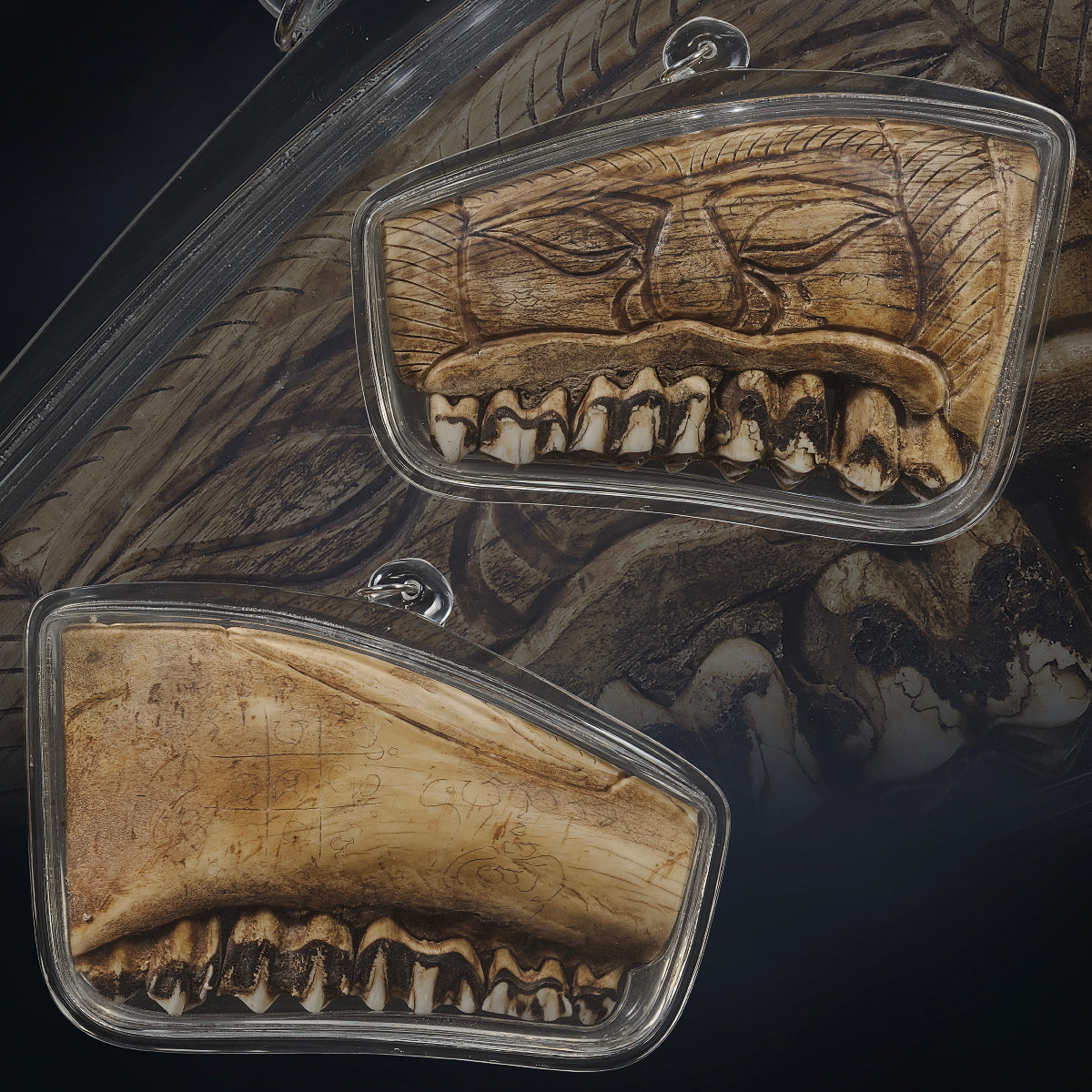
The piece is individually carved from Keow Moo Tong Deang, with the natural tooth formations of the material deliberately preserved and incorporated into the formidable mouth of the guardian.
Within the tradition surrounding these pieces, Mii refers to powerful bear-like cave entities described in local animistic and esoteric accounts as Jinn inhabiting deep, secluded cave systems.
These entities are regarded as spiritually advanced beings. Some are traditionally understood to seek liberation or release from the limitations of their environment, creating the basis for a cooperative spiritual relationship centred upon merit and acknowledgement.
Por Sala Tan frequently entered such cave environments for meditation and ritual observation, an important part of his practice. During certain periods, sacred relic materials were consecrated directly within these caves, aligning the completed objects with the guardian presences traditionally associated with them.
The reverse of this example carries handwritten Yant personally inscribed by Por Sala Tan, completing an artifact traditionally valued for guardian protection, Klaew Klaad, safe travel, strong spiritual boundaries and resilience in unfamiliar environments.
Historical Background
Khiaw Phraya Mii belongs to a specialised category within Por Sala Tan's Barang practice, connected specifically with the cave traditions encountered during his work in northern regions.
Within this lineage, Mii refers to bear-like cave entities.
Local animistic and esoteric accounts describe these beings as powerful Jinn inhabiting deep and secluded cave systems, where their presence may remain associated with a particular location for extended periods.
The bear-like character carries important symbolism.
Strength, territorial awareness, endurance and formidable defensive behaviour all contribute to the guardian identity associated with Phraya Mii.
Within the spiritual accounts preserved around Por Sala Tan's practice, certain cave entities are regarded as spiritually advanced beings seeking liberation or release from the constraints of their environment.
This creates an important relationship between practitioner and guardian.
The purpose of the practice is understood through meditation, acknowledgement, merit and spiritual cooperation, with the guardian qualities of the entity becoming associated with sacred objects prepared within this environment.
Por Sala Tan's Northern Cave Practice
Cave meditation formed an important element of Por Sala Tan's spiritual work.
He frequently entered remote cave systems in northern regions for meditation, ritual observation and interaction with the spiritual landscape of these secluded environments.
Such caves are traditionally regarded as powerful locations for practice.
Their isolation removes many distractions of ordinary life, while their age, silence and physical separation from settlements have long contributed to beliefs concerning guardian beings and unseen inhabitants.
According to the tradition surrounding Khiaw Phraya Mii, Por Sala Tan encountered bear-like cave Jinn during these periods of practice.
Some were understood to possess considerable spiritual development while continuing to remain connected with their cave environment.
Certain beings were believed to seek assistance towards liberation.
Por Sala Tan's relationship with these presences was therefore based upon spiritual acknowledgement and the dedication of merit, creating a cooperative relationship between practitioner and guardian.
Keow Moo Tong Deang
The principal material of this Khiaw Phraya Mii is Keow Moo Tong Deang.
Por Sala Tan selected the sacred material and individually worked its natural form into the distinctive Phraya Mii guardian image.
The original tooth formations remain one of the most striking characteristics of the piece.
Instead of removing these features, Por Sala Tan incorporated them directly into the design. The natural teeth form the lower portion of the guardian's formidable mouth, while the broader material above provides the surface for the carved facial features.
The aged cream, brown and darker areas remain visible throughout the object, preserving the natural character of the Keow Moo Tong Deang.
This relationship between natural material and hand carving gives each Phraya Mii an individual appearance.
The Phraya Mii Guardian Form
The front presents a broad, imposing guardian face.
Large eyes, a pronounced nose and a heavy upper mouth were individually carved into the Keow Moo Tong Deang, while the existing teeth complete the lower portion of the face.
The resulting expression reflects the protective character traditionally attributed to the bear-like cave Jinn of the Mii lineage.
Within local belief, these entities are associated with powerful territorial protection.
Their strength is directed towards guarding boundaries, confronting disturbances and maintaining a protective presence around the person or environment placed under their care.
This helps explain why villagers particularly value Khiaw Phraya Mii when travelling into forests, remote areas and unfamiliar places.
Handwritten Yant
The reverse preserves a broad natural section of the Keow Moo Tong Deang and carries handwritten Yant and sacred inscriptions personally applied by Por Sala Tan.
These markings form an integral part of the ritual preparation.
Within Thai esoteric practice, Yant are employed according to the practitioner's Wicha and the intended purpose of the sacred object. For a guardian piece such as Khiaw Phraya Mii, the emphasis centres upon protection, Klaew Klaad, spiritual defence and reinforcement of boundaries.
The natural shape of every piece differs.
Por Sala Tan therefore had to adapt his inscriptions individually to the available surface, resulting in natural differences in handwriting, positioning and arrangement between examples.
Cave Consecration
The cave environment is particularly important to understanding this piece.
During certain periods of his practice, Por Sala Tan consecrated sacred relic materials directly within the cave environments where he meditated and conducted ritual observation.
Within the tradition, these locations were understood to carry the presence of powerful guardian beings accumulated through long periods of isolation.
The consecration drew upon three closely connected elements: the secluded spiritual environment of the cave, Por Sala Tan's prolonged meditation and ritual practice, and the guardian presence traditionally associated with the Mii entities inhabiting these locations.
The resulting sacred objects were aligned particularly towards guardianship, clearing disturbances and strengthening the keeper's protective boundary.
For devotees, this cave connection gives Khiaw Phraya Mii its characteristic heavy and grounded protective reputation.
The Mii Jinn & Liberation
An important aspect of Por Sala Tan's tradition concerns the relationship established with the cave entities themselves.
The Mii are described within these accounts as powerful bear-like Jinn, with some believed to possess considerable spiritual development.
Certain entities were understood to desire liberation or release from the restrictions of their existing state.
Por Sala Tan's practice therefore centred upon cooperation.
Through meditation, prayer, ritual acknowledgement and the dedication of merit, assistance could be directed towards the spiritual being.
In return, its guardian qualities became associated with the sacred object and its keeper.
Within this understanding, the relationship is reciprocal: merit and spiritual acknowledgement are offered, while guardianship and protection are received.
This principle forms an important part of the traditional identity of Khiaw Phraya Mii.
Traditional Blessings
Khiaw Phraya Mii is primarily regarded within Por Sala Tan's tradition as a powerful guardian artifact.
Its most important quality is protection. Devotees associate the Mii guardian with creating a strong spiritual boundary around its keeper, particularly when travelling through unfamiliar territory or entering environments where the surrounding conditions are uncertain.
It is also strongly connected with Klaew Klaad — escaping or passing safely through danger. The account of the villager surviving the encounter with wild boars unharmed is representative of the type of protective experience traditionally associated with the piece.
The bear-like guardian character further represents strength, endurance and resilience. Wearers may approach it for greater courage when confronting difficult people, competitive situations or circumstances requiring firm personal boundaries.
Its cave lineage is additionally associated with awareness and intuition, helping the keeper remain alert to changing circumstances and recognise potentially troublesome situations before they develop.
Together, these qualities centre upon protection, safe passage, endurance, courage, awareness and strong spiritual boundaries.
Modern Application
For modern wearers, Khiaw Phraya Mii is particularly relevant for those who frequently enter unknown or unpredictable environments.
Travellers, drivers, hikers and people whose work takes them into remote areas may value its traditional association with protection and Klaew Klaad.
It may also be meaningful for people who regularly enter unfamiliar buildings, work late at night or visit locations they consider spiritually heavy.
Business owners and professionals working in highly competitive environments may carry the piece for stronger personal boundaries and resilience against hostile intentions or interpersonal pressure.
Within a home or workplace, Khiaw Phraya Mii may also be respectfully kept as a guardian associated with maintaining a stable and protected environment.
Physical Details
This Khiaw Phraya Mii by Por Sala Tan is individually carved from Keow Moo Tong Deang, with the natural structure of the sacred material deliberately incorporated into the completed guardian image. The broad upper surface has been hand-carved into the characteristic Phraya Mii face, while the original tooth formations remain exposed along the lower edge and form the formidable teeth of the guardian.
The reverse retains much of the natural Keow Moo Tong Deang surface and carries handwritten Yant and sacred markings personally applied by Por Sala Tan. The natural ageing, colour variation and irregular tooth formation remain clearly visible throughout the piece.
The completed artifact is protected within a custom waterproof casing suitable for wearing, allowing both the carved guardian face and handwritten reverse to remain visible.
Each piece was individually examined and carved according to its natural shape before Por Sala Tan applied the sacred inscriptions and completed its consecration. Variations in tooth formation, colour, surface texture, carving and handwritten Yant ensure that every example possesses its own individual character.
Recommended Pairing
Khiaw Phraya Mii + Tao Wessuwan
A strong pairing for guardian protection and defence against harmful unseen influences.
Khiaw Phraya Mii contributes the territorial and protective character of the cave guardian, while Tao Wessuwan is traditionally revered for authority over hostile spirits and supernatural disturbances.
Khiaw Phraya Mii + Keow Moo Paa
A focused combination for Klaew Klaad, courage, endurance and protection during travel.
Both carry strong associations with survival and resilience, making this pairing particularly suitable for people frequently exposed to unfamiliar or unpredictable environments.
Personal Notes
Khiaw Phraya Mii represents a particularly distinctive part of Por Sala Tan's northern cave practice.
Its identity comes from several interconnected elements: the natural Keow Moo Tong Deang, the imposing bear-like guardian imagery, Por Sala Tan's handwritten Yant and the cave tradition from which the Phraya Mii concept originates.
The natural teeth are especially important to the visual character of this example. Por Sala Tan worked around the existing structure of the material, transforming its natural formations into the guardian's mouth while carving the upper surface to complete the face.
The sacred material was individually examined, carved and inscribed by hand before consecration. Natural differences in the Keow Moo Tong Deang required every guardian face and Yant arrangement to be individually adapted, making each completed piece unique.
The traditional accounts of villagers feeling an unseen protective shield when entering unknown places closely reflect the purpose attributed to this lineage. The account of a villager escaping a wild-boar attack unharmed has likewise become part of the personal experiences through which devotees understand the guardian character of Phraya Mii.
For collectors of Por Sala Tan's Barang work, Khiaw Phraya Mii brings together cave meditation, guardian Jinn traditions, sacred material, handwritten Wicha and the principle of merit-based spiritual cooperation.
Its character is centred firmly upon guardianship — protecting the keeper, strengthening boundaries and providing a sense of security when travelling into the unknown.
-
Free Shipping for Singapore| $15 Worldwide | $60 USA For Items Below $350