
OOBThaiAmulets
Por Sala Tan
Por Sala Tan
Couldn't load pickup availability
MS6
Guman Thong
Por Sala Tan
Summary
Collectors traditionally seek this Guman Thong when business has become quiet, customers have stopped responding, negotiations remain unresolved or opportunities appear unable to move forward. The blessing is associated with renewing activity around the keeper—a former client returning unexpectedly, a delayed conversation reopening, a useful person offering an introduction or favourable attention arriving from an unanticipated direction.
Created by Por Sala Tan, this is a distinctly spirit-oriented Guman Thong prepared according to Prai wiccha. Its sacred body incorporates cemetery soil, earth gathered from deserted places associated with spirit activity, Nur Hom, Luk Kok material, Nam Man Prai and other ritual substances selected for Metta, opportunity, commerce and Chok Lap.
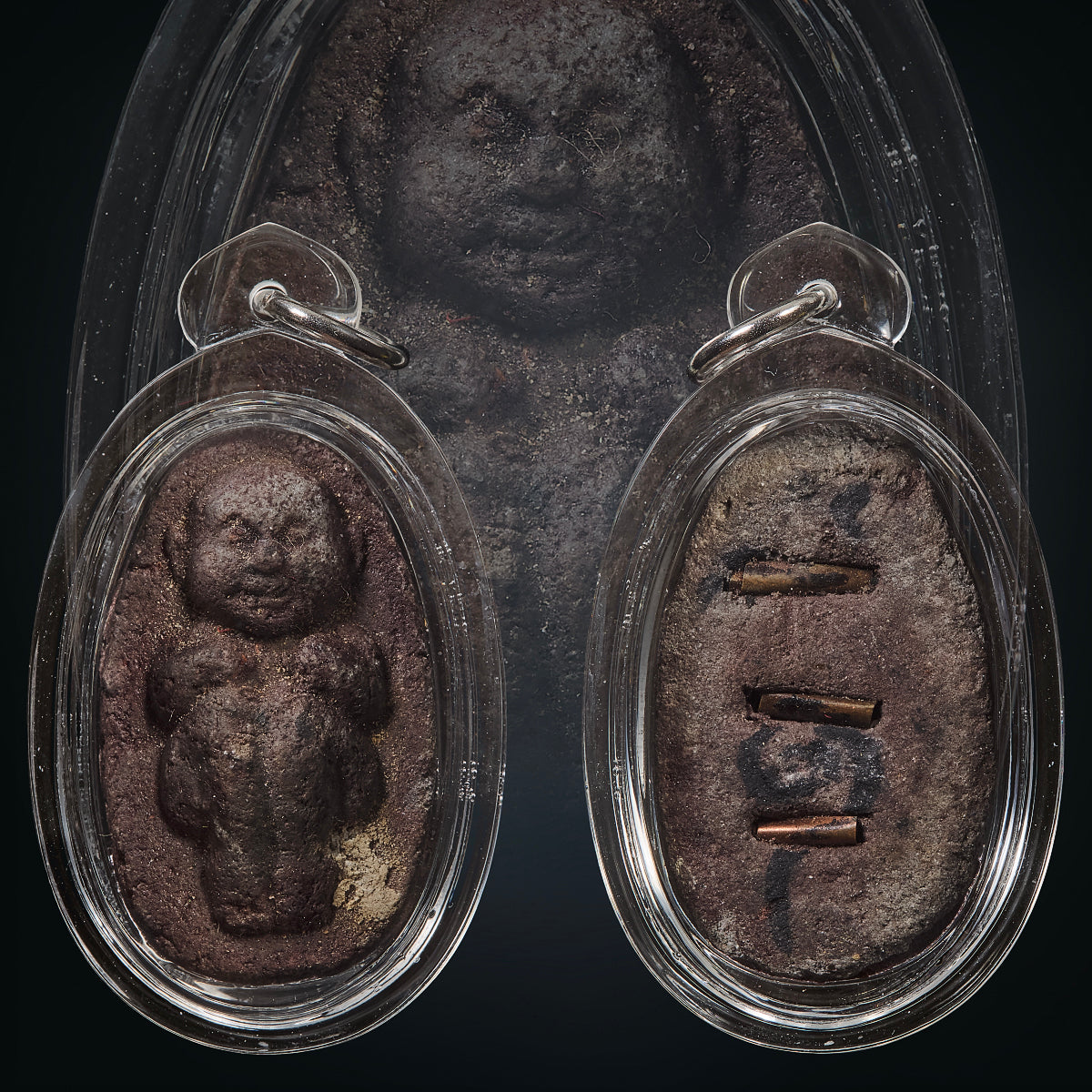
After the figure was formed, it underwent seven nights of chanting and consecration within a cemetery. The reverse carries a handwritten yant together with three individually inscribed copper takruts prepared on a spiritually significant day chosen by Por Sala Tan for Prai-related work.
The result is a compact but materially complex sacred object associated with favourable attention, renewed movement, unexpected fortune and spiritual guardianship.
Historical Background
Guman Thong occupies a distinctive place within Thai sacred-object traditions. The figure is commonly represented in the form of a small child and is traditionally understood as a sacred spiritual presence capable of assisting, protecting and accompanying its keeper.
Methods of creating Guman Thong differ between masters and regional lineages. In Prai-oriented traditions, the ritual materials may be gathered from cemeteries, deserted places and other locations regarded as spiritually active. These environments are understood as threshold spaces situated between ordinary human activity and the unseen world.
Cemeteries have long been used by certain practitioners for meditation, protective rites, spirit-related wiccha and the consecration of materials associated with impermanence and the departed. Deserted places possess a related significance because they are removed from normal domestic life and are traditionally associated with wandering presences and unsettled spiritual energy.
The Guman form gives these materials a recognisable identity. The sacred mixture is shaped into a child effigy through which the master's intentions are directed towards assistance, Metta, protection and beneficial opportunity.
Por Sala Tan's example preserves this traditional spirit-ground character through both its material composition and its seven-night cemetery consecration.
Por Sala Tan
Por Sala Tan was known for creating sacred objects in which the origin and ritual history of each material were central to the completed piece.
His work frequently combined sacred powders, naturally occurring substances, handwritten yants, copper takruts and materials gathered from locations possessing particular ritual associations. Each component was selected according to its traditional purpose.
Materials associated with Metta were used to encourage goodwill and favourable reception. Cemetery and spirit-ground substances provided the foundation for Prai practice. Handwritten takruts introduced mantra, sacred geometry and the personal ritual discipline of the master.
This layered method allowed several currents of wiccha to operate within one sacred object. In the case of this Guman Thong, the body, reverse inscriptions and cemetery consecration form one continuous ritual process.
Sacred Materials
The body of the Guman Thong is formed from a dense sacred mixture whose ingredients were selected for their physical origin and traditional spiritual associations.
Cemetery soil establishes the principal connection with Prai and spirit-ground practice. Within Thai occult belief, cemetery earth carries the symbolism of impermanence, the departed and the boundary between visible and unseen existence.
Soil from deserted spirit-ground contributes the energy of places where ordinary human occupation has withdrawn. Such locations are traditionally associated with wandering presences, movement and forces existing beyond the usual rhythm of inhabited spaces.
Nur Hom is connected with Metta, attraction and favourable reception. Its inclusion directs the piece towards beneficial relationships, cooperation and greater warmth from the people encountered by the keeper.
Luk Kok material strengthens the Guman's association with Prai, fortune and the drawing of circumstances towards the keeper. Within certain lineages, it is valued for opportunity, commerce and unexpected openings.
Nam Man Prai contributes to Metta, attraction and spirit-assisted influence. In this preparation, it forms part of the complete sacred mixture and its ritual character.
Together, these substances create several complementary currents:
-
Prai and spirit-ground energy
-
Metta and favourable attention
-
Commerce and customer attraction
-
Chok Lap and unexpected fortune
-
Movement within stagnant circumstances
Ritual Consecration
The ritual history of this Guman Thong is one of its defining features.
Por Sala Tan first prepared and blended the sacred substances before forming them into the image of a standing child. A yant was then written by hand across the reverse, transforming the back of the piece into an active ritual surface.
Three copper takruts were individually handwritten and embedded horizontally into the sacred body. These takruts were prepared on a day regarded within Por Sala Tan's practice as especially spiritually charged and suitable for Prai-oriented wiccha.
The completed Guman Thong was subsequently taken into a cemetery for seven nights of chanting and consecration. The environment was directly connected with the origin and symbolism of several materials contained within the piece.
Within the tradition, repeated consecration over successive nights is intended to deepen, stabilise and complete the ritual intention established during its creation.
Traditional Blessings
Metta and Favourable Reception
Metta concerns the goodwill, kindness and receptiveness of others. It is relevant whenever a person's progress depends upon communication, trust or cooperation.
The Guman Thong may therefore be carried by someone hoping to improve customer relationships, reduce unnecessary hostility, communicate more smoothly with colleagues or receive greater support from people in influential positions.
Metta in this context extends beyond romantic attraction. It applies equally to merchants, employees, consultants, agents and anyone whose daily work involves dealing with the public.
Opportunity and Renewed Movement
A central association of this piece is the stirring of situations that have become stagnant.
Collectors may seek it when enquiries have stopped, negotiations remain delayed, projects are unable to progress or opportunities repeatedly disappear before reaching completion.
The traditional experience is often described through small but meaningful changes. A telephone call arrives after weeks of silence. A former customer makes contact. Someone provides an introduction. A delayed discussion begins moving again.
These openings create circumstances in which the keeper's own effort can begin producing results.
Chok Lap and Unexpected Fortune
Guman Thong and Prai-related wiccha are traditionally associated with Chok Lap—fortunate circumstances arriving from an unexpected direction.
This may include an old client returning, an unplanned commission, a useful introduction, a sudden buyer or an opportunity discovered through an incidental conversation.
Such experiences remain personal accounts within the collector tradition and should not be regarded as guaranteed outcomes.
Commerce
Commerce depends upon attention, communication and trust. The Guman Thong's Metta and movement-related associations make it particularly suitable for businesses in which customer relationships are central.
It may be kept near a work desk, shop counter or place where customer enquiries are handled. Salespeople may also carry it when meeting clients, attending negotiations or following up dormant leads.
Spiritual Guardianship
The cemetery consecration gives the piece a traditional protective and guardian-related dimension. This is associated with spiritual awareness, companionship and the diversion of troublesome influences.
Collectors may value this aspect when working in competitive environments or dealing regularly with jealousy, conflict and difficult personalities.
Modern Application
Although its materials belong to an old spirit-oriented tradition, the purposes associated with the Guman Thong remain relevant to modern working life.
It may be suitable for:
-
Business owners and online sellers
-
Salespeople, advisers and commission-based professionals
-
Property agents and negotiators
-
Shopkeepers and customer-facing workers
-
Employees seeking greater visibility and cooperation
-
People experiencing prolonged inactivity in business or career
A business owner may keep the Guman near the workplace with the intention that useful people, customers and beneficial opportunities begin moving towards the business again.
For an employee, the same blessing may express itself through smoother relationships, increased visibility, greater responsibility or support from someone capable of assisting their advancement.
Within traditional practice, the sacred object accompanies consistent effort. Opportunities still require communication, follow-up and decisive action from the keeper.
Physical Details
The Guman Thong is formed as a small standing child effigy pressed from the prepared sacred-material mixture.
Its facial features, torso, arms and legs are rendered in simple relief, allowing the texture and composition of the sacred substances to remain visible. The surface ranges from deep brown to reddish-brown, with lighter inclusions appearing throughout the material.
As each example is individually handmade, natural variation may include uneven powder distribution, small inclusions, rough areas, minor depressions and differences in colour or surface texture.
The reverse is especially important. Three handwritten copper takruts are visibly embedded across the sacred body, accompanied by a handwritten yant. Their exposed placement allows the ritual construction of the piece to be appreciated directly.
The photographed example is preserved inside a clear oval casing, protecting the sacred mixture while allowing both the front and reverse to remain visible.
Recommended Pairing
Nang Kwak complements the Guman Thong for commerce and customer attraction. The Guman encourages movement and favourable circumstances, while Nang Kwak is traditionally associated with calling customers towards a business.
Salika is suitable for sales, negotiation and persuasive communication. The Guman supports the creation of opportunities, while Salika strengthens pleasant and convincing speech during the interaction itself.
Na Hua Chamut may be paired with it for commerce, wealth pathways and side-income opportunities. The Guman encourages movement, while Na Hua Chamut directs attention towards profitable openings.
Maha Amnaj or Baramee is appropriate for career advancement and leadership. The Guman supports favourable reception and cooperation, while authority-oriented wiccha strengthens recognition, standing and command.
Personal Experiences
Collectors of Guman Thong and related Prai objects frequently describe increased activity as the earliest noticeable change.
Dormant customers begin replying. Business enquiries become more frequent. Delayed negotiations resume. Difficult people become more willing to cooperate, and unexpected introductions place the keeper in contact with someone useful.
Some collectors later associate these changes with financial results, while others value the Guman primarily for Metta, guardianship or the traditional sense of spiritual companionship.
These experiences remain individual and form part of the living tradition surrounding Guman Thong practice.
Who Is This For?
This Guman Thong is especially suited to collectors who appreciate Por Sala Tan's more distinctly Prai-oriented work and sacred objects with a complete ritual history.
Its handwritten yant, three individually prepared copper takruts, cemetery materials and seven-night consecration preserve several layers of traditional practice within a compact handmade form.
It may appeal particularly to those seeking favourable attention, renewed business activity, smoother relationships, unexpected opportunity and spiritual guardianship.
Its traditional purpose can be summarised simply: to encourage people and circumstances to begin moving beneficially around the keeper.
-
Free Shipping for Singapore| $15 Worldwide | $60 USA For Items Below $350