
OOBThaiAmulets
Por Sala Tan
Por Sala Tan
Couldn't load pickup availability
PST07
Pong Ngan & Phra Ngan
Por Sala Tan
Barang Artifact
Individual Craftsmanship
Each component was individually prepared from old and sacred materials. Differences in the metal figure, Paneang, relic materials, inscriptions, takruts and hand assembly make each surviving set individually distinctive.
Personal Experiences Shared by Luksits
This paired set became particularly associated with strong Saneh and Metta Maha Niyom.
One experience came from a luksit working in the nightlife business, where competition between neighbouring establishments was naturally intense.
According to his account, after praying to and carrying these artifacts, his business began receiving noticeably more customers than the competitors immediately around him. He described people naturally choosing his establishment and customers gathering there in greater numbers than usual.
Other traditional qualities associated with the set include attraction, personal charisma, kindness and favour from others, everyday good fortune and being warmly received wherever the bearer goes.
The character of the Wicha is therefore not simply about forcing an outcome.
Its traditional emphasis is upon presence — making the bearer more approachable, noticeable and favourably received.
Summary
This is one of Por Sala Tan's rarer creations using a substantial concentration of materials personally obtained through his Khmer connections and travels.
Por Sala Tan visited Khmer practitioners to learn different branches of Phra Ngan Wicha, studying with several masters and learning not only the ritual practice but also how to identify and obtain the correct traditional materials.
The completed set combines two distinct objects:
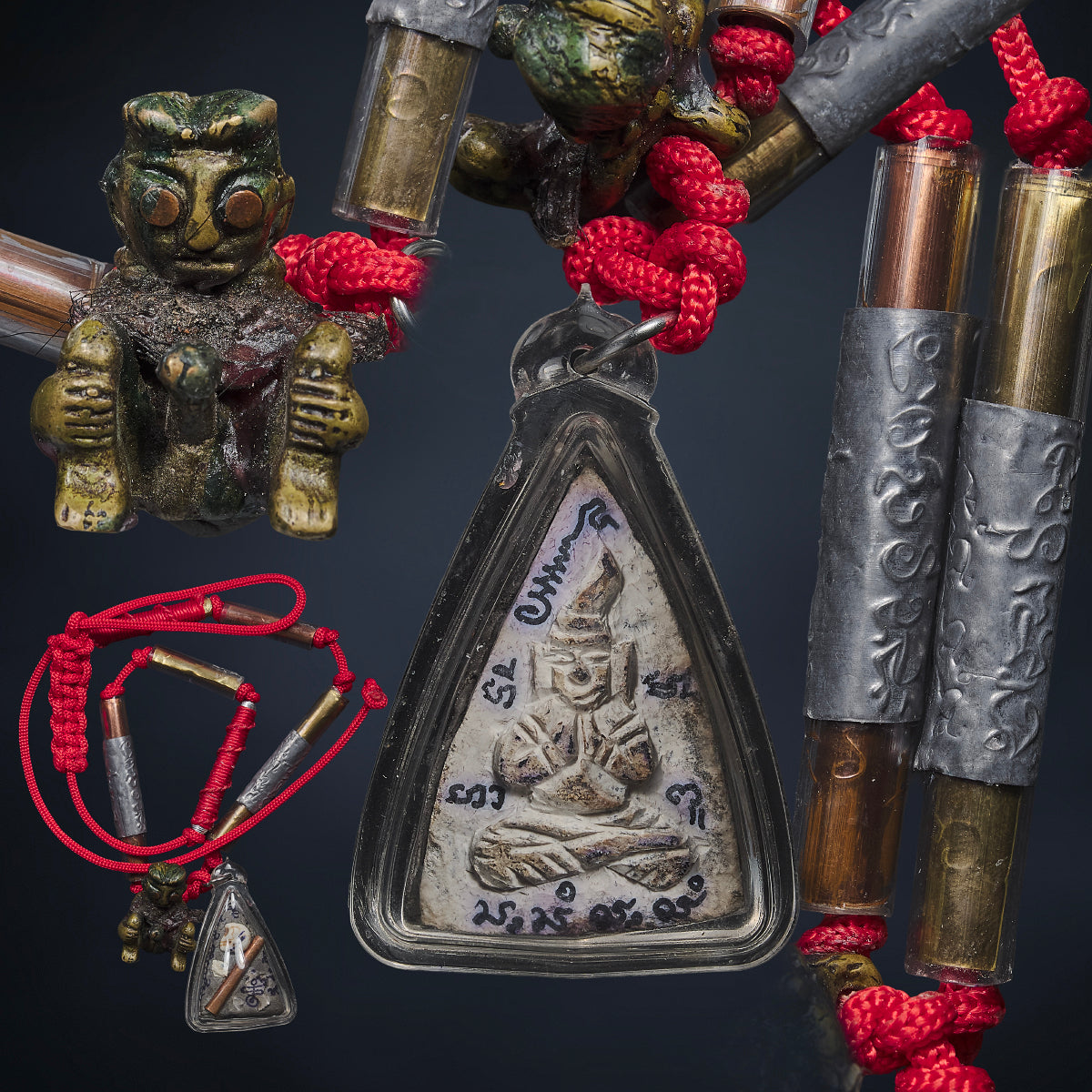
Pong Ngan — an old mixed-alloy figure received from a Khmer master and subsequently enhanced by Por Sala Tan.
Phra Ngan — carved from Paneang and prepared with Khmer materials, cemetery soil, Graduk, relic fragments and a takrut.
Both were eventually joined together with Por Sala Tan's handwritten takruts for wealth and Choke Lap.
The result is a particularly concentrated Ngan set directed towards Maha Saneh, Metta Maha Niyom, attraction, business, customers, wealth and personal influence.
Historical Background
Phra Ngan belongs to a complex family of Khmer-influenced talismanic figures found across Thai, Khmer, Lao and Isan occult traditions.
It is not generally treated in the same way as a conventional Buddha image. Instead, Phra Ngan occupies a space between Khmer folk religion, guardian-spirit traditions, Maha Saneh practices and protective Kreung Rang.
Its precise historical origin is difficult to reduce to a single story.
Different traditions describe Phra Ngan as a guardian figure, an image influenced by older Khmer or Shaivite traditions, an unusual sacred figure, or a protective form connected with warrior beliefs. Other popular legends explain its strong association with attraction and desire.
This diversity is important.
Rather than identifying every Phra Ngan according to one universal legend, an individual piece is better understood through its maker, materials, Wicha and documented lineage.
In this set, that lineage is particularly clear: Por Sala Tan learnt the Wicha through Khmer practitioners and personally brought back many of the materials used in its construction.
Origins of the Materials
The two Ngan figures have separate origins.
The Pong Ngan was already an existing sacred object when Por Sala Tan obtained it from a Khmer master. It was made from a mixture of old sacred alloys.
Por Sala Tan enhanced this figure with:
Mai Rak, Si Peng Metta, and hair from the relic materials.
The second Phra Ngan began with a piece of Paneang obtained during Por Sala Tan's Khmer travels. He carved the figure from this material and applied Khmer Wicha yantra.
Its reverse was then prepared with cemetery soil, together with Graduk fragments, relic materials and a takrut.
Por Sala Tan considered obtaining the appropriate materials from the tradition itself important to the character of the finished artifact.
The set therefore represents more than simply reproducing a Khmer-style image in Thailand. Much of its physical material was actually collected through Por Sala Tan's Khmer travels and contacts.
Ritual
Por Sala Tan's approach to Phra Ngan began with learning.
During his visits to Khmer practitioners, he studied the relevant Wicha with several masters, including how particular materials were selected and prepared.
The old Pong Ngan received from a Khmer master provided one foundation.
The Paneang Phra Ngan provided another.
Por Sala Tan then added his own materials and Wicha to both pieces, eventually joining them onto a single cord.
The final stage was especially significant: handwritten takruts were added along the string to increase the wealth and luck purpose of the completed set.
The result combines older Khmer material tradition with Por Sala Tan's own work in Metta, Saneh and wealth-oriented Wicha.
Blessings and Effects
The strongest traditional emphasis of this set is Maha Saneh and Metta Maha Niyom.
Phra Ngan traditions more broadly are associated with being noticed, receiving favourable treatment, attraction, business, protection, courage, luck and opportunity.
For this particular Por Sala Tan set, the intended qualities concentrate especially upon:
- Strong Maha Saneh and attraction
- Metta Maha Niyom
- Personal charisma and presence
- Customer attraction
- Sales and business
- Being liked and favourably received
- Help and kindness from others
- Wealth and Choke Lap
- Opportunities arriving with less resistance
The handwritten takruts added by Por Sala Tan place an additional emphasis upon wealth and luck, while the Khmer materials form the foundation of the Ngan Wicha itself.
Modern Application
This set was particularly suited to people whose livelihood depends upon being seen, remembered and favourably received by others.
That naturally includes those working in entertainment, nightlife, customer-facing professions, sales and business— precisely the types of users for whom the artifacts were intended.
For a salesperson, Saneh is not necessarily understood only as romantic attraction. It may mean that a customer feels comfortable staying longer, listening to an explanation or returning again.
For a business owner, Metta Maha Niyom may be approached for smoother relationships and customers naturally favouring the establishment.
For someone working in entertainment or nightlife, the emphasis becomes stronger still: visibility, attraction, charisma and drawing people towards one's presence.
The wealth takruts then complement these qualities by directing favourable human interaction towards livelihood and financial opportunity.
Physical Details
A paired Por Sala Tan Ngan set assembled on red sacred cord. One component is an older Pong Ngan Roop cast from mixed sacred alloy, later enhanced with Mai Rak, Si Peng Metta and hair relic material. The second is a triangular-cased Phra Ngan carved from Paneang, bearing Khmer-style sacred inscriptions and prepared at the reverse with cemetery soil, Graduk fragments, relic material and takrut. Multiple handwritten takruts prepared by Por Sala Tan are mounted along the cord in metal and bamboo-style tubes, creating an elaborate wearable set combining Khmer-origin materials with Por Sala Tan's later wealth, Metta and Saneh work.
Recommended Pairing
This is already a highly complete artifact and does not require extensive pairing.
Its two Ngan components provide the Saneh and Metta Maha Niyom foundation, while Por Sala Tan's handwritten takruts add the wealth and luck direction.
For business use, it could nevertheless be paired with a Riak Sap, Choke Lap or Maha Pokasap piece when the intention is specifically to strengthen financial movement.
For someone in a highly competitive customer-facing environment, a separate Baramee piece may complement it by adding greater authority and respect alongside the Ngan's attraction and approachability.
Personal Notes
The provenance is particularly important with this set.
It was later collected from one of Por Sala Tan's close luksits, someone who had personally seen Por Sala Tan return from Khmer territory with the Pong Ngan and Phra Ngan. The additional takruts along the carrying string were subsequently added by Por Sala Tan himself.
This gives the set a clear connection with an important period in Por Sala Tan's practice.
He was not merely making something that looked Khmer. He had travelled there, learnt from several practitioners, studied their Wicha, obtained the appropriate materials and brought sacred objects and materials back with him.
For me, this is what makes the set unusual.
It preserves both stages of that journey: the Khmer materials and Wicha Por Sala Tan brought home, followed by the personal additions he made to direct the completed artifact towards Saneh, Metta Maha Niyom, wealth and business fortune.
It is one of the rarer Por Sala Tan pieces in which his Khmer learning, collected materials and later personal Wicha can all be seen together in a single surviving set.
-
Free Shipping for Singapore| $15 Worldwide | $60 USA For Items Below $350