
OOBThaiAmulets
Por Sala Tan
Por Sala Tan
Couldn't load pickup availability
PST07
Mae Hong Prai
Por Sala Tan
2 Inches
Barang Artifact
Individual Craftsmanship
Each piece was handmade from individually prepared sacred materials. Differences in the carving, Graduk, ritual substances, Sai Sin and placement of the materials naturally make every example unique.
Personal Experiences Shared by Luksits
One account shared by a luksit concerned a businessman who became involved in a serious matter with the authorities after being reported by a competitor.
Believing that he had been wrongly accused, he approached Por Sala Tan for advice.
Por Sala Tan told him to speak directly to the Mae Hong Prai, explain the situation and ask for her assistance.
According to the luksit's account, not long afterwards the case against him was dropped when the allegations could not be established against him. He later learnt that the competitor who had reported him already carried a poor reputation within the industry.
The luksit regarded the outcome as assistance from the Mae Hong Prai, particularly because the situation changed after he had followed Por Sala Tan's instructions.
Summary
This Mae Hong Prai carries an unusually direct relationship between the spirit, her remains, the ceremony performed for her and the finished artifact.
The story began when Por Sala Tan was asked to assist villagers who believed they were experiencing disturbances connected with a woman from a neighbouring village.
The woman had been pregnant when she died in an accident while returning to her village during heavy rain.
After communicating with the spirit according to his practice, Por Sala Tan learnt the circumstances surrounding her death and agreed to conduct the appropriate rites.
An understanding was established: Por Sala Tan would help settle the spiritual disturbance, while some of the remaining relics and materials associated with her would be made into sacred artifacts.
Within the tradition surrounding these pieces, the purpose was not simply to contain a spirit. It was to give the Mae Hong Prai a continuing avenue through which she could assist those who respectfully carried and cared for the artifacts connected with her.
Historical Background
Within older Thai folk and esoteric traditions, Mae Hong Prai is associated with the spirit of a woman whose death occurred under unusual or tragic circumstances, particularly where pregnancy was involved.
Such beliefs belong to a much wider Southeast Asian understanding that an unexpected death may leave a spirit unsettled, especially when death occurs away from home or before important responsibilities in life have been completed.
Por Sala Tan was occasionally approached when villagers believed that disturbances had a spiritual origin.
In this particular case, the matter concerned a pregnant woman from a neighbouring village.
It had been raining heavily, and she was hurrying back towards her village when she slipped and fell from a cliff.
She was not immediately found.
After some time, villagers began searching for her and eventually discovered her body. Simple funeral rites were performed and an attempt was made to cremate the remains. Materials that could not be completely cremated were subsequently buried.
According to the account preserved with these artifacts, disturbances later began affecting people in the area.
The villagers eventually sought Por Sala Tan's assistance.
Origins of the Materials
When Por Sala Tan became involved, he communicated with the spirit according to his traditional practice and learnt the circumstances surrounding the woman's death.
Rather than simply attempting to drive the presence away, he agreed to help through the relevant ceremonies.
Some of the relic materials remaining from the woman were subsequently entrusted to him.
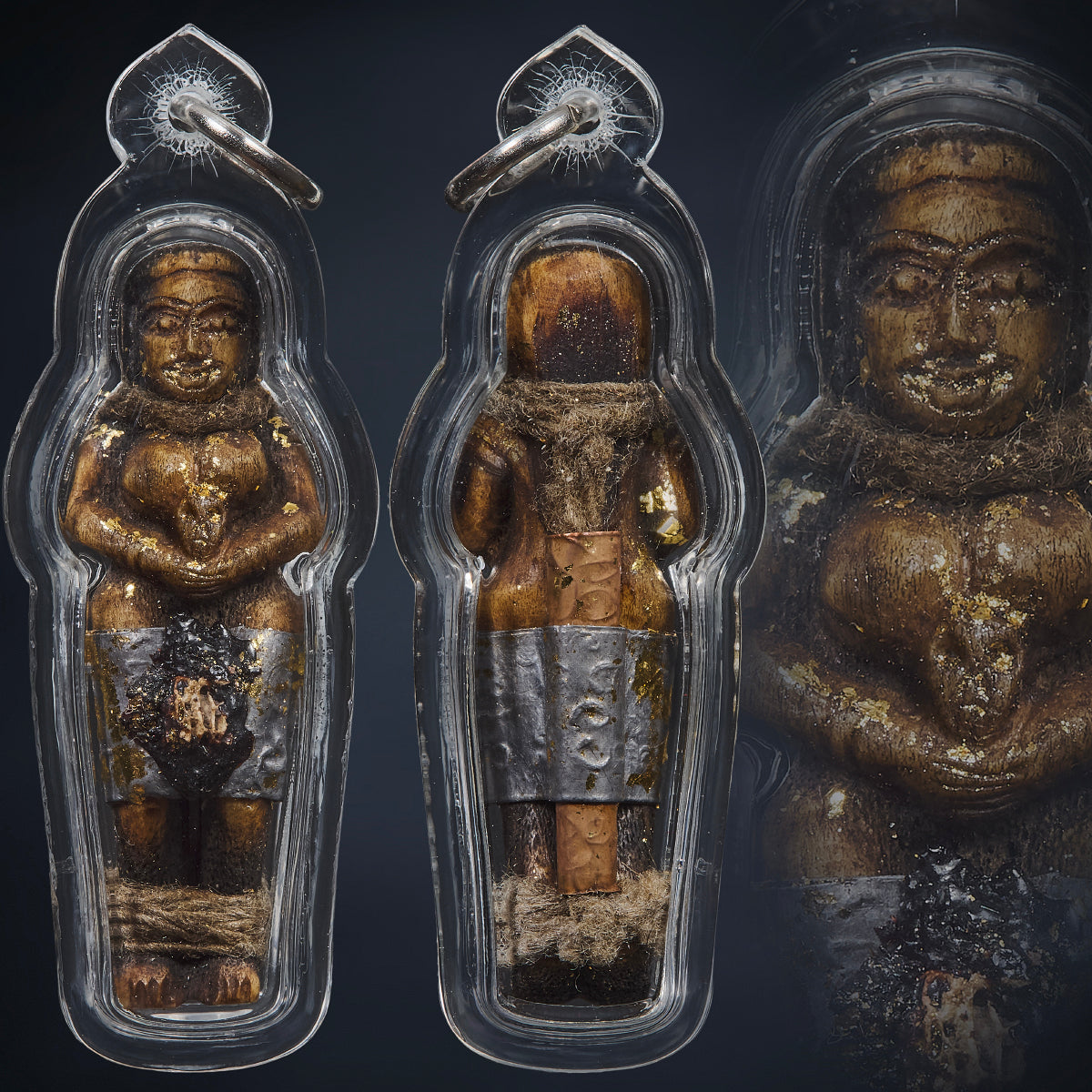
A portion of the Graduk was prepared and soaked in Nam Man Saneh, forming the principal material from which the female image was carved.
The construction also incorporated materials directly associated with the original rites and the deceased:
Graduk, Nam Man Saneh, Takruts, ceremonial Sai Sin, Tid Jai and a fragment of Paneang belonging to the woman.
The combination makes this a particularly personal form of Por Sala Tan's Barang work, as several of its principal components are directly connected with the Mae Hong Prai represented by the carving.
Ritual
Por Sala Tan's involvement began with addressing the disturbance experienced by the villagers.
Through his traditional practice, he communicated with the spirit and sought to understand why she remained unsettled. After learning what had happened, Por Sala Tan agreed to conduct the necessary rites for her.
An understanding was then made that some of her remaining relics could be used to create sacred objects.
The Graduk was prepared with Nam Man Saneh before the woman's image was carved upon it. Takruts were added, and Sai Sin that had participated in the ceremony was retained and tied to the figure.
Tid Jai was applied to the piece together with a fragment of Paneang associated with the woman.
Within Por Sala Tan's tradition, these physical connections were important. The completed artifact was intended to maintain a link with the Mae Hong Prai so that, rather than continuing to disturb the village, her presence could be directed towards helping those who respectfully kept the piece.
Blessings and Effects
Within the traditional beliefs surrounding this Mae Hong Prai, luksits associate the piece with assistance during difficult situations, Metta, Saneh, protection and the movement of circumstances in the user's favour.
It may traditionally be approached for help when facing complicated situations involving other people, particularly when the user feels misunderstood or unfairly treated.
The Nam Man Saneh and Tid Jai connect the piece particularly strongly with attraction, goodwill and the softening of attitudes.
The takruts reinforce the intended Wicha, while the direct relic materials establish the traditional connection with the Mae Hong Prai herself.
Some luksits also regard this type of artifact as a spiritual companion — something they can quietly speak to when facing problems that appear difficult to resolve through ordinary means.
These effects belong to traditional practitioner beliefs and personal accounts rather than guaranteed outcomes.
Modern Application
For modern users, this Mae Hong Prai is particularly associated with situations involving people, relationships, business dealings and difficult interpersonal circumstances.
A business owner might traditionally seek assistance when encountering hostility from competitors, disputes, misunderstandings or situations in which another person's actions are creating obstacles.
Those working in sales or professions dependent upon relationships may instead focus upon its Metta and Sanehaspects — seeking smoother communication, goodwill and greater willingness from others to listen or assist.
The account of the businessman also gives the piece another important meaning: when confronted with accusations or conflict, remain composed, explain the circumstances clearly and allow the truth to emerge through the proper channels.
The sacred object should therefore complement practical action rather than replace professional, legal or other appropriate assistance.
Physical Details
A hand-carved Mae Hong Prai image by Por Sala Tan, fashioned from Graduk prepared in Nam Man Saneh. The standing female figure has individually carved facial and bodily details, with areas of ritual coating and gold leaf visible across the surface. Takruts are incorporated into the construction, while ceremonial Sai Sin is tied around the figure. Tid Jai and a small fragment of Paneang associated with the woman are attached to the piece, creating a direct material connection with its origin story. The artifact is now preserved within a clear protective casing.
Recommended Pairing
This Mae Hong Prai may be paired with sacred objects associated with Metta Maha Niyom, Saneh, protection, business relationships and Choke Lap.
For business users, pairing it with a wealth or opportunity-oriented piece creates a balanced purpose: the Mae Hong Prai is approached for human relationships, assistance and the softening of difficult circumstances, while the accompanying piece focuses upon prosperity and opportunity.
For those primarily concerned with protection, it may instead be carried alongside a protective Lersi, Tao Wessuwan or another traditional guardian piece.
Personal Notes
What makes this Mae Hong Prai significant is the continuity of its story.
It began with tragedy — a pregnant woman attempting to return home during heavy rain, an accidental fall from a cliff and a death that villagers later associated with unexplained disturbances.
Por Sala Tan's role was not simply to obtain materials from the incident. He was originally called because the villagers wanted help.
Only after communicating with the spirit and performing the appropriate rites were some of the remaining materials incorporated into sacred objects.
The Graduk, the ceremonial Sai Sin, the Tid Jai and especially the fragment of Paneang belonging to the woman give the finished artifact a direct connection with the story from which it originated.
Within Por Sala Tan's tradition, the intention was to transform an unsettled situation into something constructive: allowing the Mae Hong Prai to move from disturbing the living towards assisting those who respectfully carried the artifacts connected with her.
-
Free Shipping for Singapore| $15 Worldwide | $60 USA For Items Below $350